
- Catalogs
- mmcité street furniture
- MATERIALS & COLOURS


- Company
- Products
- Catalogs
- News & Trends
- Exhibitions
MATERIALS & COLOURS
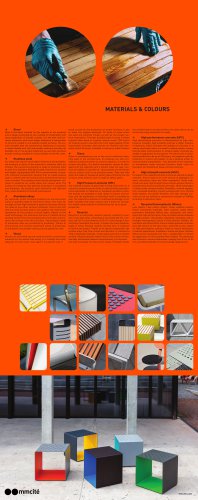
MATERIALS & COLOURS
Steel is the primary material used in many products, protected by zinc coating and powder coating for superior corrosion resistance. This combination prevents spontaneous corrosion effectively. The final surface treatment involves a matt structure powder coating available in various RAL shades.
For higher resistance and durability, stainless steel is used, with AISI 304 as standard and AISI 316 for more demanding environments. Its passive layer protects against corrosion, and surface treatments like shot peening and polishing enhance durability and aesthetics.
Aluminium alloys are used for street furniture due to their high corrosion resistance without additional treatment. Sanding provides a matt look, and anodising protects the surface while preserving the aluminium color. Powder coating is optional.
Wood is a natural, flexible, and solid material. Only high-quality wood, such as FSC-certified tropical wood or sustainable European alternatives like Robinia, is used. Surface treatments ensure durability and aesthetic appeal.
Glass is a traditional architectural material, resistant to scratches, easy to maintain, and durable. Tempered safety glass is used for panels to minimize injury risk.
HPL consists of paper and resins, offering resistance to mechanical damage, frost, heat, and humidity. It is available in various colors and motifs, making it popular in architecture.
Resysta is a durable, recyclable material made from rice husks, salt, and mineral oil. It resembles wood but lacks its disadvantages, requiring minimal care and resisting vermin and fungus.
HPC offers high compressive strength and durability, suitable for reducing weight and enhancing sustainability. It has a predicted service life of up to 200 years.
HSC is used for thin-walled concrete furniture, offering high compressive strength and durability. It contains polymer fibers for enhanced strength and flowability.
Mínus is a recyclable thermoplastic made from discarded materials, available in various finishes and thicknesses. It is durable, affordable, and can be resurfaced or fully recycled.
The document lists various materials and their color options, including RAL shades for powder coatings and other finishes. It emphasizes the importance of using standard color samplers for accuracy.
Catalog excerpts
MATERIALS & COLOURS Steel is the basic material for the majority of our products and is always protected by zinc coating. In combination with spray application of powder coating, it is the best anti-corrosion protection with much higher resistance in comparison to only zinc coated or only powder coated surfaces. The surveys revealed that the spontaneous beginning of corrosion on steel treated with zinc and powder coating is actually not possible. As a fi nal surface treatment we use matt structure powder coating, available in various shades of the RAL chart. Stainless steel For those who require much higher resistance and durability, the products or parts of the products in stainless steel are offered. The connecting material is made of stainless steel as well. As a standard, AISI 304 is used, however for location with higher requirements AISI 316 is recommended. Its specific chemical composition ensures that so called passive layer is created onto the surface which protects the surface from corrosion. The stainless steel resists atmospheric corrosion in industrial air, outlet water and various salts. The surface is treated by shot peening, brushing or it is polished and therefore, the products gain distinctive and high-end look, great durability at minimal maintenance. Aluminium alloys For particular street furniture products we use aluminium alloys or profiles made of aluminium alloys. The main advantage is their high resistance against corrosion without the need of any other surface treatment. Due to the fact that any other surface layer is not applied, the mechanical resistance of the product is much higher. Based on the used technology, the aluminium surface is treated only by sanding which forms the characteristic matt look and protects the surface from the corrosion. The products made of aluminium alloy are protected by anodising. Thanks to this process, the common aluminium colour is preserved. If requested, the powder coating can be applied as well. Wood is an unrivalled natural material which is used by the mankind for the whole time being. It is flexible and solid, pleasant to touch and it also ages in its specific way. If wood is used for the production of street furniture, it has to meet the highest demands. All kinds of wood which are used are carefully chosen as well as the proper surface treatments. The best possible type of wood is either tropical oiled wood or tropical natural wood. FSC-certifi ed tropical wood is sourced only from legal logging. Other sustainable European alternatives are Robinia and thermally modifi ed wood, available in natural or oiled finishes. Glass is considered as one of the most traditional materials used in the architecture. Its features are still unrivalled if compared mainly to common plastics. It is hard to scratch the glass, it is easily maintained, cannot be damaged with the cigarette and it almost does not age. Concern of fragility is unjustifi ed – glass panels can be broken only by using a tool or an extreme power. Rear and side walls are made of tempered safety glass (limiting the risk of injury when broken), roof is made of safety glass. High Pressure Laminate (HPL) The material consists of paper (60 %) and resins (40 %). It concerns pressed boards made of natural fibres and decorative laminates of melamine or tempered synthetic resins. The boards are available in wide range of colours and motives and the application of individual motif is possible as well. The material is resistant to mechanical damage, frost, heat, humidity and water vapours and it does not corrode. It is widely used material in architecture due to its great properties. Resysta is an extremely durable material, resistant to sun, rain, frost, salt water, consisting of rice husks (60 %), common salt (22 %) and mineral oil (18 %). Even though it aesthetically resembles the wood, it misses the main disadvantages of wood. Resysta requires minimal care, is resistant to vermin and fungus. Thanks to its special composition, the surface stays free from cracks and splinters. In contrast to other composite materials, it looks great and it has a smooth surface. Resysta already meets most of the future environmentally sustainable material requirements; it is recycled and fully recyclable. For the current range of Resysta family the prefabricated extruded profiles are used; these can be reinforced using steel profi les inside. High performance concrete (HPC) High strength concrete (HSC) Recycled thermoplastic (Mínus) High performance concrete is characterized by high compressive strength, high durability and has a higher modulus of elasticity, which increases the stability of concrete. It is mainly used where there is a need to reduce weight, remove internal steel reinforcement or achieve higher concrete durability in aggressive environments. The service life is realistically predicted to be up to 200 years, and together with the reduction in volume and weight, it has a positive effect on environmental sustainability - less demand on the substrate or foundations under concrete furniture, lower costs for transport and handling of large concrete castings. For specific thin-walled concrete furniture we use high strength concrete. This is made up of a fine mixture of aggregate, cement, microsilica, water and other ingredients. Unlike traditional concretes, high strength mixes contain polymer fibres to increase flexural and compressive strength. Other advantages of these mixes include excellent flowability, minimal segregation, increased durability, smooth surfaces with no or minimal small bubbles, and partial flexibility. The high strength concrete mix we use achieves a compressive strength of 100Mpa according to laboratory tests. Less plastic. Less carbon impact. Fewer polluted streets. Fewer incinerated materials. New material called Mínus transforms discarded fishing nets, keyboards, and televisions into high-performance, fully recyclable panels designed for public spaces. This durable, repeatedly recyclable, and affordable thermoplastic comes in three distinct finishes. Mínus Black and Mínus White feature subtle speckled contrasts that add texture to the base color, while Mínus Onyx allows for light permeability, making it ideal for natural illumination or backlit applications. Available in matte and gloss finishes, Mínus can be resurfaced over time – sanded down to refresh its appearance or fully recycled when needed. The panels are also offered in various thicknesses, ranging from 5 mm to 25 mm, providing flexibility for diverse desig
Open the catalog to page 1All Mmcité street furniture catalogs and technical brochures
 Public space now 2026
81 Pages

- Chair
- Modern chair
- Indoor seat
- Coffee table
- Contemporary coffee table
- Table
- Industrial contemporary table
- Dining table
- Commercial chair
- 4-legged chair
- Mmcité public bench
- Contemporary dining table
- Chair with armrests
- Metal base chair
- Mmcité contemporary public bench
- Mmcité commercial public bench
- Mmcité trash can
- Black chair
- Mmcité contemporary trash can
- Wooden coffee table