

- Products
- Catalogs
- News & Trends
- Exhibitions
Tri-Lock
1 / 1 PageView full catalog
Tri-Lock
Product catalog summary
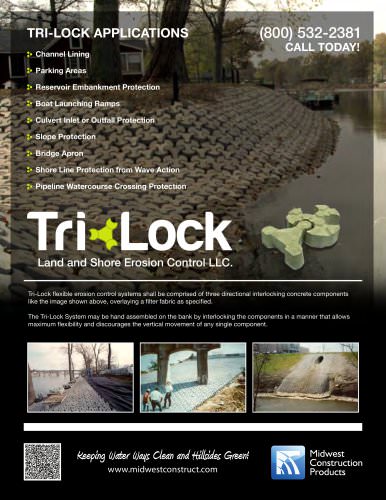
Overview: The document describes the Tri-Lock flexible erosion control systems, which consist of interlocking concrete components designed to overlay a specified filter fabric. These systems are intended to provide flexibility and prevent vertical movement of individual components.
Specifications: The Tri-Lock system is comprised of three-directional interlocking concrete components. It is designed to be hand-assembled on-site, ensuring maximum flexibility and stability.
Applications: The system is suitable for various applications, including channel lining, parking areas, reservoir embankment protection, boat launching ramps, culvert inlet or outfall protection, slope protection, bridge aprons, shoreline protection from wave action, and pipeline watercourse crossing protection.
Contact Information: For more information, visit www.midwestconstruct.com or call (800) 532-2381.
See more
Catalog excerpts

TRI-LOCK APPLICATIONS Channel Lining Parking Areas Reservoir Embankment Protection Boat Launching Ramps Culvert Inlet or Outfall Protection Slope Protection Bridge Apron Shore Line Protection from Wave Action Pipeline Watercourse Crossing Protection Tri-Lock flexible erosion control systems shall be comprised of three directional interlocking concrete components like the image shown above, overlaying a filter fabric as specified. The Tri-Lock System may be hand assembled on the bank by interlocking the components in a manner that allows maximum flexibility and discourages the vertical movement of any single component. Keeping Water Ways Clean and Hillsides Green! www.midwestconstruct.com
Open the catalog to page 1All Midwest Construction Products catalogs and technical brochures
 The Klarifier Brochure
2 Pages
 PYRAMAT
3 Pages
 Enkamat
4 Pages
 Recyclex
2 Pages
Archived catalogs
 CULTEC
2 Pages
Related Searches
- Plain canvas
- Outdoor fabric
- Industrial concrete block
- Solar protection textile
- Piping
- Polypropylene fabric
- Industrial geotextile
- Retaining wall
- High-resistance concrete block
- Channeling
- Industrial geogrid
- Concrete retaining wall
- Drainage system piping
- Public work concrete block
- Reinforcement geogrid
- Modular retaining wall
- Non-woven geotextile
- Retaining wall concrete block
- Geocomposite
*Prices are pre-tax. They exclude delivery charges and customs duties and do not include additional charges for installation or activation options. Prices are indicative only and may vary by country, with changes to the cost of raw materials and exchange rates.
About ArchiExpo
ArchiExpo is a marketplace that offers B2B players a complete experience, from product sourcing to purchase. ArchiExpo is an entity of VirtualExpo Group.
Are you a buyer?
Are you a supplier?