

Glass Laminated Aluminium Foam GLAF
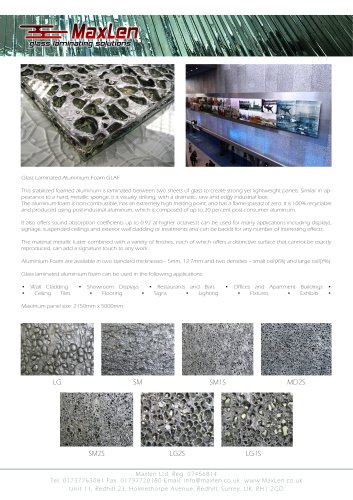
Glass Laminated Aluminium Foam GLAF
This document provides an overview of Glass Laminated Aluminium Foam (GLAF), a material developed by Maxlen Ltd. GLAF is a stabilized foamed aluminum laminated between two sheets of glass, offering a strong yet lightweight panel with a unique industrial appearance.
The aluminum foam is non-combustible, has a high melting point, and a flame spread of zero. It is 100% recyclable, made from post-industrial aluminum with up to 20% post-consumer content. The material provides sound absorption coefficients up to 0.92 at higher octaves.
GLAF can be used in various applications such as wall cladding, showroom displays, restaurants, bars, offices, apartment buildings, ceiling tiles, flooring, signs, lighting, fixtures, and exhibits. It can also be backlit for enhanced visual effects.
Available in two standard thicknesses: 5mm and 12.7mm, and two densities: small cell and large cell. The maximum panel size is 2150mm x 5000mm.
The material's metallic luster and variety of finishes provide distinctive surfaces that add a signature touch to any project.
Catalog excerpts
Glass Laminated Aluminium Foam GLAF This stabilized foamed aluminum is laminated between two sheets of glass to create strong yet lightweight panels. Similar in appearance to a hard, metallic sponge, it is visually striking, with a dramatic, raw and edgy industrial look. The aluminum foam is non-combustible, has an extremely high melting point, and has a flame spread of zero. It is 100% recyclable and produced using post-industrial aluminum, which is composed of up to 20 percent post-consumer aluminum. It also offers sound absorption coefficients up to 0.92 at higher octaves.It can be used for many applications including displays, signage, suspended ceilings and exterior wall cladding or treatments and can be backlit for any number of interesting effects. The material metallic luster combined with a variety of finishes, each of which offers a distinctive surface that cannot be exactly reproduced, can add a signature touch to any work. Aluminium Foam are available in two standard thicknesses– 5mm, 12.7mm and two densities – small cell(X%) and large cell(Y%). Glass laminated aluminium foam can be used in the following applications: • Wall Cladding • Ceiling Tiles • Showroom Displays • Restaurants and Bars • Flooring • Signs • Lighting • Offices and Apartment Buildings • • Fixtures • Exhibits • Maximum panel size: 2150mm x 5000mm Maxlen Ltd, Reg. 07456814 Tel. 01737763081 Fax. 01737720180 Email: [email protected] www.MaxLen.co.uk Unit 11, Redhill 23, Holmethorpe Avenue, Redhill, Surrey, UK, RH1 2GD
Open the catalog to page 1All Maxlen catalogs and technical brochures
 Collection%20Brochure
4 Pages
- Architectural glass
- Interior glass panel
- Building glass panel
- Patterned glass panel
- Transparent glass panel
- Laminated glass panel
- Safety glass panel
- Tempered glass panel
- Flat glass panel
- Translucent glass panel
- High-resistance glass panel
- Fire protection glass panel
- Glass panel with insert
- Roof glass panel
- Wired glass panel
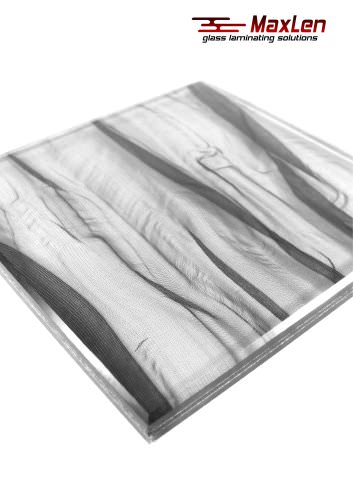
- Glass panel with metal insert
- Glass panel with textile insert