

Slab Track China

Slab Track China
The document discusses the construction and implementation of the high-speed railway track between Beijing and Tianjin, China, using the Slab Track Bögl technology. This project marked a significant advancement in railway construction, coinciding with the 2008 Olympic Games.
Project Overview
The high-speed track spans 115 km, reducing travel time to 30 minutes at speeds up to 350 km/h. The project involved a technology transfer agreement for the Slab Track Bögl, signed in 2005 and 2006, and included technical responsibility and consulting for the entire track.
Construction Details
Construction began in June 2005, with the foundation works for a 10 km test track. The track predominantly used single-span girder bridges and required various foundation techniques to ensure stability. The project expanded to cover the full 115 km, divided into two lots of 49 km and 66 km.
Technical Implementation
Six field factories produced pre-fabricated bridge girders. The construction involved innovative methods to optimize costs and efficiency, such as using a continuous reinforced steel concrete cable supporting layer. This eliminated the need for costly rail expansion joints and reduced pile forces.
Challenges and Solutions
The project faced logistical challenges due to tight schedules and surrounding construction. The Max Bögl Group provided training and nationalized certain construction materials and equipment to meet local needs.
Completion and Testing
Structural construction was completed by spring 2007, with the Slab Track Bögl assembly following. By October 2007, all track supporting layers were installed. The first test drives began in spring 2008, with successful trials exceeding the designed speed.
Technical Data
- Total distance: 115 km double track
- Construction time: June 2005 to July 2008
- Client: Jingjin Intercity Railway Co. Ltd.
- Implementation: China Railway 17 Bureau Group & Co. Ltd.
- Planning and Consultation: Max Bögl Group
Conclusion
The project was a significant achievement for the Max Bögl Group, ensuring European quality standards and timely completion. The high-speed train now connects Beijing and Tianjin efficiently, supporting modern high-speed traffic in China.
Catalog excerpts
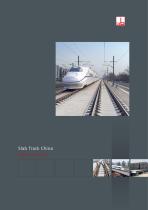
Slab Track China Progress is built on ideas.
Open the catalog to page 1
After successfully signing the contract in Beijing the official ground breaking ceremonies took place next to the track.
Open the catalog to page 2
27 months of planning and construction, a distance of 115 km and only 30 minutes travelling time: With the grand opening and commissioning of the first high speed track between the metropolises Beijing and Tianjin, China heralded a new era for high speed tracks in railway construction at the beginning of August. In good time for the 2008 Olympic Games, the Slab Track Bögl ensures that passengers travelling by rail at speeds of up to 350 km/h need not relinquish highest comfort. The basis for the success of this project were the contracts signed mid November 2005 and mid May 2006 for the technology...
Open the catalog to page 3
In six field factories pre-fabricated bridge girders with lengths from 20 to 32 m were produced. The foundation works within the test track area began in June 2005. The section consisted predominantly of a single span girder chains bridge construction instead of continuous girder bridges and earthworks. In order to achieve the required load carrying capacity and to reduce the settlements to a minimum, foundations in form of drilled piles, CFG – piles and pilling piles were required. Half a year later the technology transfer could be contractually expanded to a total distance of about 115 km long....
Open the catalog to page 4
Gantry cranes lifted tons of heavy bridge girders onto heavy load vehicles to be assembled later on site. A team of approximately 80 experts of the Max Bögl Group were responsible for geotechnical consulting, checking the design for the substructures and for the high quality with respect to design and execution of the Bögl precast slabs among others. Our specialized staff also planned the construction of two pre-fabricated plants and gave professional advice in construction and the equipment of the production plants in Beijinger suburbs Fangshan and Pinggu. Furthermore, the team of experts offered...
Open the catalog to page 5
Precast launching units lifted the bridge girders along the track to its final assembly position. Except for the nationalization of the components, the Slab Track Bögl could be implemented 1 : 1. The only extension affected the train positioning system TVM in China (Transmission Voie Machine: a French train positioning system). Having already received the approval for the train positioning system (LZB), used in Germany, measurements confirmed the suitability of the Slab Track Bögl for the Chinese train positioning on direct current circuit basis. Even more innovative improvements for the construction...
Open the catalog to page 6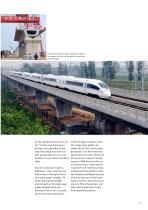
Settlement-sensitive alluvial deposits required the support of the track system on more than 100 km length. to the distributing function of the “continuous base layer”. Besides, the assembly of the Slab Track Bögl was even further accelerated, since it was possible to use mainly standard slabs. For the crossing of express highways, rivers and the new motorway to Shanghai three four-span girder bridges, 33 three-span girder bridges and altogether 16 single-span girder bridges were constructed with in-situ concrete. All the pre-fabricated parts of the bridges, together with the single-span girders...
Open the catalog to page 7
Laying of the Bögl precast slabs with the help of a gantry crane Preparation of the grouting of the Bögl precast slabs Individual track sections with altogether 16 km total length were executed as earth structures – approximately 1 km of it in so-called supported construction method. They were built on 30 m long driven piles with 45 cm diameters or on 28 m long spiral in-situ concrete piles with a diameter of 40 cm. The deep foundation Switch parts and the rails were assembled directly on the Bögl switch parts (WTB). of the bridge construction, in contrast, consists of drilling piles with 100...
Open the catalog to page 8
High speed switches at the YiZhuangs railway station year, approximately all 36.000 track supporting layers were assembled on a length of twice 115 km and the rails were laid. For the first time, sever al high speed switches were implemented with the Chinese partners, which likewise were assembled with the proven pre-fabricated component solution. The assembly pro- cedure at the Railway Station YiZhuang took place similarly to the standard system of the Slab Track Bögl: The switch support layers were laid, adjusted and grouted. Subsequently the switch rails and the switch parts were mounted...
Open the catalog to page 9
Essential for the success of the project is, apart from the most modern train technology, particularly the innovative track system technology of the Slab Track Bögl.
Open the catalog to page 10
With up to 350 km/h en-route. The Chinese high speed train needs only 30 minutes for the approximately 115 km long track between Beijing and Tianjin. Due to extremely tight installation time schedule, enormous logistical efforts were faced by the Chinese construction firms in order to be present at several installation sites simultaneously. The laying of the Slab Track Bögl was made more difficult by the existent surrounding construction, so that the delivery over construction roads could not be ensured everywhere. The Max Bögl Group was also responsible for the execution of training courses...
Open the catalog to page 11
Technical Data: Length of total distance: approximately 115 km double track Lot 1: 49 km Lot 2: 66 km 3 four-span girder bridges: with wingspans 46–70–70–46 m 33 three-span girder bridges: with wingspans 33–48–33 m to 82–128–82 m 16 single-span girder bridges: wingspans 40 m 2.513 pre-fabricated single-span bridges: with wingspans 2.260 x 32 m, 193 x 24 m and 44 x 20 m Longest single-span girder chain: 36 km Earth structures: approximately 16 km; of supported construction: approximately 1 km Piles: approximately 3.100 pieces Pile heights: 3 to 22 m Bore piles: approximately 30.000 pieces Track...
Open the catalog to page 12All Max Bögl catalogs and technical brochures
 European Championship
12 Pages
 Commerzbank Arena Frankfurt
12 Pages
 BayArena Leverkusen
8 Pages
 Audi Dome, Munich
8 Pages
 Arena Varazdin
8 Pages
 ARENA NÜRNBERGER
8 Pages
 Al Maktoum International
8 Pages
 Strelasundquerung
12 Pages
 Outstanding Roof Structures
66 Pages
 MGB - Maglev Guideway Bögl
20 Pages
 Max Bögl Hybrid Tower System
28 Pages
 Machines made of Concrete
8 Pages
 Environmental Policy
2 Pages
 Quality Standard
28 Pages
 Value management
20 Pages
 People. Building. Visions.
48 Pages
 Light Rail Bögl
20 Pages
 Slab Track Bogl
28 Pages
 BÜB - Level Crossing Bögl
8 Pages
 BSB - Concrete Sleeper Bögl
4 Pages
 architectural concrete
8 Pages
 Infrastructure Progess
40 Pages
 Building construction brochure
40 Pages
 Pre-cast Concrete Elements
32 Pages


- Stairs
- Metal staircase
- Metal frame staircase
- Staircase with risers
- Industrial tensile structure
- Half-turn staircase
- Industrial formwork
- Beam
- Beam with symmetrical section
- Tensile roof
- Tensile structure with PVC membrane
- Metal formwork
- Rectangular beam
- Wall formwork
- Concrete beam
- Cable-and-membrane tensile structure
- Industrial wind turbine
- Horizontal-axis wind turbine
- 3-blade wind turbine
- Onshore wind turbine