
- Catalogs
- Marley Plumbing & Drainage
- Sustainable drainage systems technical guide

Sustainable drainage systems technical guide

Sustainable drainage systems technical guide
Sustainable drainage systems (SUDS) are crucial for managing stormwater in the face of climate change and urban development. They replicate natural drainage processes to prevent flooding and support groundwater replenishment, aligning with environmental policies.
Marley Plumbing & Drainage, part of the Aliaxis group, is dedicated to sustainable practices, adhering to environmental legislation, enhancing performance, and increasing the use of recycled materials. The company complies with BS EN ISO 9001:2008 and BS EN ISO 14001:2004 standards.
The Waterloc250 modular geocellular unit is designed for efficient water storage with a 96% void ratio, minimizing excavation needs. It offers easy assembly, high loading capacity, and design flexibility. The Flowloc vortex controller manages water discharge rates, ensuring consistent flow.
Documents like PPS25 and the Pitt Review highlight the importance of SUDS in flood risk management. In Scotland, legislation requires Scottish Water to maintain public SUDS. CIRIA publications provide best practices for SUDS implementation.
Waterloc250 cells are used in infiltration systems to temporarily store surface water, allowing natural dispersion into the soil. These systems require less volume than traditional soakaways and depend on soil permeability. Geotextile wrapping is necessary for installation, and multiple inlet chambers can be used for larger schemes.
Overview: The document discusses stormwater management systems focusing on attenuation and infiltration techniques. These systems temporarily store stormwater and release it at a controlled rate to prevent overloading downstream pipelines and watercourses.
- Use of silicone sealant for sealing membranes.
- Installation of 600mm riser kits with clamps and seals.
- Requirement for 150mm concrete bed and surround for stability.
- Use of 100mm sharp sand base for foundational support.
Catalog excerpts
Plumbing & Drainage Solutions
Open the catalog to page 1
sustainable drainage systems geocellular unit is the result of extensive research and testing This improved product forms part of the range of Marley sustainable drainage systems, which also includes the Flowloc vortex controller. Plumbing & Drainage Solutions
Open the catalog to page 3
have necessitated dealt with. Sustainable drainage systems (SUDS) provide an effective way of mimicking natural drainage before development takes place; whether to counteract the effect of overloading gravity pipelines and watercourses, which can contribute to flooding downstream; or conversely, dealing with rainwater run off on site to replenish ground water levels, particularly in times of water forefront of environmental policy marley.co.uk Technical hotline: 01622 852695
Open the catalog to page 4
sustainable drainage systems ground SUDS solutions: ■ No health and safety risk ■ Adaptability to suit site conditions Compared with the more traditional metl storage, such as concrete rings or large d some distinct advantages. ■ Geocellular units are exceptionally easy to handle on site, allowing rapid construction of the tank ■ The modular format allows flexibility in the design of the tank plan area or depth to suit available space and ground water levels. nods of creating underground stormwater iameter pipe sections, modular cells offer ■ A square or rectangular tank amount of excavated spoil...
Open the catalog to page 5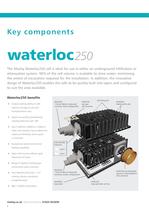
Key components The Marley Waterloc250 cell is ideal for use in either an underground infiltration or attenuation system. 96% of the cell volume is available to store water, minimising the extent of excavation required for the installation. In addition, the innovative design of Waterloc250 enables the cells to be quickly built into layers and configured to suit the area available. Waterloc250 benefits ‧‧ ‧‧ ‧‧ Unique nesting ability of cells reduces storage on site and WLRE250 110mm/160mm inlet/outlet connector (inlet configuration) WLRC250 top layer cell connector Cell lifting bars WLRB250 Waterloc250...
Open the catalog to page 6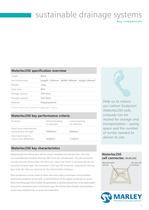
sustainable drainage systems Unit dimensions Length: 1200mm. Width: 800mm. Height 290mm* Void ratio Storage volume Storage capacity * Effective depth when installed in multiple layers: 260mm Vertical loading Lateral loading Short term characteristic compressive strength Short term load to transportation - saving Waterloc250 has lifting bars and an arrow moulded into the top face. The cells are assembled by rotating them by 180° from the nested stack. The cell connector actually consists of two clips; the 'pop-out' clip in the centre is the base cell clip, for securing the base layer, the remainder...
Open the catalog to page 7
Key components flowloc Flowloc is a Vortex flow control unit, which is used as part of an attenuation scheme. Flowloc controls the rate at which water is discharged to a surface water drain or Heavy duty aluminium flow tank. Available to accommodate flow rates ranging from 2 l/s to 15 l/s, Flowloc is controller and coupling system, installed in a chamber base with a withdrawal handle to allow easy access from the electro coated for long service life. surface for maintenance. In the unlikely event of blockage, an overflow pipe allows Available to suit a wide range of water to bypass the controller...
Open the catalog to page 8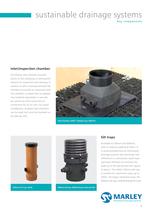
sustainable drainage systems Inlet/inspection chamber The Marley inlet chamber provides access to the soakaway or attenuation scheme for inspection and cleaning. A column of cells is omitted beneath the chamber to provide an inspection well. The chamber is seated into an adaptor tray (ordered separately). It can also be used as an inlet connection or connection for an air vent. For larger installations, multiple inlet chambers can be used, but must be bounded on Silt traps with or without additional filters. It is recommended that all stormwater drainage systems that discharge into infiltration...
Open the catalog to page 9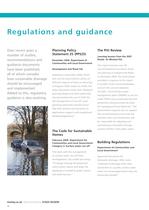
Over recent years a guidance documents have been published, Added to this, regulatory guidance is also evolving. Planning Policy Communities and Local Government Development and flood risk sets out the Government's policy on different aspects of land use planning in England. With respect to SUDS, the policy document states that "Regional planning bodies and local authorities should promote the use of SUDS for the management of run-off Local planning authorities should ensure that their policies and decisions on applications support and complement Building Regulations." Communities and Local Government...
Open the catalog to page 10
sustainable drainage systems CIRIA publications This guidance provides best practice advice on the planning, design, construction, operation and maintenance of Sustainable Drainage Systems (SUDS) to facilitate their effective implementation within Sustainable drainage systems - Hydraulic, structural and water quality advice 2004. CIRIA C609 A report which details the successful design and construction of Sustainable Drainage Systems. Structural design of modular geocellular drainage tanks 2008. Co-sponsored by Marley, this report focuses specifically on the different types of underground geocelluar...
Open the catalog to page 11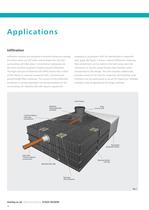
Infiltration systems are designed to provide temporary storage of surface water run off while natural dispersion into the surrounding soil takes place. Conventional soakaways are the most common example of below ground infiltration. The high void area of Waterloc250 (96%) means that a third of the volume is required compared with a conventional gravel/shingle filled soakaway. The success of any infiltration installation is wholly dependent on the permeability of the surrounding soil. Waterloc250 cells require a geotextile wrapping in accordance with the specification in appendix one, (page 28)...
Open the catalog to page 12
sustainable drainage systems Designed to store stormwater temporarily in a suitable chamber below ground and release it at a pre-determined rate via a vortex flow control unit, such as the Marley Flowloc or an orifice plate. This limits the peak flow of water, thereby reducing the likelihood of overloading pipelines or watercourses downstream. The sizing of the attenuation tank is critical, to allow sufficient capacity to prevent upstream flooding. The Marley Technical Services team offer a design service to assist with this calculation. Attenuation tanks must be encapsulated within an impermeable...
Open the catalog to page 13All Marley Plumbing & Drainage catalogs and technical brochures
 New Product Guide MARCH 2021
3 Pages
 Roofing Accessoiries
33 Pages
 Multikwik®
50 Pages
 Underground
27 Pages
 PRODUCT PORTFOLIO
11 Pages
 Rainwater
23 Pages
 ABOVE AND BELOW GROUND
41 Pages
 soil waste
27 Pages
 ABOVE GROUND
35 Pages
 Anti-flood valve datasheet
2 Pages
 HPDE Drainage
27 Pages
 Sanitary Systems technical guide
17 Pages
 Sanitary Systems Brochure
13 Pages
 Marley Range
11 Pages


Archived catalogs
 underground drainage system
23 Pages
 PRODUCT PORTFOLIO_2017
11 Pages
 RAINWATER_2017
19 Pages
 Marley Rainwater
28 Pages
 Marley Sanitary
13 Pages

- Industrial floor drain
- Stainless steel floor drain
- Piping
- Square floor drain
- Industrial roof gutter
- Bathroom floor drain
- Toilet flush button
- Grated floor drain
- Channeling
- Plastic floor drain
- Drainage system piping
- Anchoring system
- Shower drain
- Drainage system channeling
- Semi-circular roof gutter
- Round floor drain
- Metal anchoring system
- Plastic channeling
- Patio floor drain
- Metal channeling