


Restoration and protection of reinforced concrete

Restoration and protection of reinforced concrete
- Preparation of Substrates: Techniques such as hydro-scarifying, chiselling, and hydro-sandblasting are used to prepare surfaces for restoration.
- Steel Reinforcement: Damaged steel is replaced, and electro-welded mesh is applied for reinforcement.
- Formwork: Proper positioning and support of formwork are essential for structural strengthening.
- Anti-Corrosion Cementitious Mortar: One-component or two-component mortars protect steel from carbonation and chlorides.
- Galvanic Cathodic Protection: Methods for structures in chloride-rich environments, applicable to both new and existing structures.
- Thixotropic Mortars: Rapid-setting and normal-setting mortars are used for concrete affected by carbonation, chlorides, and sulphates.
- Structural Restoration: Techniques for various works, including those under dynamic stress scenarios.
- Shrinkage Reducer: Curing admixtures reduce hydraulic shrinkage and micro-cracks.
- Repairs to Cracked Concrete: Injection or casting methods for dry or slightly damp cracks.
- Structural Bonding: Techniques for bonding hardened and fresh concrete, and steel plates to concrete.
- Surface Skimming: Techniques for uneven surfaces with or without dynamic stress.
- Anchoring and Fastening: Methods for anchoring steel reinforcement and rapid fastening of components.
- Protection of Concrete Surfaces: Hydrophobic impregnation and coatings resistant to aggressive agents, chemicals, and suitable for contact with drinking water and food products.
- Preparation of Substrates: Deteriorated concrete is removed to achieve a solid substrate. Steel reinforcement is cleaned to bare metal.
- Protection of Steel Reinforcement: Steel is treated with anti-corrosion cementitious mortar after rust removal.
- Restoration Operations: Surfaces are cleaned and saturated before mortar application. Mortars like Mapegrout 430 or T40 are used, mixed with Mapecure SRA to reduce shrinkage.
- Application of Thixotropic Mortars: Mortars must meet EN 1504-3 standards, with specific performance characteristics.
- Performance Characteristics: Mortars must comply with EN 1504-3 standards, with requirements for compressive strength, flexural strength, adhesion, and thermal compatibility.
- Application Techniques: Mortars are applied by trowel or spray, with proper curing techniques to ensure longevity.
- Modulus of Elasticity: 22 GPa after 28 days.
- Adhesion to Substrate: > 2 MPa after 28 days.
- Capillary Absorption: < 0.25 kg/m²·h0.5.
- Impermeability to Water: Penetration depth < 10 mm.
- Thermal Compatibility: > 2 MPa after freeze-thaw cycles.
- Reaction to Fire: Euroclass E.
- Consumption: Approximately 21 kg/m² per cm of thickness.
- Hydro-cleaning and saturation of substrate before mortar application.
- Application by trowel or spray around steel reinforcement.
- Levelling and tamping of surfaces.
- Curing by spraying water for at least 24 hours post-application.
- Use of two-component, normal-setting, shrinkage-compensating, class R3 thixotropic mortar with low modulus of elasticity.
- Application in layers from 0.5 to 2 cm thick.
- Compliance with EN 1504-3 for structural R3-class mortars.
- Performance characteristics include compressive strength ≥ 38 MPa, flexural strength ≥ 7 MPa, and adhesion to substrate ≥ 2 MPa.
- Preparation involves removing deteriorated concrete and cleaning steel reinforcement.
- Use of one-component, normal-setting, shrinkage-compensating, class R4 thixotropic mortar for layers from 1 to 3.5 cm thick.
- Compliance with EN 1504-3 for structural R4-class mortars.
- Performance characteristics include compressive strength > 60 MPa, flexural strength > 8.5 MPa, and adhesion to substrate > 2 MPa.
- Use of Mapecure SRA additive to reduce shrinkage.
- Application in multiple coats if thickness exceeds specified values.
- Use of electro-welded mesh for reinforcement.
- Damp-curing technique recommended in hot or windy conditions.
- Hydro-sandblasting is necessary for long steel reinforcement. Damaged or corroded steel must be replaced. After rust removal, apply two coats of Mapefer anti-corrosion mortar.
- Surfaces must be cleaned and saturated before restoration. Use Mapegrout BM for layers 1-3.5 cm thick, mixed with Mapecure SRA to reduce shrinkage. Apply with a trowel or spray, reinforcing with electro-welded mesh if necessary. Ensure proper curing to prevent rapid evaporation.
- Complies with EN 1504-3 for R4-class mortars. Key characteristics include compressive strength >47 MPa, flexural strength >10 MPa, and adhesion >2 MPa. Consumption is approximately 21 kg/m² per cm thickness.
- Prepare substrates by removing deteriorated concrete and cleaning steel reinforcement. Use Mapegrout Hi-Flow for layers 1-4 cm thick, adding Mapecure SRA to reduce shrinkage. Cast the mortar ensuring air expulsion and proper curing.
- Complies with EN 1504-3 for R4-class mortars. Key characteristics include compressive strength >75 MPa, flexural strength 12 MPa, and adhesion >2 MPa. Consumption is approximately 21 kg/m² per cm thickness.
- Prepare substrates similarly, using products like Mapegrout T60 or Mapegrout Easy Flow for layers 1-5 cm thick. These mortars are designed for high resistance and ductility, suitable for dynamic stress environments.
- Preparation of Mortar: Add Mapecure SRA, a shrinkage-reducing agent, at 0.25% weight of the mortar. Apply within the specified temperature range.
- Application: Mortar can be applied by trowel or spray. For thicknesses exceeding specified values, apply in multiple coats with electro-welded mesh reinforcement.
- Substrate Preparation: Remove deteriorated concrete to form a rough, solid substrate. Clean steel reinforcement to bare metal and apply a passivating treatment.
- Mapegrout BM: A two-component, normal-setting, shrinkage-compensating, class R4 thixotropic mortar with a low modulus of elasticity for layers from 1 to 3.5 cm thick. It is suitable for structures subjected to small deformations under load.
- Mapegrout SV Fiber: A one-component, normal-setting, shrinkage-compensating, high-ductility, class R4 castable mortar strengthened with metal fibres for layers from 1 to 5 cm thick.
- Mapegrout Hi-Flow GF and TI 20: One-component, normal-setting, shrinkage-compensating, high-ductility, class R4 castable mortars for layers from 1 to 5 cm thick.
- Mortars should be applied by trowel or spray, ensuring the substrate is clean and saturated with water.
- For thicker applications, mortars should be applied in multiple coats with electro-welded mesh reinforcement to compensate for shrinkage.
- Special care should be taken to prevent rapid evaporation of water during curing, especially in hot or windy conditions.
- Use anti-corrosion treatments for steel reinforcement to prevent rust formation.
- Ensure proper curing by spraying water or using anti-evaporation products.
- Follow technical data sheets for mixing ratios and application conditions.
- Prepare the substrate by removing deteriorated concrete and cleaning steel reinforcement.
- Apply a passivating treatment to the steel reinforcement.
- Cast the mortar in layers from 1 to 5 cm thick on a saturated substrate.
- Add a curing additive to reduce shrinkage.
- Two-component, super-fluid epoxy resin for monolithic repairs and structural consolidation, meeting EN 1504-5 standards.
- Two-component epoxy resin with very low viscosity for micro-cracked concrete, also meeting EN 1504-5 standards.
- Two-component fluid adhesive for medium-viscosity applications, complying with EN 1504-4 standards.
- Expanding cementitious binder for injection slurry, used for high-quality, no-shrink slurry applications.
- Surface Preparation: Remove all crumbling or detached areas to ensure a solid substrate. Clean the surface to remove dust or other elements that could prevent adhesion.
- Application: Apply the mortar with a smooth metal trowel or by spray on a clean, damp substrate. The thickness of the application varies from 1 to 6 mm depending on the product and substrate conditions.
- Finishing: Finish the surface with a smooth metal trowel or sponge float.
- Compressive Strength: Ranges from >16 MPa to >50 MPa after 28 days.
- Flexural Strength: Ranges from >4 MPa to >10 MPa after 28 days.
- Adhesion to Substrate: ≥1 MPa to ≥2 MPa after 28 days.
- Impermeability: Low permeability to water (Class III) with W < 0.05 kg/m²·h0.5.
- Permeability to Water Vapour: Class I, SD < 0.5 m.
- Reaction to Fire: Euroclass E.
- Substrate Preparation: Remove all crumbly or detached areas and dust to ensure a solid substrate.
- Application: Apply the mortar with a smooth, metal trowel in layers up to 3 mm thick. For thicker layers, apply in two steps with glass fibre mesh reinforcement.
- Finishing: Finish the surface with a trowel or sponge float.
- Use alkaline-resistant glass fibre mesh for reinforcement in thicker applications.
- Ensure substrates are clean and damp (for absorbent surfaces) or dry (for old paintwork) before application.
- Follow specific performance requirements for each type of mortar, including compressive strength and adhesion.
- Compressive strength ranges from >6 MPa to >16 MPa after 28 days, depending on the mortar type.
- Adhesion to substrate is generally ≥ 1 MPa after 28 days.
- Water permeability is classified as low (Class III) with W < 0.1 kg/m²·h0.5.
- Reaction to fire varies from Euroclass A1 to E.
- Ensure proper substrate preparation to prevent adhesion issues.
- Use appropriate mesh reinforcement for surfaces with different material types.
- Follow specified application thickness and performance standards to ensure durability and effectiveness.
- Application of Cementitious Mortar: The mortar is applied in two layers with an alkaline-resistant glass fibre mesh between them. The product must meet EN 1504-2 standards and exhibit specific adhesion, flexibility, and impermeability characteristics.
- Application of Expanding Mortars: These mortars are used for anchoring steel reinforcements and machinery. They must comply with EN 1504-6 standards and demonstrate high compressive and flexural strength.
- Application of Epoxy Mortars and Resins: Used for precision anchoring, these products must meet EN 1504-6 standards and show excellent adhesion and mechanical properties.
- Rapid Fastening and Filling: Utilizes rapid-setting hydraulic binders for fastening construction elements. The binders must set quickly and provide high compressive strength.
- Adhesion to concrete, flexibility, crack-bridging, and impermeability are critical performance metrics for the cementitious mortar.
- Expanding mortars must exhibit high compressive strength, low water permeability, and excellent adhesion.
- Epoxy mortars and resins should have high tensile and compressive strength, low creep, and good thermal properties.
- Rapid-setting binders must set quickly and provide sufficient strength for immediate use.
- Ensure proper substrate preparation by removing deteriorated concrete and cleaning surfaces thoroughly.
- Apply products in specified thicknesses and ensure proper curing to achieve desired performance.
- Overlap reinforcement materials adequately to ensure structural integrity.
- Rapid-Setting Mortar: Used for reconstructing deteriorated concrete and fastening urban features. It sets for pedestrian and vehicular traffic in approximately 2 hours at 20°C. The mortar's compressive strength varies with temperature, reaching >45 MPa after 28 days.
- Thixotropic Mortar: Applied in layers of 1 to 5 cm on a prepared substrate. It also sets for traffic in about 2 hours at 20°C.
- Hydrophobic Impregnation: Utilizes a silane and siloxane impregnator to make surfaces water-repellent. It has a penetration depth of 4 mm and complies with various absorption and resistance standards.
- Elastic Cementitious Coatings: Applied by trowel or spray, these coatings protect against chlorides and carbonation. They require a solid substrate and may include glass fibre mesh for reinforcement.
- Elastic Acrylic Coatings: These coatings, such as Elastocolor Paint, provide crack-bridging and protective properties. They are applied in two coats and have high resistance to aging and atmospheric agents.
- Surface Preparation: All substrates must be adequately prepared by removing deteriorated areas and ensuring a clean, damp surface for optimal adhesion.
- Application Techniques: Products can be applied using trowels, brushes, rollers, or spray machines, depending on the product type and desired finish.
- Adhesion and Elasticity: Products are tested for adhesion to concrete, elasticity, and crack-bridging capabilities under various conditions.
- Permeability and Resistance: Coatings are evaluated for water and CO2 permeability, resistance to carbonation, and thermal compatibility.
- Application: Two coats using brush, roller, or spray after primer.
- Characteristics: Thick liquid, dry solids content approx. 59%, density approx. 1.27 g/cm³.
- Performance: High CO2 permeability, water vapor permeability class I, compliant with thermal compatibility and crack resistance standards.
- Application: Two coats with brush, roller, or spray after primer.
- Characteristics: Thick liquid, dry solids content approx. 61%, density approx. 1.35 g/cm³.
- Performance: High CO2 permeability, water vapor permeability class I, compliant with thermal compatibility and crack resistance standards.
- Application: Two-component epoxy paint, two coats on prepared substrate.
- Characteristics: Transparent white or grey, density 1.3 g/cm³, viscosity 2600 MPa·s.
- Performance: Compliant with EN 1504-2, resistant to thermal shock and chemical attack.
- Application: Two-component epoxy resin paint, two coats on prepared substrate.
- Characteristics: 100% dry solids content, final hardening in 7 days.
- Performance: High CO2 permeability, resistant to thermal shock and severe chemical attack.
- Application: Two-component epoxy paint with high covering pigments, two coats on prepared substrate.
- Characteristics: Mixing ratio 4:1, density 1,300 kg/m³, viscosity 1,500 mPa·s.
- Performance: High CO2 permeability, resistant to thermal shock and chemical attack.
- Application: Two-component epoxy paint, two coats on prepared substrate.
- Characteristics: Complies with EU regulations for potable water and food contact.
- Performance: High CO2 permeability, resistant to thermal shock and chemical attack.
Catalog excerpts

DESIGN GUIDE ARCHITECTURAL SOLUTIONS RESTORATION AND PROTECTION OF REINFORCED CONCRETE ADHESIVES • SEALANTS • CHEMICAL PRODUCTS FOR BUILDIN
Open the catalog to page 1
specifications of RESTORATION AND PROTECTION OF REINFORCED CONCRETE PRELIMINARY OPERATIONS LAVORAZIONIPRELIMINARI PREPARATION OF SUBSTRATES Idroscarifica STEEL REINFORCEMENT APPLICATION OF ELECTRO-WELDED MESH FORMWORK PROTECTION OF STEEL REINFORCEMENT PROTECTION USING ANTI-CORROSION CEMENTITIOUS MORTAR Concrete structures deteriorated by carbonation and chlorides INTERNAL GALVANIC CATHODIC PROTECTION Concrete structures exposed to chloride-rich environments F.2.2.1 PROTECTION OF NEW STRUCTURES Procedure F.2.2.2 PROTECTION OF STRUCTURES TO BE RESTORED (duration 10 years) Procedure F.2.2.3 PROTECTION...
Open the catalog to page 2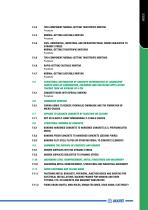
F.4.2 TWO-COMPONENT NORMAL-SETTING THIXOTROPIC MORTAR Procedure F.4.3 NORMAL-SETTING CASTABLE MORTAR Procedure F.4.4 CIVIL, RESIDENTIAL, INDUSTRIAL AND INFRASTRUCTURAL WORKS SUBJECTED TO DYNAMIC STRESS NORMAL-SETTING THIXOTROPIC MORTARS Procedure F.4.5 TWO-COMPONENT NORMAL-SETTING THIXOTROPIC MORTARS Procedure F.4.6 RAPID-SETTING CASTABLE MORTAR Procedure F.4.7 NORMAL-SETTING CASTABLE MORTAR Procedure F.5 STRUCTURAL RESTORATION OF CONCRETE DETERIORATED BY AGGRESSIVE AGENTS SUCH AS CARBONATION, CHLORIDES AND SULPHATES WITH LAYERS THICKER THAN AN AVERAGE OF 5 CM F.5.1 CONCRETE MADE WITH SPECIAL...
Open the catalog to page 3
AND TELEPHONE POLES, FENCES, ETC. IN PLACE F.12 PROTECTION OF CONCRETE SURFACES F.12.2 COATING RESISTANT TO THE PENETRATION OF AGGRESSIVE AGENTS F.12.3 COATING RESISTANT TO CHEMICAL PRODUCTS F.12.4 COATING FOR CONTACT WITH DRINKING WATER AND FOOD PRODUCTS
Open the catalog to page 4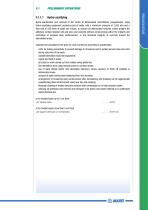
PRELIMINARY OPERATIONS F.1.1.1 Hydro-scarifying Hydro-scarification and removal of the cortex of deteriorated cementitious conglomerate, using hydro-scarifying equipment producing jets of water with a maximum pressure of 2,500 atm and a flow-rate of 250 litres of water per minute, to remove all deteriorated concrete and/or prepare the adhesion surface between old and new cast concrete without compromising either the integrity and anchorage of exposed steel reinforcement, or the structural integrity of concrete around the demolished areas. Included and calculated in the price for work carried...
Open the catalog to page 5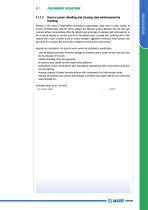
PRELIMINARY OPERATIONS F.1.1.2 Hand or power chiselling and cleaning steel reinforcement by brushing Removal of the cortex of deteriorated cementitious conglomerate, using hand or power chisels, to remove all deteriorated concrete and/or prepare the adhesion surface between old and new cast concrete without compromising either the integrity and anchorage of exposed steel reinforcement, or the structural integrity of concrete around the demolished areas. Exposed steel reinforcement is then cleaned with a hand or power brush to remove oxidation, aggressive chemicals, loose surfaces and any traces...
Open the catalog to page 6
PRELIMINARY OPERATIONS Cleaning of concrete surfaces and exposed steel reinforcement, where hydro-scarifying has not been carried out, by hydro-sandblasting with silica sand to remove oxidation, aggressive chemicals, loose surfaces and any traces of oil, grease, dirt and all other pollutants to leave a bare metal surface (grade SA 2½) (ISO 8501-1). Hydro-sandblasting is not required if the surface has been prepared by hydro-scarifying. However, if the time between hydro-scarifying and treating the steel reinforcement is particularly long due to on-site logistics, hydro-sandblasting must be carried...
Open the catalog to page 7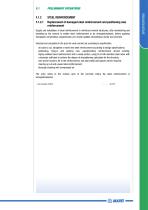
PRELIMINARY OPERATIONS STEEL REINFORCEMENT Replacement of damaged steel reinforcement and positioning new reinforcement Supply and installation of steel reinforcement in reinforced cement structures, after demolishing and breaking-up the cement to enable steel reinforcement to be arranged/replaced, before applying rheoplastic cementitious conglomerate, pre-mixed castable cementitious mortar and concrete. Included and calculated in the price for work carried out according to specification: all costs to cut, straighten or bend new steel reinforcement according to design specifications; positioning,...
Open the catalog to page 9
PRELIMINARY OPERATIONSF.1.3 APPLICATION OF ELECTRO-WELDED MESHF.1.3.1 Application of electro-welded mesh Supply and application of electro-welded steel mesh dimensioned according to design specifications (for any diameter of steel wire and any size of mesh) with relative certificate of origin and quality, to reinforce cast concrete, pre-mixed thixotropic, castable cementitious mortar and concrete, suitable also for restoration work and cladding. Included and calculated in the price for work carried out according to specification: -cutting; - all costs for cutting/bending to shape; - wire to tie...
Open the catalog to page 10
PRELIMINARY OPERATIONS
Open the catalog to page 11
PROTECTION OF STEEL REINFORCEMENT F.2.1 PROTECTION USING ANTI-CORROSION CEMENTITIOUS MORTAR Concrete structures deteriorated by carbonation and chlorides F.2.1.1 Application of one-component, anti-corrosion, re-alkalising cementitious mortar Supply and application of a passivating treatment for steel reinforcement, by brush-applying two coats of one-component, anti-corrosion cementitious mortar made from cementitious binders, powdered polymers and corrosion inhibitors (such as Mapefer 1K produced by MAPEI S.p.A.). Apply the mortar after adequate preparation of the substrate (not included), by...
Open the catalog to page 13
PROTECTION OF STEEL REINFORCEMENT Application of two-component, anti-corrosion, re-alkalising cementitious mortar Supply and application of a passivating treatment for steel reinforcement by brush-applying two coats of two-compone anti-corrosion cementitious mortar made from cementitious binders, powdered polymers and corrosion inhibitors (such Mapefer produced by MAPEI S.p.A.). Apply the mortar after adequate preparation of the substrate (not included), by remov all deteriorated concrete to obtain a solid, sufficiently-rough substrate with no loose portions and removing all rust from s reinforcement...
Open the catalog to page 14
F.2 PROTECTION OF STEEL REINFORCEMENT Procedure Protection of steel reinforcement Protection of steel reinforcement using Mapeshield 110/20 (see section F.2.2.1.1) or Mapeshield I 30/20 (see section F.2.2.1.2) pure zinc internal sacrificial anodes. The number of anodes connected to the steel reinforcement depends on the amount of steel contained in the first 20 cm of concrete, starting from the surface exposed to aggressive agents. For a steel/concrete surface area ratio of 1, use 2 Mapeshield 110/20 anodes per square metre or 1.5 Mapeshield I 30/20 anodes per square metre. Weld the connectors...
Open the catalog to page 15All MAPEI catalogs and technical brochures
 GENERAL CATALOGUE_2024
224 Pages
 KERAQUICK S1
4 Pages
 ADESILEX P9 EXPRESS
4 Pages
 PLANITOP 100
4 Pages
 COLORITE PERFORMANCE
6 Pages
 ULTRATOP LOFT F
6 Pages
 ULTRACOLOR PLUS
6 Pages
 keracolorff
4 Pages
 ISOLASTIC
4 Pages
 KERAPOXY
6 Pages
 mapebandpe120
2 Pages
 PRIMER G
4 Pages
 KERAFLEX MAXI S1
4 Pages
 KERABOND T
4 Pages
 ADESILEX P4
4 Pages
 MAPESIL LM
4 Pages
 MAPECOAT I 600W
4 Pages
 WALLGARD BARRIER
4 Pages
 MAPE-ANTIQUE RINZAFFO
4 Pages
 MAPECURE SRA
4 Pages
 LAMPOCEM
4 Pages
 365-epojetlv-gb
4 Pages
 Thermal insulation
60 Pages
 ULTRAFLEX S2 QUICK
4 Pages
 MARBLE & STONE
4 Pages
 Protecting and decorating buildings
193 Pages
 LIGNOBOND
4 Pages
 ULTRABOND ECO S955 1K
4 Pages
 ULTRABOND P902 2K
4 Pages
 ULTRABOND P913 2K
4 Pages
 ULTRABOND P990 1K
4 Pages
 ULTRABOND S997 1K
4 Pages
 FIBERPLAN
4 Pages
 LATEX PLUS
4 Pages
 NIVORAPID
4 Pages
 TOPCEM
4 Pages
 SILWOOD
4 Pages
 MAPEPROOF ESM
4 Pages
 TRIBLOCK P
4 Pages
 ULTRACOAT HIGH TRAFFIC
4 Pages
 ULTRACOAT OIL
2 Pages
 MAPEPLAST LA
4 Pages
 MAPETHERM AR1
4 Pages
 MAPETHERM NET
2 Pages
 ELASTOCOLOR RASANTE SF
4 Pages
 ELASTOCOLOR WATERPROOF
6 Pages
 General catalogue 2017
292 Pages
 FastTrack
24 Pages
 Ultralite range
8 Pages
 Keracolor Flex
2 Pages
 Kerapoxy CQ
2 Pages
 Mapei Coloured grouts
2 Pages
 Ceramic Pocket Guide
82 Pages
 MAPELASTIC TURBO
2 Pages
 PURTOP LINE
2 Pages


Archived catalogs
 RE-CON Zero
6 Pages
 Concrete Admixtures
30 Pages
 Marble and Stone
4 Pages
 Granirapid
4 Pages
 AQUADEFENSE
2 Pages
 Keracolor GG
6 Pages
 Realtà MAPEI
84 Pages
 Realtà Mapei 48
84 Pages
 Realtà Mpaei 46
116 Pages
 Realtà Mapei 43
84 Pages
 Realtà Mapei 45
84 Pages
 Maintenance work on Roads
6 Pages
 Soundproofing Wooden Floorings
15 Pages
 Ceramic Pocket Guide
41 Pages
 MAPEFER 1K
4 Pages
 ADESILEX PA
4 Pages
 ECO PRIM GRIP
4 Pages
 KERAFLEX
4 Pages
 ELASTORAPID
4 Pages
 MAPEFLEX PU45
4 Pages
 FUGOLASTIC
4 Pages
 MAPESILENT PANEL
4 Pages
 realta mapei
84 Pages
 MAPEKER RAPID SET FLEX
4 Pages
 MAPEFLEX PU30
4 Pages
 AQUAFLEX ROOF
2 Pages
 Realata Mapei 49
84 Pages
 Realtà Mapei 47
84 Pages
 Mapei et vous 40
36 Pages
 Realtà Mapei 44
84 Pages
 Resin & Cementitious Flooring
22 Pages
 Resilient Adhesives
16 Pages
 WallGard Graffiti BARRIER
4 Pages
 ULTRATOP INDUSTRIAL
4 Pages
 ULTRABOND P980 1K
4 Pages
 MAPEPRIM SP
4 Pages
 ADESILEX P9
4 Pages
 ADESILEX P10
4 Pages
 KERAPOXY SP
4 Pages
 General Catalogue
291 Pages


