


Realata Mapei 49

Realata Mapei 49
This document is the 49th issue of Realtà Mapei International, published in September 2014. It provides insights into Mapei's product offerings, contributions to construction projects, and industry-related news.
Mapei introduces a new range of grouting mortars available in 14 natural colors, designed for ceramic tiles. The products include cementitious and epoxy grouts, with detailed information available on Mapei's website.
The Porta Nuova urban development project in Milan is nearing completion, with Mapei supplying various building products, concrete admixtures, and solutions for waterproofing and laying ceramics and stone materials.
Highlighted products include Kerapoxy Design, Ultracolor Plus, and Ultralite Flex, among others. These products are noted for their high performance, ease of use, and compliance with European standards.
The 2014 Annual Confindustria Assembly in Rome focused on economic development and the need for reforms in Italy and Europe. President Giorgio Squinzi emphasized the importance of moving away from austerity and fostering growth.
Significant projects include the Porta Nuova area in Milan, the new Florence Opera House, and the Donau City tower in Vienna. Mapei's products played a crucial role in these developments.
Mapei continues to innovate with transparent quality adhesives, enhancing product performance and sustainability.
This issue highlights Mapei's commitment to innovation, quality, and sustainability in the construction industry, alongside its active participation in significant international projects and industry events.
Giorgio Squinzi, President of Confindustria, emphasizes the importance of enforcing existing laws rather than creating new ones to combat corruption in Italy. He highlights the need for a culture of transparency and a fair legal system.
Squinzi discusses the high taxation rate in Italy, which is the 19th highest globally, and its impact on tax evasion. Despite these challenges, Italy remains a leading manufacturer in Europe. He calls for a new approach to improve the relationship between taxpayers and tax authorities.
Squinzi highlights the potential for growth through global competition and the importance of expanding Italian exports. He notes that Italian exports currently account for 30% of GNP, with a goal to reach 40%.
Paolo Caputo, an architect, discusses his experiences with urban design and the challenges of working with Italian institutions compared to those abroad. He emphasizes the need for simplification of procedures in Italy.
Caputo shares his experience working with the American design studio Pei Cobb Freed & Partners on the Palazzo Lombardia project, highlighting the benefits of international collaboration.
Caputo discusses his approach to requalification projects in former industrial areas, emphasizing the importance of respecting the historical context while introducing innovation.
Caputo expresses his interest in vertical buildings and their role in modern cities. He discusses the potential and challenges of tall buildings, particularly in terms of energy requirements and historical context.
Both Squinzi and Caputo advocate for change and innovation in their respective fields, emphasizing the need for transparency, fair legal practices, and thoughtful urban development.
The Territorial Masterplan of Milan outlines the city's development, focusing on regenerating key areas such as City Life, Santa Giulia, Bovisa, Adriano, and Rubattino. The plan emphasizes strengthening centers of excellence like universities and hospitals to anchor further urban revitalization.
There is a noted gap in pre-university education between students from classical studies and other backgrounds. The flexibility in university courses is seen as excessive, and a more regimented approach is suggested. Positive aspects include opportunities for international learning experiences, which broaden students' perspectives. However, there is a concern about the dominance of theoretical over practical skills in architectural education.
The architect reflects on his career, noting that working with excellent clients leads to memorable experiences. He emphasizes the importance of simple beauty in social sector projects and acknowledges the challenges posed by public and private sector regulations.
The Porta Nuova project is a significant urban redevelopment in Milan, transforming the Isola, Varesine, and Garibaldi areas. It includes a mix of residential, commercial, and green spaces, with a focus on eco-sustainability and LEED certification. The project is a collaboration of various international design studios and is considered one of the largest urban redevelopment sites in Europe.
The UniCredit complex, part of the Porta Nuova project, includes three towers, with Tower A being the tallest in Italy. The complex is designed by César Pelli and serves as the headquarters for UniCredit bank. It features eco-friendly designs and has achieved LEED GOLD pre-certification.
Designed by Stefano Boeri, the Vertical Wood towers are notable for their extensive vegetation, providing environmental benefits such as air purification and noise reduction. The towers incorporate innovative systems for plant anchoring and water recycling.
Mapei provided technical support and products for various aspects of the Porta Nuova project, including waterproofing and tile bonding. Their products were used in the UniCredit complex and Vertical Wood towers, contributing to the projects' sustainability goals.
- Construction Period: 2009-2014
- Intervention Period: 2012-2014
- Designers: Stefano Boeri Architetti
- Client: Hines Italia sgr
- Contractor: Colombo Costruzioni SpA
- Mapei's Role: Supplied products for stone material installation
- Construction Period: 2011-2013
- Intervention Year: 2013
- Designers: Studio Piuarch
- Client: Hines Italia sgr
- Contractor: Colombo Costruzioni SpA
- Mapei's Role: Supplied products for substrate preparation and resin flooring
- Key Products: Primer SN, Quartz 1.2, Mapecolor Paste, Mapefloor Finish 55
- Construction Period: 2010-2014
- Designers: Arquitectonica and Caputo Partnership
- Client: Hines Italia sgr
- Contractor: ATI CMB-Unieco
- Mapei's Role: Supplied products for soundproofing, flooring, and stone slab installation
- Key Products: Mapesilent Roll, Ultrabond P913 2K, Keraflex Maxi S1
- Design: Paolo Desideri, Studio ABDR
- Features: Opera house, auditorium, open-air amphitheatre
- Mapei's Role: Provided solutions for façade renovation and interior installations
- Challenges: Addressed issues with carbonate calcium efflorescence and cracking on façades
- Estonia and Lithuania are expected to see GDP growth of around 3% in 2014-2015, with Lithuania's construction market growing by 5% while Estonia faces a temporary decline.
- The Czech Republic's GDP fell by 0.9% in 2013, but moderate growth is expected in 2014-2015, with a slight recovery in the construction sector anticipated in 2015.
- Slovakia's growth is projected between 2% and 3% for 2014-2015, with a construction market recovery expected in 2015.
- Slovenia's economy is predicted to grow in 2015-2016, despite a significant drop in construction investments over the past four years.
- Serbia, not yet an EU member, is forecasted to see a construction market recovery in 2014, driven by strategic investments from Italy and companies like Mapei.
- Low market demand, lack of investments, and high corporate debt are significant challenges across the region.
- In Poland, the construction sector faces a decline in physical volume and quality due to cost-cutting measures in public contracts.
- Croatia continues to experience recession, with a 12% drop in GDP since 2008, and ongoing negative trends in the construction market.
- Mapei has established subsidiaries in several Eastern European countries, including the Czech Republic, Hungary, Poland, Slovakia, Slovenia, Croatia, Serbia, Bulgaria, and Romania.
- The company focuses on providing high-quality building products and technical assistance, contributing to market growth despite economic challenges.
- Mapei's strategic investments in distribution centers and manufacturing plants, such as in Bulgaria and Romania, support its expansion and market penetration.
The document provides detailed information on Mapei's Ultracoat products and their application in various projects, focusing on parquet protection and concrete repair. It highlights the features, application procedures, and benefits of using these products in high-traffic areas and structural repairs.
Ultracoat High Traffic is a two-component, water-based varnish made from 100% aliphatic polyurethane resins. It offers excellent resistance to abrasion and scuff marks, making it ideal for high-traffic areas in both civil and commercial environments. The varnish provides a natural wood finish and enhances the wood's color without yellowing over time. It contributes to LEED certification by offering low VOC emissions.
The application involves several steps: cleaning and sanding the wooden floors, applying Ultracoat Premium Base, and finishing with Ultracoat High Traffic varnish. The process ensures a durable and aesthetically pleasing finish, suitable for environments like the Valamar Dubrovnik President Hotel.
The document also details the repair and protection of the Valea lui Stan viaduct in Romania. The repair involved removing rust from reinforcement rods, applying anti-corrosion mortar, and using fiber-reinforced mortars for structural consolidation. Carbon fiber fabrics were used for additional strengthening, and the structure was protected against atmospheric agents using Mapelastic Smart.
Specific projects, such as the Valamar Dubrovnik President Hotel and the Valea lui Stan viaduct, are highlighted with technical data, including construction periods, involved parties, and specific Mapei products used.
Mapei's products, including Ultracoat and various concrete repair solutions, provide effective and sustainable options for floor protection and structural repairs. These products are designed to meet high standards of durability, environmental safety, and aesthetic appeal.
- KERAFLEX MAXI S1: A high-performance, deformable cementitious adhesive with no vertical slip, suitable for large-size ceramic tiles and natural stone. It features Low Dust technology and can contribute to LEED certification.
- MAPELASTIC: A two-component, flexible cementitious mortar used for waterproofing substrates, ideal for balconies, terraces, and swimming pools.
- For the Paradise Center, KERAFLEX MAXI S1 was used to install porcelain tiles and natural stone slabs, with substrates waterproofed using MAPELASTIC.
- In Terme 3000, renovation involved removing old tiles, preparing substrates with high-pressure water jets, and using products like PLANITOP FAST 330 for levelling and MAPELASTIC for waterproofing.
- Products comply with EN 12004 and EN 14891 standards, ensuring quality and performance in waterproofing and adhesive applications.
- Use MAPEBAND for sealing joints and MAPEFLEX PU45 for sealing expansion joints to ensure flexibility and waterproofing.
- For effective renovation, plan thoroughly, use experienced teams, and select high-quality materials.
- Paradise Center project duration: 2010-2013.
- Terme 3000 renovation period: April-August 2013.
- Client for Paradise Center: BULFELD EOOD; for Terme 3000: Sava Hotels Resorts.
The European standard EN 12004, first introduced in 2001, classifies adhesives for ceramic tiles into fundamental and optional categories. Fundamental classes include C1 and C2 for cementitious products, D1 and D2 for dispersion adhesives, and R for reactive adhesives. Optional classes for cementitious adhesives include F (fast-setting), E (extended open time), T (no vertical slip), S1 (deformable), and S2 (highly deformable). The CE mark indicates compliance with these standards, essential for products in the EU market.
Products must meet minimum requirements for their class, with documentation and certification from notified European bodies. This ensures transparency and reliability in product performance, supported by Factory Production Control (FPC) systems for ongoing compliance.
The standard facilitates comparison of adhesives from different suppliers and simplifies technical specifications. It provides guidance for selecting adhesives based on specific installation conditions, such as using class C2 for porcelain tiles or class T for large wall tiles.
Since July 2013, a DoP is mandatory for products with a CE mark, detailing performance characteristics. Mapei, a leading manufacturer, provides these documents online, ensuring transparency and ease of access for clients.
Mapei emphasizes quality and transparency, offering detailed product information and maintaining rigorous production controls. The company adapts to market needs by updating product formulations and obtaining new certifications as necessary.
EN 12004 remains a vital tool for ensuring quality and consistency in ceramic tile adhesives, benefiting manufacturers, suppliers, and end-users by providing clear standards and facilitating informed product choices.
The document provides an overview of recent renovations and projects undertaken by Mapei GmbH in Austria, highlighting the use of Mapei products in various construction and renovation projects. It also details the company's focus on customer relations and its efforts to expand its training center.
The entrance hall of Mapei GmbH's headquarters was renovated using several Mapei products, including MAPEGROUT 430, MAPELASTIC, MAPEBAND, ELASTORAPID, and ULTRACOLOR PLUS. A new kitchen was installed using PRIMER G, ULTRAPLAN MAXI, and other Mapei products for substrate preparation and installation of ceramics and wooden materials.
The training center was expanded from 24 to 36 seats to accommodate more customers and employees. The center hosts six courses a month and is used for practical demonstrations of Mapei products.
Mapei GmbH held a summer celebration on June 5th, featuring a gala dinner and entertainment by Billy the Artist and a local band. The event emphasized the company's achievements and future goals in Austria.
Weinblick Grafinger Hotel and Winery: Mapei products were used for laying wooden floors, including ULTRABOND ECO S955 1K and ULTRACOAT OIL. The project was completed ahead of schedule, showcasing the quality of Mapei products.
Donau City Tower 1: Mapei products were used in the construction of Austria's tallest skyscraper, including concrete admixtures and adhesives for stone materials. The project emphasized eco-sustainability and architectural quality.
The document highlights Mapei GmbH's commitment to quality and innovation in construction, as well as its focus on customer relations and training. The use of Mapei products in high-profile projects underscores their reliability and effectiveness.
Keraquick, Keralastic, Keraflex Maxi S1, and Elastorapid are admixtures manufactured and distributed in Austria by Mapei Betontechnik. For grouting joints, Ultracolor Plus is used, and for sealing expansion joints, Mapesil AC is recommended. Further information can be found on Mapei's websites.
ECO PRIM GRIP is a multi-purpose, ready-to-use solvent-free primer composed of synthetic resin in water dispersion. It offers excellent bond strength, resistance to water and aging, and is suitable for both internal and external floors and walls. It enhances the bond of cement, gypsum, and lime-based plasters on various substrates and can contribute to LEED certification for eco-sustainable buildings.
Mapei Day is an annual event celebrating sport and community, held in Bormio, Italy. The 2014 edition marked the 10th anniversary of the event, coinciding with the 30th edition of the Re Stelvio cycling race. The event is organized by Mapei in collaboration with local sporting associations and sponsors, featuring various sports activities including cycling, running, skiing, and golf.
- Skiing: Held on the Stelvio glacier, with races organized by Pirovano Ski University.
- Golf Tournament: The Mapei Golf Trophy was held at Bormio Golf Club, with Roberto Bono winning the men's event and Diana Barassi winning the women's event.
- Cycling and Running: The Re Stelvio cycling race and half marathon attracted numerous participants, with Michele Boscacci and Valentina Mabritto winning the cycling races, and Michele Belluschi winning the half marathon.
- Ski Roll: The roller skiing event was won by Sergio Bonaldi, with Serena Boner winning the women's race.
The gala evening was held at the Pentagono, featuring speeches from Mapei's CEO Giorgio Squinzi and other dignitaries. The event celebrated Mapei's corporate values and included a presentation of sports shirts from previous Mapei Day editions. The evening also featured the awarding of the "Aldo Sassi" research prize.
Mapei Day is a celebration of sport, community, and corporate values, with a focus on charity and interpersonal relations. The event brings together athletes, sports enthusiasts, and Mapei partners in a festive atmosphere, promoting the company's commitment to sport and community engagement.
The document provides an overview of the Sassuolo football team, its organizational changes, and preparations for the upcoming season. It also details the renovation work at the Mapei Stadium in Reggio Emilia.
Sassuolo aims to maintain its position in Italy's top football division and achieve ambitious goals while being recognized as the friendliest team in Serie A. The club has undergone organizational changes, appointing Giovanni Carnevali as Managing Director and Nereo Bonato in charge of technical-sports management. Carlo Rossi remains the club Chairman, and Eusebio Di Francesco continues as head coach.
The team began its training in Bormio and Malles, followed by a series of friendly matches in Carpineti and other locations. The schedule included matches against local and international teams, culminating in the Italian Cup and the Tim Trophy.
Major renovations at the Mapei Stadium included installing a new giant screen, upgrading the pitch with MAPESOIL technology, enhancing floodlights, and improving safety features. These upgrades aim to meet Serie A standards and enhance the spectator experience.
The document highlights Sassuolo's strategic planning and infrastructure improvements to support its competitive goals and strengthen its community ties.
Catalog excerpts

GROUT SELECTION * A choice of colours for grouting mortars with an unrivalled effect. From Mapei Research: 14 colours with a natural effect, the perfect combination for grouting ceramic tiles. A touch of design you weren’t expecting. Mapei is with you: let’s take a deeper look together at: www.mapei.com *A choice of 14 colours from the new range of Ultracolor Plus cementitious grouts and Kerapoxy Design epoxy grouts. Find out more about the complete range at our website www.mapei.com Product info Mapei grouts are available from authorized leading distributors GROUT SELECTION
Open the catalog to page 2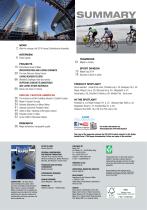
2 Work for change: the 2014 Annual Confindustria Assembly INTERVIEW 10 Porta Nuova area in Milan WATERPROOFING AND LAYING CERAMICS 20 The new Florence Opera House WOODEN FLOORS LAYING 66 Weinblick Grafinger hotel and winery SUPPLYING CONCRETE ADMIXTURES AND LAYING STONE MATERIALS 68 Donau City tower in Vienna SPECIAL FEATURE AMERICAS 26 The economy and the building industry in Eastern Europe 30 Mapei in Eastern Europe 34 Hilandar Monastery on Mount Athos 41 Valamar Dubrovnik President Hotel 44 Valea lui Stan: repairing a Romanian viaduct 48 Paradise Center in Sofia 52 Terme 3000 in Moravske Toplice...
Open the catalog to page 3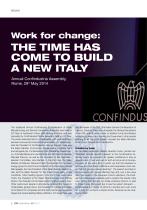
the time has come to build a new Italy Annual Confindustria Assembly, Rome, 29th May 2014 The traditional Annual Confindustria (Confederation of Italian Manufacturing and Service Companies) Assembly was held on 29th May at Auditorium Parco della Musica in Rome and was preceded by Confindustria Private Assembly held on 28th May. The public assembly held in a hall bursting with over 3000 people saw more women involved than ever before. On stage alongside the President of Confindustria, Giorgio Squinzi, there was the Italian Minister of Economic Development, Federica Guidi and alongside her, Confindustria’s...
Open the catalog to page 4
As regards growing Euro-scepticism, Squinzi did not hesitate to point out that “there is a reason for all this malaise: austerity policies have not helped revive the economy or create jobs. There is, in fact, some growth but not in Europe. Global industrial production and world trading are up and running again, although they are less sturdy than before the recession. The facts and figures since 2008 are very clear: the GNP in the USA is +6.3% compared to -2.5% in the Eurozone, with increasing disparity between wealthy nations such as Germany at +3.8% and the poorest nations like Greece at -23.6%....
Open the catalog to page 5
is no work; divisions take precedence over unity, holding onto privileges becomes more important than merit”. Nevertheless, Squinzi claimed: “We refuse to resign ourselves to being a tired and disillusioned nation, the victim of age-old failings, abstruse and hostile to business, merit and risk-taking”. “This is not the Italy we see every day at the workplace - so the President went on to say - we see a country that is more about manufacturing plants than statistics, which is not concerned about +0.1 or -0.1%, which protects jobs and creates them, which is part of Europe and proudly operates...
Open the catalog to page 6
stitute for Foreign Trade. “We have great ambitions out on the markets and for many foreigners we are a model to be copied - so the President of the Italian industrialists went on to say – and we have a great opportunity to systematically showcase all this here in Milan, namely the Expo; the whole world will be visiting us. Businesses, visitors, institutions, schools. They will all be coming to Milan to ponder over one of the key issues of today and tomorrow: how everybody can feed themselves in a healthy and sustainable way. But they will not just be coming to Milan for that reason only. They...
Open the catalog to page 7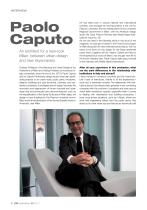
Paolo Caputo An architect for a new-look Milan, between urban design and new skyscrapers He has taken part in various national and international contests, and amongst his winning projects is the one for Palazzo Lombardia, the new headquarters of the Lombardy Regional Government in Milan, with the American design studio Pei Cobb Freed & Partners (see Realtà Mapei International, issue No. 35). As one can read in the following article in this issue of the magazine, he was also involved in the Porta Nuova project in Milan along with 20 other international architects, with his name to be found on...
Open the catalog to page 8
equipped as the most aggressive and experienced private companies, or others from Jordan to China or Morocco that have a slim-line structure and operate very rapidly. I don’t intend this as a criticism of the work carried out by public engineering offices in Italian cities: I can honestly say that the undersized offices of the Milan City Council often work heroically to deal with an enormous amount of work and complex problems within an acceptable timeframe. As everybody knows, we need to implement an intelligent and drastic simplification of procedures by working on the general and needlessly...
Open the catalog to page 9
The Solea tower, a “sister” of the Solaria and Aria towers in Milan technical round tables with tens and, in some cases, hundreds of experts. many of its design principles on the urban matrix of architecture and I believe it was the first one in Italy, and is maybe still the only one, that trains urban designers. It was of huge benefit to me to undergo this specific training at the Milan Polytechnic, which I then went on to feed thanks to my interest in this area of design. As a professional architect I have cultivated these opportunities and developed them in Italy and abroad, and naturally...
Open the catalog to page 10
case and, above all, investigate more thoroughly into fields such as energy requirements and the right balance regarding these types of building. Not only that, their congruence will have to be carefully assessed from an historical, morphological, environmental and visual impact standpoint. And then there are the objective consistencies between living in a tall building (especially on the floors from 100 to 130 metres upwards) and specific functions. I find there is a certain incompatibility with buildings that high or even higher that are used as homes, while they are completely adequate for...
Open the catalog to page 11All MAPEI catalogs and technical brochures
 GENERAL CATALOGUE_2024
224 Pages
 KERAQUICK S1
4 Pages
 ADESILEX P9 EXPRESS
4 Pages
 PLANITOP 100
4 Pages
 COLORITE PERFORMANCE
6 Pages
 ULTRATOP LOFT F
6 Pages
 ULTRACOLOR PLUS
6 Pages
 keracolorff
4 Pages
 ISOLASTIC
4 Pages
 KERAPOXY
6 Pages
 mapebandpe120
2 Pages
 PRIMER G
4 Pages
 KERAFLEX MAXI S1
4 Pages
 KERABOND T
4 Pages
 ADESILEX P4
4 Pages
 MAPESIL LM
4 Pages
 MAPECOAT I 600W
4 Pages
 WALLGARD BARRIER
4 Pages
 MAPE-ANTIQUE RINZAFFO
4 Pages
 MAPECURE SRA
4 Pages
 LAMPOCEM
4 Pages
 365-epojetlv-gb
4 Pages
 Thermal insulation
60 Pages
 ULTRAFLEX S2 QUICK
4 Pages
 MARBLE & STONE
4 Pages
 Protecting and decorating buildings
193 Pages
 LIGNOBOND
4 Pages
 ULTRABOND ECO S955 1K
4 Pages
 ULTRABOND P902 2K
4 Pages
 ULTRABOND P913 2K
4 Pages
 ULTRABOND P990 1K
4 Pages
 ULTRABOND S997 1K
4 Pages
 FIBERPLAN
4 Pages
 LATEX PLUS
4 Pages
 NIVORAPID
4 Pages
 TOPCEM
4 Pages
 SILWOOD
4 Pages
 MAPEPROOF ESM
4 Pages
 TRIBLOCK P
4 Pages
 ULTRACOAT HIGH TRAFFIC
4 Pages
 ULTRACOAT OIL
2 Pages
 MAPEPLAST LA
4 Pages
 MAPETHERM AR1
4 Pages
 MAPETHERM NET
2 Pages
 ELASTOCOLOR RASANTE SF
4 Pages
 ELASTOCOLOR WATERPROOF
6 Pages
 General catalogue 2017
292 Pages
 FastTrack
24 Pages
 Ultralite range
8 Pages
 Keracolor Flex
2 Pages
 Kerapoxy CQ
2 Pages
 Mapei Coloured grouts
2 Pages
 Ceramic Pocket Guide
82 Pages
 MAPELASTIC TURBO
2 Pages
 PURTOP LINE
2 Pages


Archived catalogs
 RE-CON Zero
6 Pages
 Concrete Admixtures
30 Pages
 Marble and Stone
4 Pages
 Granirapid
4 Pages
 AQUADEFENSE
2 Pages
 Keracolor GG
6 Pages
 Realtà MAPEI
84 Pages
 Realtà Mapei 48
84 Pages
 Realtà Mpaei 46
116 Pages
 Realtà Mapei 43
84 Pages
 Realtà Mapei 45
84 Pages
 Maintenance work on Roads
6 Pages
 Soundproofing Wooden Floorings
15 Pages
 Ceramic Pocket Guide
41 Pages
 MAPEFER 1K
4 Pages
 ADESILEX PA
4 Pages
 ECO PRIM GRIP
4 Pages
 KERAFLEX
4 Pages
 ELASTORAPID
4 Pages
 MAPEFLEX PU45
4 Pages
 FUGOLASTIC
4 Pages
 MAPESILENT PANEL
4 Pages
 realta mapei
84 Pages
 MAPEKER RAPID SET FLEX
4 Pages
 MAPEFLEX PU30
4 Pages
 AQUAFLEX ROOF
2 Pages
 Realtà Mapei 47
84 Pages
 Mapei et vous 40
36 Pages
 Realtà Mapei 44
84 Pages
 Resin & Cementitious Flooring
22 Pages
 Resilient Adhesives
16 Pages
 WallGard Graffiti BARRIER
4 Pages
 ULTRATOP INDUSTRIAL
4 Pages
 ULTRABOND P980 1K
4 Pages
 MAPEPRIM SP
4 Pages
 ADESILEX P9
4 Pages
 ADESILEX P10
4 Pages
 KERAPOXY SP
4 Pages
 General Catalogue
291 Pages


