


MAPEFLEX PU45

MAPEFLEX PU45
Catalog excerpts
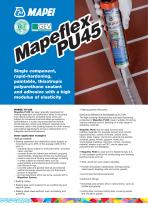
Single component, rapid-hardening, paintable, thixotropic polyurethane sealant and adhesive with a high modulus of elasticity WHERE TO USE Mapeflex PU45 has been specially developed for sealing expansion and distribution joints in horizontal and vertical surfaces, including those which are subject to occasional chemical attack provoked by hydrocarbons. It is also recommended for flexible bonds between similar and different materials most commonly used in the building industry for both internal and external applications and as a replacement or to integrate mechanical fasteners. Some application examples Used as a sealant: • Sealing expansion and distribution joints subject to movements up to 20% of the average width of the joint in: – industrial floors subject to vehicular traffic, including heavy vehicles; – concrete floors for internal and external car-parks, supermarkets, shopping centres and warehouses; – ceramic and stone flooring and coatings, including in areas subject to intense traffic such as supermarkets and industrial environments where fork-lifts are in use; – concrete walls and general internal and external vertical structures where the use of a thixotropic product is required; – old concrete floors which are to be covered with a Mapefloor System. • Sealing general fillet joints. Used as an adhesive at thicknesses up to 3 mm: The high bonding characteristics and rapid-hardening properties of Mapeflex PU45 make it suitable for joining various materials and for bonding on a wide range of substrate materials. Mapeflex PU45 may be used to bond most building materials, for example cement and cementbased products, cellular concrete, natural stone, bricks, steel, copper, aluminium, general pre-painted surfaces, glass, mirrors, gypsum, wood and wood-based materials, ceramics, clinker, insulating material, plastics such as PVC, acrylic glass and polycarbonate and fibreglass. If Mapeflex PU45 is used to form flexible bonds, it is a multi-purpose product for constructing and finishing building works such as: • steel, aluminium and copper cladding; • wooden and plastic baseboards, skirting boards, cable beads, beading rods and corner guards; • pre-formed decorative elements; • bathroom fittings; • Sealing cracks. • Sealing pipe-work systems for air-conditioning and electric cables. • Sealing sheet-steel sections, such as flashing and guttering. • doorsteps and window sills in natural stone, such as marble and granite; • roofing tiles, concave roofing tiles, covering panels and insulation panels.
Open the catalog to page 1
TECHNICAL CHARACTERISTICS Mapeflex PU45 is a single component, thixotropic, easy-to-apply polyurethanebased sealant and adhesive with a high modulus of elasticity, made according to a formula developed in MAPEI’s own R&D laboratories and meets the requirements of ISO 11600 class F20 HM. Solventfree, odourless with a low impact on the environment, Mapeflex PU45 is certified as EC1 R by the GEV Institute as a product with extremely low emission levels of volatile organic compounds. Mapeflex PU45 hardens following its reaction with atmospheric humidity and its special characteristics offers a guarantee...
Open the catalog to page 2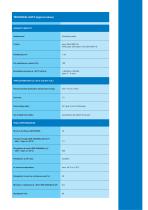
TECHNICAL DATA (typical values) PRODUCT IDENTITY thixotropic paste grey, black (600 ml); white, grey, dark grey (113), black (300 ml) Density (g/cm³): Brookfield viscosity at +23°C (mPa·s): Recommended application temperature range: Final setting after: Set to light foot traffic: according to the depth of the joint FINAL PERFORMANCES Tensile strength (DIN 53504S3a) (N/mm²) – after 7 days at +23°C: Elongation at break (DIN 53504S3a) (%) – after 7 days at +23°C: Elongation in service continuous use (%): Modulus of elasticity at +23°C (ISO 8339) (N/mm²):
Open the catalog to page 3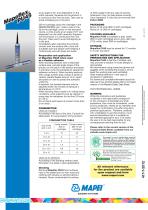
of fresh sealant with any type of solvent, otherwise it may not polymerise correctly. Once hardened, it may only be removed with Pulicol 2000. 300 ml cartridge; place the cartridge in the special extrusion gun, make a hole in the tip of the cartridge, screw on the extrusion nozzle, cut the nozzle at an angle of 45° and dependent on the width required. Squeeze out the product in a continuous flow into the joint. Take care to avoid entrapping air in the joint. Immediately after extruding the product, smooth over the surface with a tool with a suitable size and shape while keeping it continuously...
Open the catalog to page 4All MAPEI catalogs and technical brochures
 GENERAL CATALOGUE_2024
224 Pages
 KERAQUICK S1
4 Pages
 ADESILEX P9 EXPRESS
4 Pages
 PLANITOP 100
4 Pages
 COLORITE PERFORMANCE
6 Pages
 ULTRATOP LOFT F
6 Pages
 ULTRACOLOR PLUS
6 Pages
 keracolorff
4 Pages
 ISOLASTIC
4 Pages
 KERAPOXY
6 Pages
 mapebandpe120
2 Pages
 PRIMER G
4 Pages
 KERAFLEX MAXI S1
4 Pages
 KERABOND T
4 Pages
 ADESILEX P4
4 Pages
 MAPESIL LM
4 Pages
 MAPECOAT I 600W
4 Pages
 WALLGARD BARRIER
4 Pages
 MAPE-ANTIQUE RINZAFFO
4 Pages
 MAPECURE SRA
4 Pages
 LAMPOCEM
4 Pages
 365-epojetlv-gb
4 Pages
 Thermal insulation
60 Pages
 ULTRAFLEX S2 QUICK
4 Pages
 MARBLE & STONE
4 Pages
 Protecting and decorating buildings
193 Pages
 LIGNOBOND
4 Pages
 ULTRABOND ECO S955 1K
4 Pages
 ULTRABOND P902 2K
4 Pages
 ULTRABOND P913 2K
4 Pages
 ULTRABOND P990 1K
4 Pages
 ULTRABOND S997 1K
4 Pages
 FIBERPLAN
4 Pages
 LATEX PLUS
4 Pages
 NIVORAPID
4 Pages
 TOPCEM
4 Pages
 SILWOOD
4 Pages
 MAPEPROOF ESM
4 Pages
 TRIBLOCK P
4 Pages
 ULTRACOAT HIGH TRAFFIC
4 Pages
 ULTRACOAT OIL
2 Pages
 MAPEPLAST LA
4 Pages
 MAPETHERM AR1
4 Pages
 MAPETHERM NET
2 Pages
 ELASTOCOLOR RASANTE SF
4 Pages
 ELASTOCOLOR WATERPROOF
6 Pages
 General catalogue 2017
292 Pages
 FastTrack
24 Pages
 Ultralite range
8 Pages
 Keracolor Flex
2 Pages
 Kerapoxy CQ
2 Pages
 Mapei Coloured grouts
2 Pages
 Ceramic Pocket Guide
82 Pages
 MAPELASTIC TURBO
2 Pages
 PURTOP LINE
2 Pages


Archived catalogs
 RE-CON Zero
6 Pages
 Concrete Admixtures
30 Pages
 Marble and Stone
4 Pages
 Granirapid
4 Pages
 AQUADEFENSE
2 Pages
 Keracolor GG
6 Pages
 Realtà MAPEI
84 Pages
 Realtà Mapei 48
84 Pages
 Realtà Mpaei 46
116 Pages
 Realtà Mapei 43
84 Pages
 Realtà Mapei 45
84 Pages
 Maintenance work on Roads
6 Pages
 Soundproofing Wooden Floorings
15 Pages
 Ceramic Pocket Guide
41 Pages
 MAPEFER 1K
4 Pages
 ADESILEX PA
4 Pages
 ECO PRIM GRIP
4 Pages
 KERAFLEX
4 Pages
 ELASTORAPID
4 Pages
 FUGOLASTIC
4 Pages
 MAPESILENT PANEL
4 Pages
 realta mapei
84 Pages
 MAPEKER RAPID SET FLEX
4 Pages
 MAPEFLEX PU30
4 Pages
 AQUAFLEX ROOF
2 Pages
 Realata Mapei 49
84 Pages
 Realtà Mapei 47
84 Pages
 Mapei et vous 40
36 Pages
 Realtà Mapei 44
84 Pages
 Resin & Cementitious Flooring
22 Pages
 Resilient Adhesives
16 Pages
 WallGard Graffiti BARRIER
4 Pages
 ULTRATOP INDUSTRIAL
4 Pages
 ULTRABOND P980 1K
4 Pages
 MAPEPRIM SP
4 Pages
 ADESILEX P9
4 Pages
 ADESILEX P10
4 Pages
 KERAPOXY SP
4 Pages
 General Catalogue
291 Pages


