- Company
- Products
- Catalogs
- News & Trends
- Exhibitions
POST TENSIONING SYSTEM

POST TENSIONING SYSTEM
Catalog excerpts

BRITISH BOARD OF tAGREMENT Plain 25-40mm Ribbed 25-50mm Carbon only BRITISH BOARD OF lAGREMENT Macalloy Post Tensioning System Macalloy 1030 Macalloy S1030EXPERIENCE INNOVATION QUALITY ETA-07/0046 Carbon 1030 only
Open the catalog to page 1
Macalloy 1030 The Macalloy 1030 Post Tensioning System consists of high tensile alloy steel bars in diameters from 25mm to 75mm, provided with cold rolled threads for part or full length, together with a range of fittings. Bars from 25mm to 40mm diameter obtain their specified properties by cold working. Bars of 50mm and 75mm diameter obtain their specified properties via a quenching and tempering process. Sizes Macalloy bars of standard quality are available in lengths up to 11.8m for diameters between 25mm and 40mm and up to 9.6m for 50mm and 75mm diameter. Greater tendon lengths can be obtained...
Open the catalog to page 2
Steel Quality Macalloy 1030 is a carbon-chrome steel with a composition designed to give the specified properties. All bars are hot rolled. Diameters from 25mm to 40mm are cold worked by stretching. The stretching load and permanent elongation are predetermined by preliminary tests and the properties are monitiored during production to ensure that the bars as supplied comply in all respects with the provisions of BS4486. Bars of 50mm and 75mm diameter are heat treated after rolling at a controlled temperature and time to ensure that the steel achieves the mechanical properties stated in table...
Open the catalog to page 3
Typical stress strain diagram for cold worked Macalloy 1030 bar (25-40mm) Strength The specified characteristic failing loads and 0.1% proof loads for Macalloy and Macalloy S1030 bar steels are given in Table 3. Bars can be supplied with nuts, washers, plates, or couplers as required. All fittings are designed to exceed the failing load of the threaded bars. Quality Control Macalloy operates a quality assurance system complying with the provisions of BS EN ISO 9001. Macalloy 1030 bars are independently approved to the requirements of BS4486. The Macalloy 1030 system up to 40mm is independently...
Open the catalog to page 4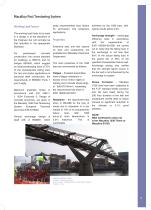
Macalloy Post Tensioning System Working Load Factors The working load factor to be used in a design is at the discretion of the Engineer but will normally be that specified in the appropriate Standard. For prestressed concrete construction, the current standard for buildings is BS8110 and for bridges BS5400, which suggest an initial prestressing force of 70% of the characteristic failing load. For ties and similar applications in structural steel construction, the requirements of BS5950: Parts 1 and 2 apply. Maximum prestress forces in accordance with EN 1992-11: 2004 Eurocode 2: Design of concrete...
Open the catalog to page 5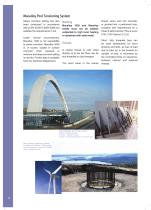
Macalloy Post Tensioning System Stress corrosion testing has also been conducted in accordance with pr EN 10138-4: 2005-2009 and satisfies the requirements in full. Under normal circumstances, Macalloy 1030 is not susceptible to stress corrosion. Macalloy 1030 is, of course, subject to surface corrosion when exposed to moisture and deep corrosion pitting is harmful. Further data is available from the Technical Department. Macalloy 1030 and Macalloy S1030 must not be welded, subjected to high local heating or splashed with weld metal. Threads A coarse thread is cold rolled directly on to the bar....
Open the catalog to page 6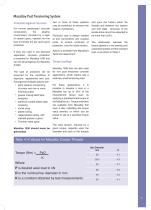
Protection Against Corrosion For normal prestressed concrete construction, the alkaline environment, provided by a layer of cement grout, injected into the duct enclosing the bar gives good protection. If bars are used in any exposed application, corrosion protection is essential for Macalloy 1030 and can be advantageous for Macalloy S1030. The type of protection will be governed by the conditions of exposure, appearance and cost. Amongst the available options are:-• paint systems (comprising of primer and one or more finishing coats) • grease impregnated tape wrapping • adhesive coated plastic...
Open the catalog to page 7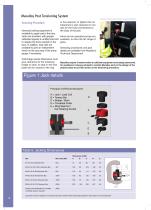
Stressing Procedure Hydraulic jacking equipment is available to apply load to the bars. Jacks are provided, with gauges calibrated against a certified load cell, to register the force exerted on the bars. In addition, load cells are available to give an independent check on the accuracy of the pump gauge, if necessary. Anchorage recess dimensions must give clearance for the stressing bridge or stool, to seat on the end plate and for access to the ring or box spanner, to tighten the nut. Clearance is also required on one axis for the hose connections to the body of the jack. Hand and air operated...
Open the catalog to page 8
nut or threaded plate = 12 for 6mm 16 for 8mm S1 = live end thread L = length over plates
Open the catalog to page 9
Table 7 Reinforcement details Anchorage Zone Reinforcement Bursting tensile forces are induced, in the concrete, immediately behind the anchorage end plates, due to the compressive load applied through the end plates. Reinforcement in the form of links, helices, or a combination of these, should be provided in each end block. The design of the anchorage reinforcement is covered by Section 4.1 of BS8110 and described in greater detail by CIRIA GUIDE 1- June 1976. Macalloy does not design or supply the helical reinforcement. A more detailed explanation of the Macalloy Post Tensioning System, including...
Open the catalog to page 10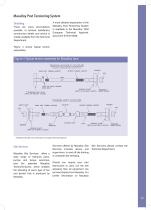
Macalloy Post Tensioning System Detailing There are many permutations possible, to achieve satisfactory construction details and advice is readily available from the Technical Department. A more detailed explanation of the Macalloy Post Tensioning System is available in the Macalloy 1030 European Technical Approval, document ETA-07/0046. Figure 4 shows typical tendon assemblies. Figure 4 Typical tendon assembly for Macalloy bars *Threaded end plate not currently part of European Technical Approval Site Services Macalloy Site Services offers a wide range of hydraulic jacks, pumps and torque wrenches,...
Open the catalog to page 11
Macalloy Post Tensioning System • Stressed connections Applications Macalloy bars were developed, initially, for use in prestressed concrete construction but have been adapted for many structural applications. Among these are:- -concrete to concrete -concrete to steel -steel to steel Prestressed block and brick construction Anchor bolts for tension ties Holding down bolts Friction grip bolts and clamps Hangers Structural steel frame ties Ground and rock anchorages High strength portal, ground or sheet pile ties Temporary or partial prestressing Pile testing Sheikh Zayed Bridge, Contract 3, Abu...
Open the catalog to page 12All Macalloy catalogs and technical brochures
 SHEET PILING SYSTEMS
8 Pages
 TENSION STRUCTURES
16 Pages