


- Products
- Catalogs
- News & Trends
- Exhibitions
Loewe Reference

Loewe Reference
Loewe, a company with a long-standing history in radio engineering since 1923, is renowned for its commitment to quality and innovation. The document highlights Loewe's pioneering role in the first public television broadcast and its ongoing evolution in smart home entertainment.
This section discusses the acoustic excellence of the Loewe Reference, featuring insights from Christoph Franke, Director of Sound for the Berliner Philharmoniker. Key elements of perfect sound include spatial, musical, and emotional experiences, with architecture playing a crucial role in acoustics. The innovative "Digital Concert Hall" is also emphasized.
The design section highlights the unique visual appeal of the Loewe Reference, focusing on the meticulous craftsmanship involved in creating its contrast filter panel at the Berliner Glas factory. The integration of glass in product design is a key feature.
This part explores the picture quality of the Loewe Reference, with insights from photographer Werner Pawlok. Technical aspects contributing to crystal-clear picture quality are discussed, showcasing the TV as a platform for renowned artworks.
The operational highlights emphasize the user-friendly nature of the Loewe Reference, illustrated through anecdotes from a day on the Loewe film set, showcasing seamless technology integration in daily life.
The document concludes with detailed technical specifications of the Loewe Reference, underscoring its high-quality standards and innovative features.
The editorial section reaffirms Loewe's commitment to "Made in Germany" quality, highlighting innovation, precision, and sustainability. Insights from Thomas Günther emphasize the company's zero-defects policy and employee pride in maintaining quality standards.
The "Digital Concert Hall" offers a virtual concert experience, providing global access to Berliner Philharmoniker performances. Despite technological advances, live concerts remain irreplaceable, with no evidence of digital experiences reducing live attendance. The app enhances accessibility across various devices.
Technological advancements have shifted focus from perfect sound systems to portable audio experiences. However, there is a renewed interest in high-quality sound, facilitated by digital transmission and improved recording techniques.
Loewe emphasizes sound quality in its products, integrating advanced features like a soundbar with eight speakers and a 5.1 audio decoder. The Loewe Reference TV offers a complete digital sound chain, minimizing signal noise and enhancing audio precision.
The document details the manufacturing process of Loewe's contrast filter panels, highlighting collaboration with Berliner Glas. The process involves precise grinding and quality checks to ensure high standards in design and functionality.
Dr. Klingel explains the optical finish process for contrast filter panels, crucial for enhancing picture quality by increasing the contrast ratio between light and dark values.
Dr. Kubatz notes that contrast filter panels were first used in televisions around the 1980s to address CRT screen curvature issues. Initially, tinted glass was popular for its aesthetic appeal.
The anti-reflective process involves applying nanometre-thick layers of metal oxides to reduce reflections, significantly enhancing the viewing experience.
After anti-reflective treatment, panels undergo screen printing to apply a border concealing the LCD panel's metal frame. Each panel is inspected under white and black light for imperfections.
Glass is highlighted as a versatile material, ideal for protective panels due to its stability, transparency, and aesthetic appeal.
Loewe's design approach focuses on minimalism and emotional appeal, with the contrast filter panel enhancing both functionality and aesthetics.
Berliner Glas, founded in 1952, has evolved from a glass wholesaler to an international group specializing in phototonics.
The document highlights the intricate processes involved in manufacturing contrast filter panels and the importance of design and material choice in enhancing modern televisions.
Werner Pawlok, a self-taught photographer, shares insights into his artistic journey and philosophy, emphasizing the importance of following one's inspiration.
Pawlok's career began with concert photography, later founding a photo gallery. His work spans various projects, maintaining personal freelance projects.
Pawlok's portfolio includes the "Cuba – expired" series and "views – faces of literature," capturing authors like T.C. Boyle and Salman Rushdie.
Pawlok embraced digital photography early, collaborating with companies like Kodak. He explores new ideas, such as displaying art on TV screens via the LUMAS app.
LUMAS Gallery, founded in 2004, aims to make modern photographic art accessible by offering hand-signed editions at affordable prices.
The LUMAS app allows users to view high-resolution art on TV screens, with Loewe's Ultra High Definition TVs enhancing this experience.
The document discusses advanced features of Loewe TVs, focusing on unique technologies and user-friendly operations.
- Ultra HD Scaling: Enhances Full HD content by converting 1,920 x 1,080 pixels to 3,840 x 2,160 pixels.
- Loewe Image+ Active: Ensures natural sharpness and vibrant colors.
- 3D Active Shutter Technology: Provides an immersive 3D viewing experience.
- Adaptive Display: Adjusts brightness based on ambient light.
- Loewe Mobile and Multi Recording: Allows remote programming and simultaneous recording.
- Loewe Assist Media 2015: Offers an intuitive user interface.
- Instant Channel Zapping: Uses Dual Tuner technology for faster channel switching.
- Smart tv2move App: Turns tablets into secondary TVs.
- Smart Assist App: Transforms smartphones into remote controls.
- Artist Search Feature: Enhances music discovery.
Loewe combines aesthetics with functionality, providing a seamless viewing experience through innovative technology and design.
The document provides a detailed description of the Loewe Reference television and sound systems, highlighting innovative functionalities and connectivity options.
- Mobile Recording: Allows remote scheduling of recordings.
- Bluetooth Connectivity: Enables high-quality music playback from smartphones or tablets.
- Pause and Record Functions: Allows pausing live programs and recording shows.
- Streaming and Multiroom Features: Supports streaming content to multiple Loewe TVs.
- Display: Ultra HD resolution with LCD technology, available in 85-inch and 55-inch models.
- Audio: Equipped with a soundbar and integrated 5.1 AV-Receiver.
- Connectivity: Includes multiple HDMI ports and LAN/WLAN connectivity.
- Energy Efficiency: The 55-inch model is rated with an EU energy efficiency class B.
- Mounting Solutions: Various stands and wall mounts available.
- Sound Systems: Includes Reference, Stand, and Satellite Speakers.
The Loewe Reference series combines advanced technology with user-friendly features, offering a versatile and high-quality entertainment solution.
The document outlines the specifications of a sound system featuring power amplifiers, bass control, and more, with a total output of 800 W.
The system includes a digital audio link cable and other accessories.
The system weighs approximately 24.0 kg.
Loewe, established in 1923, has a rich history of innovation in the television industry, known for minimalist designs and continuous software updates.
Colors in device illustrations may vary due to different printing processes. Loewe products are intended for private use, with no guarantee on Internet services.
Catalog excerpts
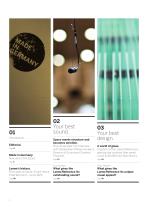
01 Introduction. Editorial. Page 4 Made in Germany. Now and in the future. 02 Your best sound. Space meets structure and becomes emotion. How do we hear? An interview with the Berliner Philharmoniker’s Director of Sound and Creative Producer. Page 10 03 Your best design. A world of glass. Creation of the Loewe Reference’s spectacular contrast filter panel: a visit to the Berliner Glas factory. Page 24 Page 5 Sound highlights. Design highlights. Loewe’s history. From past to future: Smart Home Entertainment – since 1923. What gives the Loewe Reference its outstanding sound? What gives the Loewe Reference...
Open the catalog to page 2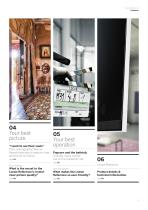
Loewe Reference. Contents. 04 Your best picture. “I want to see their souls” Click: photographer Werner Pawlok talks about creative crises and the art of chance. Page 34 05 Your best operation. Popcorn and the bathtub. One day, many scenes: live on the Loewe film set. Page 50 Picture highlights. What is the secret to the Loewe Reference’s crystalclear picture quality? Page 44 Operating highlights. What makes the Loewe Reference so user-friendly? Product details & technical information.
Open the catalog to page 3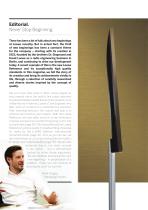
Editorial. Never Stop Beginning. There has been a lot of talk about new beginnings at Loewe recently. But in actual fact, the thrill of new beginnings has been a constant theme for the company – starting with its creation in 1923, founded by the brothers Dr. Siegmund and David Loewe as a radio engineering business in Berlin, and continuing to drive our development today. A recent example of this is the new Loewe Reference and its exceptionally high quality standards. In this magazine, we tell the story of its creation and bring its achievements vividly to life, through a selection of carefully...
Open the catalog to page 4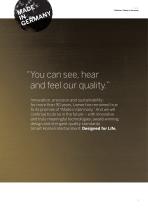
Loewe. Editorial. / Made in Germany. “ ou can see, hear Y and feel our quality.” Innovation, precision and sustainability: for more than 90 years, Loewe has remained true to its promise of “Made in Germany”. And we will continue to do so in the future – with innovative and truly meaningful technologies, award-winning design and stringent quality standards. Smart Home Entertainment: Designed f
Open the catalog to page 5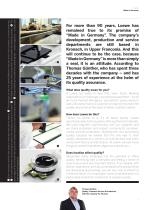
Each individual contrast filter panel is inspected manually for defects. 2 The prototype for the new Loewe Reference was also built in the company’s in-house workshop. All Loewe televisions are produced by hand in the company’s factory in Kronach. 4 The higher the quality of the components, the smoother the assembly process. 5 The glass edges of the contrast filter panel are checked carefully for even the tiniest cracks. 6 Always watching: the distinctive operating eye – Loewe’s signature – is added just before the final inspection. Loewe. Made in Germany. For more...
Open the catalog to page 7
Perfect sound. Interview. Space meets structure and becomes emotion. An interview with Christoph Franke, Director of Sound and Creative Producer with the Berliner Philharmoniker. Acoustics is the study of sound and its dissemination. Quite straightforward so far, in theory at least. However, complexities immediately emerge as soon as we attempt to describe the perception and effect of sound, for example music. Voluminous, powerful, light, clear, muffled or precise ... it all becomes very subjective, as we each hear and perceive something different. So how can we define perfect sound? Does such...
Open the catalog to page 11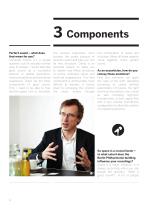
3 Components Perfect sound – what does that mean for you? Christoph Franke: It’s a simple question, but it’s actually not that easy to answer. I would describe good sound as a successful balance of spatial experience, musical experience and emotional experience. These are the three components of good sound. First, I need to be able to truly feel the space I am in. Secondly, the musical experience must surpass the purely physical or acoustic realm and take you into its very structure. Clarity is an essential aspect, to allow you to discern and follow structures of scores, individual voices and...
Open the catalog to page 12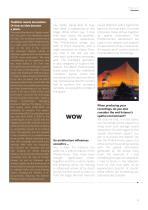
Perfect sound. Interview. Tradition meets innovation. Or how an idea became a place. The seed of the idea for a “digital concert hall” was sown in the Taiwanese capital of Taipei. The orchestra’s performance was being transmitted simultaneously to a video screen outside the concert hall. At the end of the concert, the musicians stepped outside to rapturous applause from an assembled 20,000 music enthusiasts. “We were overwhelmed by the experience, that was what started it all.” Even now, reliving the moment still brings a sparkle to the eyes of Olaf Maninger, Principal Cellist with the Berliner...
Open the catalog to page 13
On the “Digital Concert Hall” website, it states that you aim to “convey an authentic concert hall experience”. What do you mean by this? In the context of our recordings, authenticity involves imagining an “ideal seat” and using this as the basis for the creation of an artificial listening situation that makes the listener at home feel as if he or she is there in the concert hall. Of course, the sound experience is different if you are actually sitting in the Philharmonie, that’s obvious. The aim of our recordings is to make the media barrier – the sound is conveyed to you through speakers rather...
Open the catalog to page 14
Perfect sound. Interview. Does it enhance or detract from the appeal? There is no comparison between the live experience in the Philharmonie and the experience in front of a television or computer. Attending a concert feels completely different to sitting in front of your TV and following the cameras as they pan over the different instruments. We have also seen no evidence of any cannibalisation effect between the “Digital Concert Hall” and live concerts. Nobody has said, “That’s it, I don’t need to go concerts any more. I can listen to the Berliner Philharmoniker at home now”. There is room...
Open the catalog to page 15All Loewe catalogs and technical brochures
 Loewe bild c.32 datasheet
2 Pages
 Loewe iconic datasheet
4 Pages
 Loewe klang sub5 datasheet
4 Pages
 Loewe-catalogue-2023.pdf
32 Pages
 Loewe bild 3.43
3 Pages
 Loewe bild v dr+
2 Pages
 Loewe bild i
4 Pages
 Loewe bild s.77
2 Pages
 Loewe bild c
2 Pages
 Loewe bild 5.65 oled
3 Pages
 Loewe bild 5.55 oled
3 Pages
 Loewe bild 7.65
2 Pages
 Loewe bild 7.77
2 Pages
 Loewe bild 7.55
2 Pages
 Loewe klang 1
1 Page
 Loewe klang 5
1 Page
 Loewe klang m1
1 Page
 Loewe bild 2.43
2 Pages
 Loewe bild 5.32
2 Pages
 Loewe bild 1
4 Pages
 Loewe bild 3
4 Pages
 Loewe bild 5
4 Pages
 Loewe bild 5 oled
4 Pages
 Loewe bild 7
4 Pages
 Fascinerend. Anders.
4 Pages
 Loewe Individual Slim Frame
32 Pages
 Loewe Art
40 Pages
 Loewe 3D Orchestra
19 Pages
 Loewe Connect
44 Pages
 reference id
38 Pages
 GENERAL CATALOGUE
127 Pages

Archived catalogs
 GENERAL CATALOG 2011
127 Pages