


K18

K18
Catalog excerpts
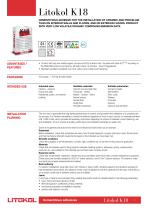
Litokol K18 CEMENTITIOUS ADHESIVE FOR THE INSTALLATION OF CERAMIC AND PORCELAIN TILES ON INTERIOR WALLS AND FLOORS, AND ON EXTERIOR FLOORS. PRODUCT WITH VERY LOW VOLATILE ORGANIC COMPOUND EMISSION RATE. ADVANTAGES / FEATURES • Product with very low volatile organic compound (VOC) emission rate. Complies with class EC1PLUS according to the EMICODE protocol and class A+ (Émission dans l’air intérieur - French Regulations) • Maintains excellent workability over time, without any bothersome thickening 20 kg bags - 1,200 kg standard pallet Intended uses Interiors - exteriors Floors and walls Residential, public, commercial building INSTALLATION PLANNING The only way to guarantee the long-lasting performance of ceramic and porcelain tile installations is to properly plan the process. It is therefore advisable to consult the national regulations in force in each country, for example standard UNI 11493 in Italy, which provides all necessary instructions regarding the choice of materials, correct planning, use and installation, so as to ensure all quality, performance and durability standards are safely met. Suitable materials Ceramic and porcelain tiles Terracotta - Clinker Marble – Granite – Stone Natural stones Double fired Single fired Porcelain stoneware Suitable substrates Cement screeds Self-levellers Skim coats Plasters Concrete Gypsum Gypsum and anhydrite Some of the general precautions that need to be followed are listed below as an example. Substrates Before installation, check that substrates are clean, free of loose fragments, properly dried and cured, flat and level, and that mechanical strength requirements based on the intended use have been met. Worksite conditions Check the suitability of the temperature, humidity, light conditions etc. at the time of the product’s application. Materials Check that all materials used for tiling (ceramic materials, levelling systems, adhesives, grouts, waterproofing products, etc.) are suitable for the intended use and have been correctly stored. Expansion joints Check that the perimeter, expansion, divider and structural elastic joints have been correctly designed and prepared. Divider joints are normally needed for 20/25 m2 indoor sections, and 9-15m2 outdoor sections. For exteriors, make sure joints are properly waterproofed and sealed. Back-buttering For exterior installations, large tiles, floors with intense or heavy traffic, vibrating supports and situations exposed to high temperature fluctuations, the adhesive mortar must be applied to both the substrate and the back of the tiles so as to obtain a solid bed of adhesive without any air bubbles. Joints In any type of ceramic and porcelain tiling, suitably sized joints must be created based on the following parameters: • Type, format and size tolerance of tiles • thermal expansion coefficients of tiling materials • mechanical properties of installation materials • position and trajectory of joints Cementitious adhesi
Open the catalog to page 1
• mechanical features of substrate • Intended use and operating conditions Butt joints are not allowed. Any plastic spacers must be removed before grouting. For example, it can also be used to install suitable materials in the following areas: Interior floors in residential and public/commercial settings (pedestrian areas) Substrates Cement or Litocem/Litocem Pronto-based non-heating screeds Sulphate-based (anhydrite) non-heating screeds (1) Interior walls in residential, public/commercial and industrial settings Substrates Lime/cement plaster Gypsum-based plaster (1) Fibre cement and cement...
Open the catalog to page 2
Spread the mix onto the substrate using the smooth part of the trowel to create a layer approximately 1 mm thick. Immediately afterwards, apply the product using the notched part of the trowel. The trowel notch size will depend on the size of the tiles. A back coverage of 65-70% of slabs is nonetheless required for interior installations, and 100% of slabs for exterior installations or floors subject to heavy traffic. In exterior installations or areas subject to high stress, the adhesive should also be applied to the back of the slabs (back-buttering method). The tiles must be laid on the adhesive...
Open the catalog to page 3
Powered by TCPDF (www.tcpdf.org) ITEM SPECIFICATION #Ceramic and porcelain floor and wall coverings will be installed using a normal cementitious adhesive in class C1 according to EN 12004, such as Litokol K18 by Litokol S.p.A. IDENTIFICATION DATA Appearance Colour Customs code Shelf life Powder White 38245090 12 months in original packaging in a dry place. APPLICATION DATA Mix ratio Mix ratio Consistency of mix Mix curing time pH of mix Specific gravity of mix Bonding time Pot life Applicable thicknesses Application Application temperatures Waiting time for grouting Set to light foot traffic...
Open the catalog to page 4All LITOKOL catalogs and technical brochures
 Aquamaster EVO
24 Pages
 Ottoseal S105
4 Pages
 Litoacril LA315
4 Pages
 Litoacril LA201
4 Pages
 Litoacril Fix
4 Pages
 Rapidflex K91
5 Pages
 Litorapid K90
5 Pages
 Hyperflex K100
6 Pages
 Superflex K77
6 Pages
 Powerflex K50
5 Pages
 Litoplus K55
6 Pages
 Litoflex Pro K80
7 Pages
 X12
X125 Pages
 X11
X115 Pages
 K17
K175 Pages
 Litoplan Smart
3 Pages
 Litoliv Express
3 Pages
 Litoliv Extra 15
3 Pages
 Litoliv S40 Eco
3 Pages
 Litocem Pronto
4 Pages
 Litocem
4 Pages
 BattiSpazio
3 Pages
 ResinaArredo EVO
5 Pages
 SpazioMateria EVO
4 Pages
 SpazioChiaroscuro EVO
4 Pages
 SpazioLamina EVO Perlato
5 Pages
 SpazioLamina EVO Crudo
5 Pages
 SpazioLamina EVO CORTEN
5 Pages
 SpazioCemento EVO
5 Pages
 SpazioResina EVO
5 Pages
 STARLIKE EVO FINISHES
5 Pages
 Osmogrout
4 Pages
 Elastocem
6 Pages
 Coverflex
6 Pages
 Litoband S.A.T.
3 Pages
 Litosil MS
2 Pages
 Consolidante Universale EVO
4 Pages
 Faster EVO
2 Pages
 Litotex
3 Pages
 Multifondo EVO
6 Pages
 Litoside
2 Pages
 Litogap
2 Pages
 Litostick X35
2 Pages
 Hydrolux EVO
5 Pages
 Prepara Fondo EVO
3 Pages
 Primer C
2 Pages
 Primer X94
3 Pages
 Concrete Primer
2 Pages
 Idrostuk
4 Pages
 Latexkol
4 Pages
 Idrokol X20
3 Pages
 Litoswell
3 Pages
 Litostop Water
2 Pages
 Litoband Koll
3 Pages
 Litomesh
2 Pages
 Litoproof Extreme
7 Pages
 Litoband Basic
3 Pages
 LITOBAND SK PIPES COLLAR
3 Pages
 LITOBAND SK IC & EC
3 Pages
 Litoband
2 Pages
 Litoproof Plus
8 Pages
 Litoband SK Net
3 Pages
 Litoband SK Tape
3 Pages
 Primer SK
3 Pages
 Primer F
3 Pages
 Hidroflex
6 Pages
 Litoscrub EVO
2 Pages
 Litoshine EVO
2 Pages
 Litostain Cleaner
2 Pages
 Litogrip Floor
2 Pages
 Litowax
2 Pages
 Litocare Stone Glossy
2 Pages
 Litostone Protector
2 Pages
 Litogres Protector
2 Pages
 Litocare Matt
3 Pages
 Litoseal Terrazze
2 Pages
 Litostrip
2 Pages
 Litonet Pro
2 Pages
 FillCleaner EVO
2 Pages
 Litonet Gel EVO
2 Pages
 Litonet EVO
2 Pages
 Litoclean EVO
2 Pages
 Litoclean
2 Pages
 X-GLM SMOOTHING
2 Pages
 X-GL SMOOTHING
2 Pages
 OTTO Cleaner T
2 Pages
 OTTO Primer 1217
2 Pages
 OTTO Cleanprimer 1101
2 Pages
 OTTO Primer 1218
2 Pages
 OTTO Primer 1105
2 Pages
 OTTO Primer 1216
2 Pages
 Ottocoll M501
3 Pages
 Ottocoll M500
4 Pages
 Ottoseal S125
4 Pages
 Ottoseal S117
4 Pages
 Ottoseal S34
4 Pages
 Ottoseal S70
4 Pages
 Ottoseal S100
4 Pages
 Defender EVO
3 Pages
 StyleGrout 3-20
5 Pages
 StyleGrout 0-8
5 Pages
 StyleGrout Tech
5 Pages
 Grouts FillGood EVO
7 Pages
 EpoxyElite EVO FR
7 Pages
 Grouts EpoxyElite EVO
8 Pages
 StenDecor
3 Pages
 Starlike Decor
5 Pages
 Starlike ColorCrystal EVO
7 Pages
 Starlike Crystal EVO
7 Pages
 Grouts STARLIKE EVO
10 Pages
 Litoelastic EVO FR
6 Pages
 Litoelastic EVO
6 Pages
 Litoacril Plus
4 Pages
 ETR
ETR1 Page
 EAT
EAT1 Page
 ETA
ETA1 Page
 ERA
ERA1 Page
 TDP - TDF
1 Page
 ESA - EFA
1 Page
 GC28
GC281 Page
 MCA, MCB, MCS
2 Pages
 MLB
MLB1 Page
 RSS
RSS1 Page
 RAD
RAD1 Page
 RAA
RAA1 Page
 RUA - RSA
1 Page
 TGA
TGA1 Page
 TCS
TCS1 Page
 TSC
TSC1 Page
 TAV
TAV1 Page
 TAS
TAS1 Page
 LITOTEX EXTREME
9 Pages
 EpoxyÉlite EVO
9 Pages
 LitoJoint EVO
7 Pages
 LITOSIL
11 Pages
 SPAZIOCONTINUO LE RESINE DI LITOKOL
100 Pages
 DS_SpazioMateria EVO_grb
4 Pages
 DS_Defender EVO_grb
2 Pages
 FillGood EVO
17 Pages
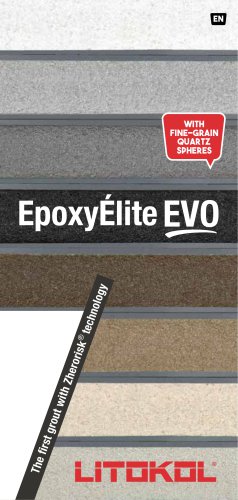 EpoxyElite EVO the first grout
21 Pages
 Starlike EVO
34 Pages
 Spaziocontinuo
100 Pages
 StyleGrout
25 Pages
 LITOLEVEL
2 Pages
 UserCatalogue
113 Pages
 Aquamaster Leaflet
12 Pages




- Litokol coating
- Building coating
- Litokol indoor coating
- Litokol wall coating
- Waterproofing membrane
- Litokol edge trim
- Roll waterproofing membrane
- Litokol decorative coating
- Plastic waterproofing membrane
- Protection waterproofing membrane
- Baseboard
- Litokol tile edge trim
- Litokol indoor primer
- Litokol aluminum edge trim
- Litokol sealant
- Smooth coating
- Protective coating
- Litokol outdoor primer