
- Catalogs
- Listone Giordano
- GUIDE TO THE CHOICE

- Products
- Catalogs
- News & Trends
- Exhibitions
GUIDE TO THE CHOICE
GUIDE TO THE CHOICE
The document explores the evolution and technical aspects of hardwood flooring, focusing on innovations by Margaritelli Company and Professor Guglielmo Giordano. It addresses traditional wood flooring challenges and advancements for improved stability and durability.
Traditional wood flooring faces issues like deformation due to humidity. Margaritelli Company developed a new system to enhance stability, informed by laboratory tests.
The "Listone Giordano" is a patented two-layered system with a wood top layer and multi-layered support, offering enhanced stability and resistance to environmental changes.
Wood's anisotropic nature affects its mechanical properties. Understanding wood's reaction to humidity is crucial for its technological use in flooring.
The history of wood flooring is traced from the 1600s to modern advancements like the Listone Giordano, which offers improved aesthetics and practicality.
The document compares solid wood, mosaic, lamparquet, and floating wood floors, highlighting the advantages of the Listone Giordano system.
Advancements in wood flooring technology, particularly the Listone Giordano, represent a significant leap forward in addressing traditional challenges.
The two-layered flooring consists of a hardwood top layer and a birch plywood support base, providing stability and resistance to expansion and contraction.
The design ensures stability through precise milling, resulting in a level surface that remains stable over time, with a lifespan of over 100 years.
The stability allows for larger boards, enhancing aesthetic appeal and maintaining a clean appearance.
The flooring can be varnished industrially, eliminating dust and smells, and is usable immediately after installation.
The product uses sustainable materials and non-toxic varnish, ensuring environmental friendliness.
Various product lines cater to different aesthetic preferences and technical requirements.
The Corona Single 70 is known for reliability and elegance, crafted from high-quality materials to preserve wood's authentic properties.
The flooring has a total thickness of 9.5 mm, with a hardwood top layer of 3.5 mm, available in various wood species.
Each species has unique characteristics, such as hardness and color stability.
Several finishes enhance the wood's appearance and durability, with options like natural oils for protection.
Professional services are available, with specific cleaning products for different finishes.
The product is environmentally friendly, with certifications ensuring sustainable management.
Wood color changes over time due to light exposure, influenced by extractives in the wood.
The document outlines compliance with formaldehyde emission standards and confirms the products are solvent-free.
Subfloors must meet specific conditions, and installation over underfloor heating is permissible under strict conditions.
Installation should occur after construction work, with stable environmental conditions.
Hardwood is a "living material" subject to environmental changes, with natural color changes and grain patterns.
The document is non-binding, emphasizing that natural characteristics of hardwood should not be considered defects.
Catalog excerpts
GUIDE TO THE CHOICE OF A HARDWOOD FLOOR
Open the catalog to page 1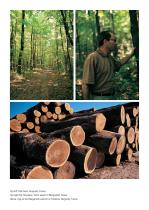
Top left: Oak forest, Burgundy, France. Top right: Mr. Rousselin, forest expert of Margaritelli France Above: Logs at the Margaritelli sawmill in Fontaines, Burgundy, France.
Open the catalog to page 2
Occasionally, a certain technical problem finds an unexpected solution in an idea nobody had paid attention to before. Wood has always been used for flooring, but this use, however traditional, is not immune to certain inconveniences due to the movements of wood as a result of changes in air humidity. This problem was often discussed during meetings with the Directors and technicians of the Margaritelli Company. When I informed them about the results of a series of laboratory tests, they agreed to place their materials and necessary equipment at my disposal to investigate a possible industrial...
Open the catalog to page 3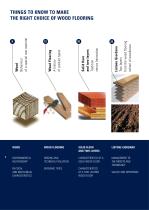
Solid floor and two layers Tradition versus Innovation Listone Giordano Two layers from the wood flooring school of excellence Wood Flooring A history of product types Wood Behaviour of a special raw material THINGS TO KNOW TO MAKE THE RIGHT CHOICE OF WOOD FLOORING WOOD FLOORING Solid floor and two layers Environmental Relationship Origins and technical evolution Characteristics of a solid wood floor Management of the forests and technology Physical and mechanical characteristics Differing types Characteristics of a two layered wood floor
Open the catalog to page 4
Wood flooring installed Where to use it Professional wood flooring Listone Giordano showrooms Collection The answer to every need Professional wood flooring wood flooring AT HOME Product Range Species, grades & finishes
Open the catalog to page 5
Above: Intermediate growth stage of the Forest of Cîteaux, Burgundy, France. Left: Oak from Fontaines (Versailles pattern).
Open the catalog to page 7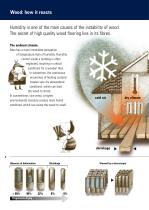
Wood: how it reacts Humidity is one of the main causes of the instability of wood. The secret of high quality wood flooring lies in its fibres. The ambient climate. Man has a more immediate perception of temperature than of humidity. Humidity control inside a building is often neglected, resulting in critical conditions for a wooden floor. In wintertime, the continuous occurrence of heating systems creates very dry atmospheric conditions, which can lead the wood to shrink. In summertime, vice versa, a higher environmental moisture creates more humid conditions which can cause the wood to swell....
Open the catalog to page 8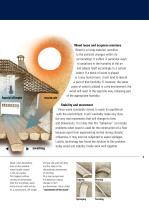
humid climate Wood loses and acquires moisture Wood is a living material, sensitive to the constant changes within its surroundings. It suffers in particular ways to variations in the humidity of the air and adapts itself accordingly to a certain extent. If a piece of wood is placed in a very humid room, it will tend to absorb a part of that humidity. If, however, the same piece of wood is placed in a dry environment, the wood will react in the opposite way, releasing part of the appropriate humidity. Stability and movement Since wood constantly strives to reach its equilibrium with the environment,...
Open the catalog to page 9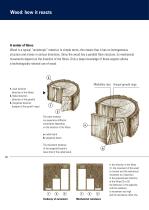
A matter of fibres Wood is a typical “anisotropic” material. In simple terms, this means that it has no homogeneous structure and moves in various directions. Since the wood has a parallel fibre structure, its mechanical movements depend on the direction of the fibres. Only a deep knowledge of these aspects allows a technologically rational use of wood. Medullary rays Annual growth rings 1. Axial direction (direction of the fibres) 2. Radial direction (direction of the growth) 3. Tangential direction (tangent of the growth rings) 1 3 The same material can experience different movements depending...
Open the catalog to page 10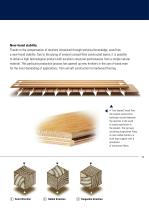
New-found stability Thanks to the compensation of tensions introduced through technical knowledge, wood has a new-found stability. Due to the gluing of several crossed-fibre constructed layers, it is possible to obtain a high technological product with excellent structural performances from a simple natural material. This particular production process has opened up new frontiers in the use of wood even for the most demanding of applications, from aircraft construction to hardwood flooring. A “two layered”wood floor: the original construction technique counter-balances the tensions in the wood...
Open the catalog to page 11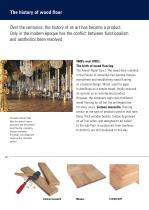
The history of wood floor Over the centuries, the history of an art has become a product. Only in the modern époque has the conflict between functionalism and aesthetics been resolved. 1600’s and 1700’s. The birth of wood flooring. The French Royal Court. The wood floor installed in the Palace of Versailles has become famous everywhere and establishing wood flooring as a feature design. Wood, used for ages in dwellings as a simple board, finally received its acclaim as an architectural product. However, the extremely high cost prohibited wood flooring for all but the privileged few for many years....
Open the catalog to page 12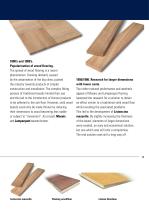
1800’s and 1900’s. Popularisation of wood flooring. The spread of wood flooring is a recent phenomenon. Growing demand, caused by the urbanisation of the big cities, pushed the industry towards products of simpler construction and installation. The complex fitting process of traditional boards limited their use and this led to the introduction of thinner products to be adhered to the sub-floor. However, solid wood boards could only be made thinner by reducing their dimensions to avoid becoming less stable or subject to “movement”. As a result, Mosaic and Lamparquet became known. 1950/1980. Research...
Open the catalog to page 13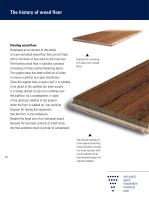
The history of wood floor Floating wood floor Developed as an answer to the needs of a pre-varnished wood floor that can be fitted with a minimum of fuss even by the final user. The floating wood floor is typically a product consisting of three counter-balancing layers. The support base has been milled on all sides to ensure a perfect join upon installation. Since the support base is quite rigid, it is suitable to be glued to the subfloor but more usually it is simply placed on top of an underlay over the subfloor. As a consequence, in spite of the optimum stability of the product, when the floor...
Open the catalog to page 14All Listone Giordano catalogs and technical brochures
 Classica
70 Pages
 INFORMATION SHEET
20 Pages
 Outdoor Catalog
27 Pages
 Contract Catalogue
69 Pages
 Catalog CLASSICA
70 Pages
 One 20 Biscuit
7 Pages
 Outdoor
33 Pages
 Natural Genius
80 Pages
 Atelier
76 Pages
 Cat_VerdeOriginale
56 Pages
 ListoneGiordano_Cat_2012
124 Pages

Archived catalogs
 LG_NG_CatSint_2012_visualiz
31 Pages
 MINI-CATALOGUE LISTONE GIORDANO
13 Pages
 Brochure
29 Pages
 bagno
bagno33 Pages
 boisierie
64 Pages
 GUIDE
GUIDE68 Pages
 COLLECTIONS
51 Pages
- Industrial wood floor
- Glued parquet flooring
- Engineered parquet flooring
- Indoor flooring
- Oak parquet floor
- Strip parquet floor
- Floating parquet floor
- Oiled parquet flooring
- Home parquet flooring
- Brushed parquet flooring
- Living room parquet flooring
- Domestic use flooring
- Commercial parquet flooring
- Gray flooring
- Commercial flooring
- FSC certified parquet flooring
- PEFC certified parquet floor
- Grooved parquet flooring
- Brown flooring