


Deep Foudation Work

Deep Foudation Work
This document provides a comprehensive overview of solutions for deep foundation work, focusing on various drilling and piling methods, equipment characteristics, and soil improvement techniques.
The document outlines several drilling methods suitable for different soil conditions and project requirements, including Kelly Drilling, Continuous Flight Auger Drilling, Full Displacement Drilling, Double Rotary Drilling, Drilling with Bored Pile Grab, and Down-the-Hole Drilling.
Pile driving involves installing and extracting piling elements, with methods divided into Impact Driving and Vibrating, suitable for urban areas due to low noise and vibration.
Slurry walls are deep wall structures for static or sealing functions, using methods like Mechanical Slurry Wall Grabs, Hydromills, and Hydraulic Slurry Wall Grabs.
Soil improvement enhances load-bearing capacity and reduces compressibility, using methods such as Dry Soil Mixing, Deep Compaction Using Vibro-Flotation, Deep Compaction Using Vibro-Replacement, Wet Soil Mixing, Cutter Soil Mixing, and Impact Compaction.
The LB series offers versatile drilling rigs for various applications, featuring configurations for different soil conditions, compact design, high stability, and efficient drive systems.
The LB series can be equipped with various attachments and tools for specific drilling needs, including Casing Oscillator, Rotary Drive, Double Rotary Drive, and Drilling Tools.
The document provides a comprehensive overview of Liebherr's solutions for deep foundation work, focusing on various drilling and piling rigs, their specifications, and applications.
The LRB series includes models like LRB 355, LRB 355 XL, LRB 16, and LRB 18, each with specific weight, torque, pile length, and engine power. The LRH series features models like LRH 100 and LRH 600.
The document outlines the use of various drilling tools and describes the application of hydraulic hammers, vibrators, and rotary drives for different soil conditions and foundation requirements.
Key innovations include the rigid leader design, parallel kinematics, and robust undercarriage for stability. The modular leader top and compact uppercarriage enhance flexibility and efficiency.
The document details various attachments like hydraulic hammers, vibrators, rotary drives, and casing oscillators.
Emphasis is placed on the modular design of equipment for easy transportation and quick setup.
Liebherr's deep foundation solutions are characterized by their versatility, efficiency, and innovative design.
The document provides detailed information on Liebherr's duty cycle crawler cranes, specifically the HS series, designed for deep foundation work.
The document lists specifications for different models, including maximum capacity, transport weight, and dimensions.
Features include hydraulic free-fall winches, self-assembly system, and high safety standards.
The cranes are equipped with the Litronic control system, offering user-friendly interfaces and various assistance systems.
The HS series supports various attachments for deep foundation work.
The cranes are designed for easy transportation and quick setup.
The operator's cabin is designed for comfort and efficiency.
Liebherr cranes incorporate features to reduce fuel consumption.
Liebherr's duty cycle crawler cranes are engineered for high performance in deep foundation work.
Liebherr-Werk Nenzing GmbH aims to optimize job-site processes through networking and digitization.
Liebherr offers real-time information, machine and process data, online display and recording, and assistance systems.
Includes Crane Planner 2.0, LiSIM®-Simulators, LIPOS®, LiDAT®, and PDE®/PDR2.
Liebherr offers comprehensive customer service to maintain equipment and maximize machine benefits.
Includes advice and support, global service network, preventive measures, application technology, and original spare parts.
Includes Reman Program and Retrofits, and Technical Support.
The Liebherr Group is a leading construction equipment manufacturer with a wide product range.
Catalog excerpts
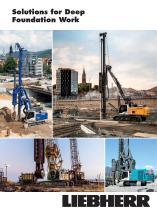
Solutions for Deep Foundation Work
Open the catalog to page 1
04 Solutions for Deep Foundation Work Drilling Methods Pile Driving Methods Slurry Wall Installation Soil Improvement 12 Drilling Rigs LB Series Characteristics Attachments Drilling Tools 18 Piling and Drilling Rigs LRB Series Characteristics Attachments
Open the catalog to page 2
24 Piling Rigs LRH Series Characteristics Swinging Leader Attachments Duty Cycle Crawler Cranes HS Series Characteristics Attachments Features Transportation and Set-up Control and Assistance Systems Operator Comfort Fuel Costs Matter IT Solutions Customer Service and Application Technology
Open the catalog to page 3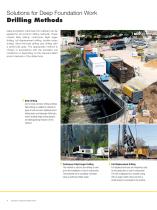
Solutions for Deep Foundation Work Drilling Methods Deep foundation machines from Liebherr can be applied for all common drilling methods. These include Kelly drilling, continuous flight auger drilling, full displacement drilling, double rotary drilling, down-the-hole drilling and drilling with a bored pile grab. The appropriate method is chosen in accordance with the prevalent soil conditions or depending on the required depth and/or diameter of the drilled hole. Kelly Drilling As the most common drilling method, Kelly drilling is suitable for almost all types of soil and rock. Relatively short...
Open the catalog to page 4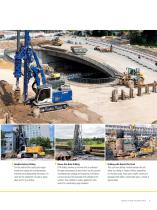
Double Rotary Drilling For this method the casing and auger (inside the casing) are simultaneously inserted and subsequently extracted. It is used for the production of cast-in-place piles and for pre-drilling. Down-the-Hole Drilling DTH drilling involves a hammer that is activated through compressed air and driven into the ground simultaneously rotating and impacting. A flushing current conveys the loosened drill cuttings to the surface. This method is mainly applied for rock and/or for penetrating large boulders. Drilling with Bored Pile Grab This common drilling method loosens the soil either...
Open the catalog to page 5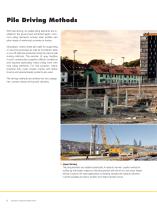
Pile Driving Methods With pile driving, so-called piling elements are installed in the ground and extracted again. Common piling elements include steel profiles and piles made of reinforced concrete or timber. Nowadays, mainly sheet pile walls for supporting or securing purposes as well as foundation piles or cut-off walls are produced using the various pile driving methods. The erection of quay facilities in port construction presents difficult conditions and requires particularly heavy piling work with long piling elements. For this purpose, mainly powerful duty cycle crawler cranes with lattice...
Open the catalog to page 6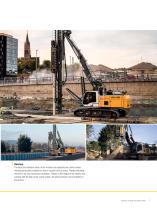
Vibrating The noise and vibration levels of this method are especially low, which makes vibrating particularly suitable for work in heavily built-up areas. Thereby the piling element is set into harmonious oscillation. Thanks to the weight of the vibrator and pushing with the help of the crowd system, the piling element can be installed in the ground. Solutions for Deep Foundation Work
Open the catalog to page 7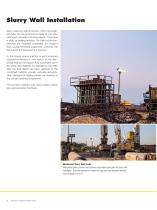
Slurry Wall Installation Slurry walls are wall structures, which are installed deep into the ground and made of concrete, reinforced concrete or binding agents. They have a static or sealing function. For their production, trenches are modularly excavated and support fluid, usually bentonite suspension, prevents the soil around the trenches from caving in. In the single phase method a self-hardening suspension remains in the trench. In the twophase method the support fluid is pumped out of the trench and replaced, for example by concrete, after the final depth has been reached. In the combined method,...
Open the catalog to page 8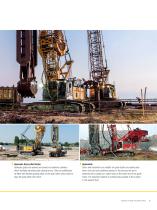
Hydraulic Slurry Wall Grabs Hydraulic grabs are opened and closed via hydraulic cylinders, which facilitate extremely high closing forces. They can additionally be fitted with flexible guiding strips on the grab frame which allow to align the grab within the trench. Hydromills Slurry wall hydromills are suitable for great depths and particularly when very hard soil conditions prevail. In the process the soil is loosened and crushed by a cutter head on the lower end of the guide frame. The loosened material is continuously pumped to the surface in the support fluid. Solutions for Deep Foundation...
Open the catalog to page 9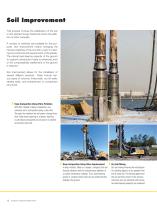
Soil Improvement This process involves the stabilization of the soil on the jobsite through treatment and/or the addition of other materials. A number of methods are available for this purpose. Soil improvement means changing the natural properties of the soil with a view to meeting the constructional requirements of the jobsite. The natural load-bearing capacity of the ground to support construction loads is enhanced and/ or the compressibility (settlement) of the ground is reduced. Soil improvement allows for the installation of several different products. These include various types of columns,...
Open the catalog to page 10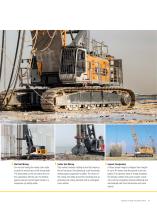
Wet Soil Mixing For wet soil mixing the mixing tools rotate around the vertical axis of the mixing shaft. The tools break up the soil matrix and mix the suspension with the soil. The binding agents used are cement types mixed to a suspension by adding water. Cutter Soil Mixing This method involves rotating drums that break up the soil structure. Simultaneously a self-hardening binding agent suspension is added. The drums of the mixing tool rotate around the horizontal axis so producing soil mixing elements with a rectangular cross-section. Impact Compaction A heavy tamper weight is dropped from...
Open the catalog to page 11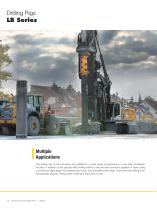
Drilling Rigs LB Series Multiple Applications The drilling rigs of the LB series are suitable for a wide range of applications in the deep foundation industry. In addition to the popular Kelly drilling method, they are also commonly applied for tasks using a continuous flight auger, full displacement tools, and a double rotary head. Down-the-hole drilling is an exceptionally popular method when working in hard soils or rock. Solutions for Deep Foundation Work
Open the catalog to page 12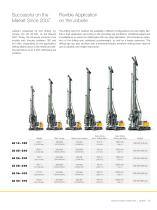
Successful on the Market Since 2007 Flexible Application on the Jobsite Liebherr presented its first drilling rig, namely the LB 28-320, at the Bauma 2007. Today, the LB series consists of six models with torques between 180 and 510 kNm. Depending on the application, drilling depths down to 95 metres and drilling diameters up to 3,000 millimetres are possible. The drilling rigs from Liebherr are available in different configurations and are highly flexible in their application according to the prevailing soil conditions. Additional equipment is available as an option for drilled piles with very...
Open the catalog to page 13All Liebherr catalogs and technical brochures
 HS 8070.1
28 Pages
 LRB 23
20 Pages
 MK 73-3.1
28 Pages
 MK 88-4.1
20 Pages
 LRS 545
5 Pages
 LRS 545-31 Toplift
3 Pages
 LRS 565-31 Intermodal
3 Pages
 Litronic- FMS III/CCS
2 Pages
 T 236
T 23624 Pages
 L 507 – L 518
34 Pages
 L 506 / L 508
20 Pages
 TA 230
16 Pages
 Telescopic Handlers
22 Pages
 Your Mining Partner
28 Pages
 T 284
T 28424 Pages
 Liebherr Components
8 Pages
 R 920
R 92028 Pages
 A 916
A 91630 Pages
 R 918
R 91828 Pages
 R 914 Compact
16 Pages
 A 910 Compact
26 Pages

Archived catalogs
 Rotary drilling tools
20 Pages
 Tower Cranes
42 Pages
 stationary concrete pumps
20 Pages
 Liebherr concrete technology
16 Pages
 truck-mounted concrete pumps
20 Pages


- Crawler excavator
- Construction excavator
- Diesel excavator
- Concrete pump
- Lifting crane
- Telehandler
- Lifting telehandler
- Boom crane
- Construction crane
- Compact excavator
- Construction drilling rig
- Diesel engine drilling rig
- Rotary drilling rig
- Mobile concrete pump
- Handling telehandler
- Truck-mounted concrete pump
- Mobile crane
- Crawler drilling rig