

ChemMax® Encapsulating Suits

ChemMax® Encapsulating Suits
Catalog excerpts
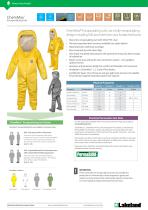
ChemMax® Ijlgp sunSfflnJHs uits Download H Download *** m >**. : c£* I m ■ ***** Derlaratmn of ChemMax® Encapsulating suits use a fully encapsulating design including full hood with face visor & attached boots • Rear entry encapsulating suit with 20mil PVC visor • Flat and expanded back versions available (see styles below) • Attached boots with boot overflaps • Rear mounted zip with storm flap • One hood-mounted exhaust port with protective shroud to allow escape of exhaled air • Elastic wrists (use with push-lock connection system - not supplied -optional extra) • Spacious and generous design for comfort and freedom of movement • Available in ChemMax® 1, 2, 3 and 4 Plus fabrics. • Certified to Types 3 & 4. These are not gas-tight suits and are not suitable for protection against hazardous gases and vapours Physical Properties Chemical Permeation Test Data ChemMax® Encapsulating Suit Styles ChemMax® Encapsulating Suits are available in two basic styles: 400 - Flat back with air inlet hose To be worn with a breathing mask fed by compressed air hose. This can be fed through the air inlet hose to the mask worn inside the suit. The exhaust valve allows escape of exhaled air. Size: M - XXL For the latest data available refer to the Chemical Search Page (accessible at www.lakeland.com) ChemMax® 3, ChemMax® 4 Plus and Interceptor® Plus fabrics work with the PermaSURE® smart-phone app for calculation of real world safe wear times according to temperature and the toxicity of the specific chemicals - with over 4000 chemicals in the database. Permeation test data should not be used as an indication of safety or safe wear time and if used so can give a false impression of safety. Users may be coming into contact with a chemical without realising it. Safe-wear times should be calculated taking into account permeation rate, temperature and chemical toxicity. WARNING! These coveralls are not gas tight and are not suitable for protection in environments where hazardous gases and vapours may be present but will provide superior protection in more hazardous liquid chemical environments. Lakeland Industries Europe Limited
Open the catalog to page 1
Protect Your People' Clothing For Protection against Hazardous Chemicals Selecting the right chemical suit for the job is vital to ensure not only are workers properly protected but that they are not overprotected - which could mean paying more than you need for PPE and that workers suffer more discomfort than necessary. Chemical protection is defined by three key standards: Consider three key factors when selecting the most appropriate clothing for an application 1.The chemical . 2. Which hazard / spray type? 3. Physical / environment factors Type 4 EN 14605 • 'Breakthrough time' provided by...
Open the catalog to page 2All Lakeland catalogs and technical brochures
 CE MicroMax NS PDS EN
2 Pages
 CE Pyrolon XT PDS
2 Pages
 CE SafeGard GP PDS
2 Pages
 CE Type 56 Select Guide
13 Pages
 Arc® X
2 Pages
 PermaSURE
2 Pages
 ALM 300
2 Pages
 ALM 300/500
2 Pages
 Arc® 43
2 Pages
 Lakeland ALM®
4 Pages
 Chemical Suit Selection
28 Pages


