

Arc® 43

Arc® 43
- The Arc® 43 suit is made of a triple-layer fabric with an Arc Thermal Protective Value (ATPV) of up to 43 cal/cm².
- The fabric composition is 48% modacrylic, 37% cellulosic, and 15% para-aramid, with a total weight of 720gsm.
- The suit includes a hood with a 40 cal-rated arc visor, jacket, bib & brace pants, gloves, and boots, all stored in a carry case.
- Seams are reinforced with a five-needle safety stitch using FR/Aramid thread.
- Tensile Strength: 970 N (md), 630 N (cd) - Pass
- Trapezoidal Tear: 29 N (md), 26 N (cd) - Pass
- Seam Strength: 355 N - Pass
- Flame Spread: ISO 15020-2000 A1 - Pass
- Heat Resistance: ISO 17492 - Pass
- Convective Heat: 5.2 sec (ISO 9151:1995) - B1
- Radiant Heat: 12.2 sec (ISO 6942:2002) - C1
- Arc Protection: Box Method (EN 61482-1-2) - 7 Ka, ATPV - 42 cal/cm²
- Arc Flash occurs when an electrical charge jumps between terminals, causing intense heat, explosive force, and potential electrical shock.
- Protective garments are primarily designed to protect against heat hazards.
- Assess: Determine the incident heat energy level using calculations based on circuit voltage and equipment class.
- Identify: Determine the required ATPV or Hazard Risk Category (HRC) based on the assessed heat energy level.
- Select: Choose garments with the appropriate HRC or ATPV rating. Layering garments can increase protection levels.
- ATPV is measured according to EN 61482-2-1 or ASTM F1959, indicating the heat energy level protection value.
- HRC defines four classes of garments based on ATPV: HRC 1 (4 cal/cm²), HRC 2 (8 cal/cm²), HRC 3 (24 cal/cm²), HRC 4 (40 cal/cm²).
- EN 61482-2-2 measures arc protection for low energy levels using the 'arc-in-a-box' method, identifying two classes: Class 1 (up to 4Ka) and Class 2 (up to 7Ka).
Catalog excerpts
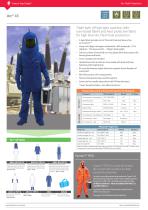
Arc Flash Protection Arc® 43 5 needle safety stitch Triple layer of high-spec superior, cellulose-based flame and heat protective fabric for high level Arc Flash heat protection. • 3-layer fabric provides an Arc Thermal Protective Value of up to 43 cal/cm2 * • 3 layers of 240gsm European-made fabric: 48% modacrylic / 37% cellulosic / 15% para-aramid... 720gsm total weight • Full suit consists of hood with arc visor, jacket, bib & brace pants with braces, gloves and boots • Carry / storage case included • Hood features 40 cal-rated arc visor, sealed with hook and loop fastening and hanging loop • 81cm jacket features raglan sleeves for superior fit and freedom of movement • Bib & Brace pants with swing pockets • Hook and loop fastenings used throughout • Seams are five needle safety stitch with FR/Aramid thread * Note: Results for fabric: visor offers 40 cal/cm2 Flame, Heat and Arc Thermal Protective Performance Physical Properties Pyrolon™TPCR is a multi-risk limited life coverall with excellent arc-flash protection properties. As well as providing chemical protection to Types 3 & 4, flame and heat protection to EN 11612, welding process protection to EN 11611 and being anti-static it is also certified to both Arc -Flash standards EN 61482-2-2 and EN 61482-2-1. It provides high level of protection measured at an ATPV of 21.9 cals/cm2. See page 33 for full details and specifications www.lakeland.com/europe [email protected]
Open the catalog to page 1
Protect Your People Understanding Arc Flash Protection What is Arc Flash? What are hazards of Arc Flash? How do you select an Arc Flash protective garment? Arc Flash occurs when an electrical charge jumps between two terminals or from a terminal to earth Arc Flash protective garments are primarily designed to protect against the heat hazard of electric arc and not the electrical shock or concussive force. Arc Flash incidents can occur in any industrial situation where a fault in a circuit occurs In an instant an arc flash incident can generate enormous amounts of heat energy and temperatures...
Open the catalog to page 2All Lakeland catalogs and technical brochures
 CE MicroMax NS PDS EN
2 Pages
 CE Pyrolon XT PDS
2 Pages
 CE SafeGard GP PDS
2 Pages
 CE Type 56 Select Guide
13 Pages
 Arc® X
2 Pages
 PermaSURE
2 Pages
 ChemMax® Encapsulating Suits
2 Pages
 ALM 300
2 Pages
 ALM 300/500
2 Pages
 Lakeland ALM®
4 Pages
 Chemical Suit Selection
28 Pages


