
- Catalogs
- Knoll Textiles
- KnollTextiles How To Specify Drapery


KnollTextiles How To Specify Drapery

KnollTextiles How To Specify Drapery
This guide provides comprehensive information for selecting drapery treatments for various spaces, developed with drapery specialist Erik Bruce. It covers key considerations, essential terminology, and tips for the selection process to assist in project completion.
When selecting drapery, consider its purpose (light control, privacy, thermal control), design aspects (length, fabric width, hardware), and logistical factors (timeline, budget, fabricator).
Fabrics range from sheer to room darkening, affecting light transparency. Examples include Sheer Color, Quest, and Gallery, each offering different levels of visibility and light control.
Key components include the track, header, buckram, overdrape, sheers, split draw, bottom hem, panel, hem weight, pleat, and side hem. Terminology such as buckram, flame treatment, fullness, hardware, and lining fabrics are defined to aid in understanding drapery construction.
Various header styles include Ripplefold®, Pinch-pleat, Pencil-pleat, Box-pleat, Accordia-fold®, Shirred, and Grommet, each with unique structures and advantages.
Considerations include pocket depth, mount type, hardware specifications, fullness, stacking direction, and hem weights. Different track and hardware options are compatible with various drapery headers.
Components include the header, hem bar, lift cord, lift controls, ribs, rings, and shade cloth. Roller shades and Hobbled Roman shades are discussed, highlighting their structure and advantages.
Detailed specifications are provided for various drapery and shade options, including measurements and fabric requirements.
This guide provides essential information for specifying drapery, offering a range of options and considerations to ensure the best fit for any project.
- Hobbled Roman Shades: Maximize heat insulation and opacity, requiring 1 ½ to 2 ½ times vertical fullness.
- Structured Flat Roman Shades: Add architectural elements without extra volume, featuring evenly spaced pleats.
- Soft Flat Roman Shades: Provide a soft dimension with loosely pleated fabric at the bottom.
- Sliding Panel Systems: Suitable for blocking light or creating privacy, featuring flat panels that slide along a track.
- Rod Mounting Depth: Options include 3.5 inches, 6 inches, or 8 inches from the wall.
- Hardware Compatibility: Different brackets and systems are compatible with various shade types.
- Shade Lift Controls: Options include manual and motorized controls.
- Mounting Options: Shades can be mounted inside or outside the window frame.
- Description: Provides operable draperies/shades as per the document and plans.
- Quality Assurance: Requires specialized firms with at least five years of experience.
- Standards: Compliance with fire codes and National Electric Code standards is necessary.
- Submittals: Includes manufacturer’s data, shop drawings, samples, and maintenance instructions.
- Product Delivery and Handling: Draperies should be delivered only when rooms are ready for installation.
- Warranty: A one-year warranty for repair or replacement due to faulty workmanship or installation.
- Examination: Inspect substrates and conditions before installation.
- Preparation: Install draperies and shades according to manufacturer’s recommendations, ensuring they are free of creases and wrinkles.
- Protection: Protect installed draperies from damage.
- Pinch-Pleat Header: Details on fabric selection, heading fabrication, fullness, hems, and hardware.
- Pencil-Pleat Header: Similar specifications as pinch-pleat with specific pleating tape requirements.
- Box-Pleat Header: Includes specifications for large openings and uniform pleat spacing.
- Ripplefold® Header: Uses woven snap tape for a structured appearance.
- Accordia-fold® Header: Features snap tape and buckram for structured pleats.
The document provides detailed specifications for various types of drapery and shade fabrications, including pleated, shirred, grommet headers, and Roman shades. It outlines the materials, construction techniques, and hardware requirements necessary to achieve the desired aesthetic and functional outcomes.
Pleats are created using a pleater spaced in ¼ inch increments. The drapery can be washed or dry cleaned. Fabrication follows Kirsch Company charts, with fullness options of 60%, 80%, 100%, or 120%. Side hems are double-turned and blind-stitched, while bottom hems are 4 inches, double-turned, and weighted. Drapery hardware must meet specified requirements.
Fabric selection is crucial. The heading is sewn to create a pocket for a pole or rod. Fullness and pocket size are specified, with bottom hems double-turned and blind-stitched. Hardware includes a wood or metal rod, and the heading is stationary.
Fabric selection is essential. The heading includes buckram and grommets, with specified spacing. Fullness is customizable. Side and bottom hems are double-turned and blind-stitched. Pole finishes include chrome, brass, or wood.
Various styles include Hobbled, Structured Flat, and Soft Flat Roman shades. Each style has specific fabrication requirements, including fabric selection, lining, and hardware. Spacing tapes or rings are used for structure, and hems are blind-stitched with optional aluminum hem bars.
Panels have a 2-inch bottom hem with an aluminum bar, side hems, and a reinforced top hem with Velcro. Panels slide on an aluminum track system.
Options include inside or outside mount, regular or reverse roll, and manual or clutch systems. Fascia can be added to conceal the top roll.
The document includes credits for contributors and references to KnollTextiles products.
Catalog excerpts

Introduction . . . . . . . . . . . . . . . . . . . . . . . . . . . . . . . . . . . . . . . . . . . . 3 Questions to Get You Started . . . . . . . . . . . . . . . . . . . . . . . . . . . . . . 5 Fabric Choices . . . . . . . . . . . . . . . . . . . . . . . . . . . . . . . . . . . . . . . . . 6 Drapery Anatomy . . . . . . . . . . . . . . . . . . . . . . . . . . . . . . . . . . . . . . . . 8 Drapery Terminology . . . . . . . . . . . . . . . . . . . . . . . . . . . . . . . . . . . . . 9 Select Your Drapery Header . . . . . . . . . . . . . . . . . . . . . . . . . . . . . . . 10 Define Your Drapery...
Open the catalog to page 2
Use this brochure as a guide to help you select the right treatments for a new project or pre-existing space. Inside, you will find a summary of starting points to address when working with a client, an overview of key terminology, tips to aid you in the selection process, and inspiration for your space. Developed in conjunction with drapery specialist Erik Bruce, this brochure will give you the essentials you need to take your project from beginning to end. Please visit knolltextiles.com to view our extensive line of drapery. You can also contact your local KnollTextiles showroom for recommendations...
Open the catalog to page 3
Ondo Drapery by KnollTextiles
Open the catalog to page 4
What Is the Use? + ight Control/Room Darkening L + Privacy + hermal Control/Energy Conservancy T + Contract/Residential + Functional/Decorative + ingle/Multiple Layers of Fabric S How Will It Be Designed? + ill it be Sill Length/Floor Length? W + hat is the Fabric Width/Fullness? W + an the fabric be Railroaded? C + ill it be Inside/Outside Mount? W + hat kind of Hardware will you need? W + s it a Soffit or Drapery Pocket? I + ow much Stackback off of the window H do you want? What Are the Logistics? + What is your Timeline? + What is your Budget? + ho will be your Fabricator? Will they also...
Open the catalog to page 5
Room Darkening KnollTextiles Draperies from top to bottom: Sheer Color, Quest, and Gallery Drapery transparency varies by fabric from sheer to room darkening. In the exercise above, three draperies have been placed in front of the same object under the same light conditions. At the top, the object is completely visible behind Sheer Color. When placed behind Quest, the object is just barely visible through the fabric’s weave. Behind a room darkening fabric, Gallery, the object is totally obscured. HOW TO SPECIFY DRAPERY // FABRIC CHOICES
Open the catalog to page 6
Parker Drapery by Rodarte for Knoll Luxe
Open the catalog to page 7
Track Buckram Side Hem Overdrape (lined) Split Draw HOW TO SPECIFY DRAPERY // DRAPERY ANATOMY
Open the catalog to page 8
Buckram . . . . . . . . . . . . . . . . . . . . . a stiff 100% polyester backing used as a stiffener for the inside of drapery headers. The standard amount of buckram needed to form pleating is 4 inches. Flame Treatment . . . . . . . . . . . . . . . a treatment that can be applied to drapery to make it less susceptible to catching fire. This treatment can be applied to fabrics that are not flame retardant, though tests must be made to ensure that fabrics can have this treatment applied. Fabrics that are already flame retardant do not need this treatment. Fullness . . . . . . . . . . . . . . ....
Open the catalog to page 9
Pinch-pleat + inch-pleats are the most popular header styles for drapery. They offer a clean P and even aesthetic that can be applied in a wide range of interiors—from traditional to contemporary spaces. + tructure: Each pleat on a pinch-pleat is composed of three evenly spaced folds. S A + dvantages: Low-cost and easy application. + dd: Trimming, tiebacks, lining, and interlining. A Pencil-pleat + Pencil-pleats offer a uniform, evenly spaced header style appropriate for both residential and corporate interiors. + tructure: This header style is given its name because of the thin width of each...
Open the catalog to page 10
Accordia-Fold® + Accordia-Fold® header styles also offer an even look from top to bottom, but each ripple is pleated, making them a crisper alternative to the Ripplefold headers. Buckram is necessary in order to create a crisp pleat. + Structure: Accordia-Fold headers are hung below the track on snap and can be hand or cord drawn. + dvantages: Can be used as a substitute to traditional partitions, delivers a clean, A uniform look front-to-back, best stacking rations, and highest stacking depth of all header styles. Shirred + Shirred headers add elegance and texture to draped surfaces. + tructure:...
Open the catalog to page 11
Cyclone Drapery by KnollTextiles
Open the catalog to page 12
Parker Drapery by Rodarte for Knoll Luxe
Open the catalog to page 13
Determine Pocket Depth Choose Mount Specify Hardware The pocket is the top section of the drapery header where a rod is inserted. The pocket depth is the circumference of the loop where the rod is inserted plus 1/2 inch. + Inside + Outside + Ceiling + Track and Hardware options include: Compatible Drapery Headers Hand Drawn Tracks that can be opened or closed by hand without the use of a cord. Batons (usually made of fiberglass) are attached to the track and used to pull open and close the drapery to prevent it from being torn or soiled. + Pinch-pleat + Ripplefold® + Grommet Cord Drawn Tracks...
Open the catalog to page 14
Sheer Draperies by KnollTextiles
Open the catalog to page 15
Choose Fullness The fullness is amount of extra fabric used on a window, plus side hems and returns, which is quantified as a multiple of the size of the window opening, drapery rod, or track. + x: For a 30 in. pleated drapery panel with 100% fullness, use a fabric that is 60 in. wide. E 100% fullness = 1 times fabric ex: 60 in. fabric = 30 in. pleated panel 150% fullness = 1.5 times fabric ex: 75 in. fabric = 30 in. pleated panel 200% fullness = 2 times fabric ex: 90 in. fabric = 30 in. pleated panel Choose Stacking Direction There are three main models for stacking drapery: + ne way pull draperies...
Open the catalog to page 16
Knoll Luxe Draperies
Open the catalog to page 17
Auden by Rodarte for Knoll Luxe
Open the catalog to page 18
Lift Control (cord) Header Rings Lift Cord Shade Cloth Hem Bar Front View of Roller Shade Back View of Structured Flat Roman Header. . . . . . . . . . . . . . . . . . . . . . . the way a shade is mounted at the top of a window treatment. Headers can be on a roller, track, board, or rod. Hem Bar. . . . . . . . . . . . . . . . . . . . . . a bar that is attached to the bottom of a shade to weigh or pull it down. Lift Cord. . . . . . . . . . . . . . . . . . . . . . a cord that runs from the header of a shade down to the hem bar and can be pulled to draw the shade upward or downward. Lift Controls...
Open the catalog to page 19All Knoll Textiles catalogs and technical brochures
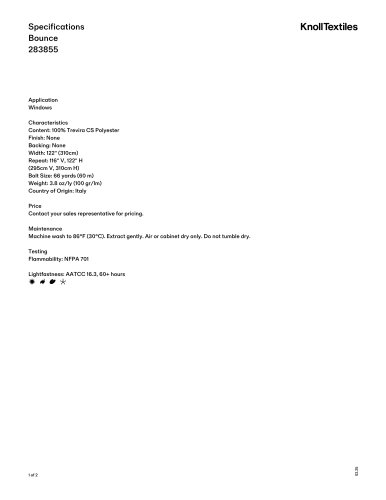
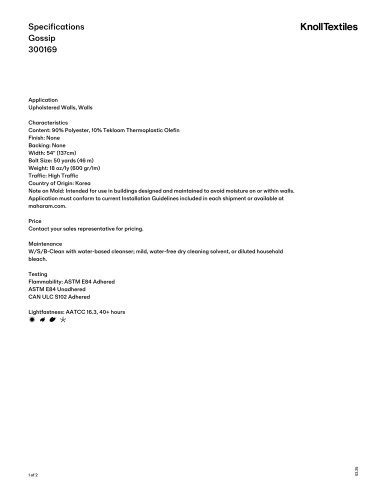
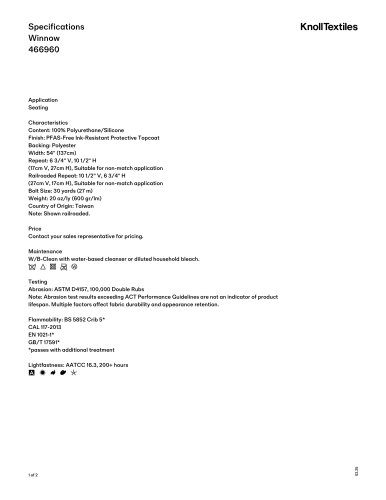
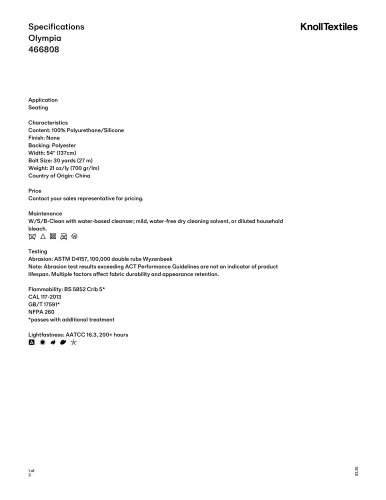
Archived catalogs
 Custom Capabilities
54 Pages
 SUNO for Knoll Luxe
16 Pages
 Open Plan Environments
20 Pages
 Antenna Workspaces
16 Pages
 Dividends Horizon
16 Pages
 Fence
Fence4 Pages
 Interpole
6 Pages
 Morrison
18 Pages
 Reff Profiles
12 Pages
 Template
16 Pages
 Template Planning Ideas
42 Pages
 Office Seating
16 Pages
 knoll kids
8 Pages
 Office Tables
24 Pages
 Activity Spaces
16 Pages
 Private Offices
20 Pages
 The Graham Collection Brochure
16 Pages
 Chadwick
16 Pages
 Life
Life14 Pages
 Moment
2 Pages
 Upstart
4 Pages
 KnollStudio Overview
66 Pages
 Dorothy Cosonas for Knoll Luxe
24 Pages
 Proenza Schouler for Knoll Luxe
20 Pages
 Rodarte for Knoll Luxe
16 Pages
 Lorelei in Bell
1 Page
 Drapery
28 Pages
 Modern Healthcare Design
8 Pages
 Equity
16 Pages
 Dividents Horizon
18 Pages
 Currents
20 Pages
 AutoStrada
20 Pages
 Acoustical Fabrics
1 Page
 Gore Seating Protection
2 Pages


- Industrial upholstery fabric
- Contemporary textile
- Patterned canvas
- Polyester textile
- Gray fabric
- Brown fabric
- Industrial wallcovering
- Cotton fabric
- Technical fabric
- Interior wall-covering
- Domestic use wall-covering
- Weave fabric
- Black fabric
- Red fabric
- Decorative wall-covering
- Viscose fabric
- Modern wall-covering
- Textured wall-covering
- Fire-retardant wall-covering