- Catalogs
- KLH Massivholz
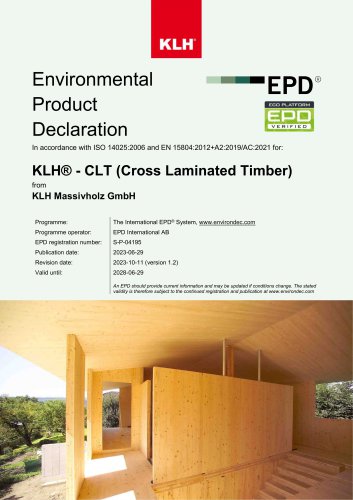
- ENVIRONMENTAL PRODUCT DECLARATION

ENVIRONMENTAL PRODUCT DECLARATION
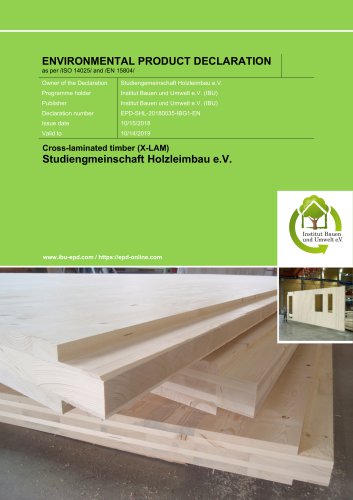
ENVIRONMENTAL PRODUCT DECLARATION
The Environmental Product Declaration (EPD) for Cross-laminated timber (X-LAM) is issued by Studiengemeinschaft Holzleimbau e.V. and verified by Institut Bauen und Umwelt e.V. (IBU). It is valid from October 15, 2018, to October 14, 2019, covering 1 m³ of X-LAM.
X-LAM is an industrially manufactured timber product used for structural applications, consisting of at least three layers of coniferous wood glued at right angles. It provides dimensional stability and load transfer capabilities, using wood species like spruce, fir, pine, larch, and Douglas fir.
Specifications include wood moisture content (≤ 15%), compression strength (18-24 N/mm² parallel to the grain), and thermal conductivity (0.13 W/(mK)). The product has a gross density of 470 kg/m³.
X-LAM is produced by drying coniferous boards to less than 15% moisture, followed by planing, sorting, and gluing with adhesives like PUR, MUF, and EPI. The process ensures minimal environmental impact.
X-LAM poses no significant risks to water, air, or soil during use. It is low in formaldehyde emissions and designed for a long service life.
X-LAM can be reused or recycled for energy recovery due to its high calorific value, with disposal complying with the Waste Wood Act.
The life cycle assessment is based on 1 m³ of X-LAM, considering adhesive mix and a mass of 469.94 kg/m³. The declared unit includes a wood moisture content of 12% and adhesive content of 2.1%.
- Wood moisture on delivery: 12%
- Adhesive content: 2.112% of overall mass
- Water content: 10.496% of overall mass
The EPD covers the production stage from raw material provision to production (Modules A1 to A3), Module A5, and parts of the end-of-life stage (Modules C2 and C3). It includes potential benefits and loads beyond the product's life cycle (Module D).
- Module A1: Provision of wood and adhesives.
- Module A2: Transport of materials.
- Module A3: Production processes including debarking, cutting, drying, and packing.
- Module A5: Disposal of product packaging.
- Module C2: Transport to disposal.
- Module C3: Waste wood preparation and sorting.
- Module D: Thermal utilization and system extension benefits.
Emissions from incineration and other processes are estimated based on literature, with data based on average values.
No material or energy flows were ignored, ensuring less than 5% of energy and mass are unaccounted for.
Data validated on a mass basis with good overall quality, based on surveys from 2009 to 2011.
Allocations follow EN 15804 and EN 16485 standards, considering economic and physical causalities.
Comparisons are valid only if data sets are created according to EN 15804 and consider product-specific characteristics.
- Construction Installation (A5): Focuses on packaging disposal.
- End of Life (C1-C4): Assumes 100% collection rate for thermal utilization.
- Reuse, Recovery, Recycling (D): Energy recovery from waste wood.
- Environmental Impact: Includes GWP, ODP, AP, EP, POCP, ADPE, ADPF.
- Resource Use: Details on renewable and non-renewable energy use.
- Output Flows and Waste: Includes hazardous and non-hazardous waste data.
- Global Warming Potential (GWP): Significant factors include electricity consumption and raw material provision.
- Ozone Depletion Potential (ODP): Mainly from adhesives and raw materials.
- Acidification Potential (AP): Influenced by wood and diesel combustion.
- Global Warming Potential (GWP): Adhesives contribute negligibly, while electricity and heat generation in Module A3 account for significant emissions.
- Eutrophication Potential (EP): Major contributions from drying and incinerating processes for wood provision, with electricity and heat generation also significant in Module A3.
- Photochemical Ozone Creation Potential (POCP): Wood provision and drying processes are primary contributors, with heat and electricity also impacting.
- Abiotic Depletion Potential (ADPE & ADPF): Wood provision is a major factor, with electricity and consumables also contributing.
- Energy Use: Renewable energy use is dominated by manufacturing processes, while non-renewable energy is spread across wood provision and manufacturing.
- Waste: Primarily from adhesives and wood provision, with consumables also contributing.
- Formaldehyde emissions are low and within class E1 limits, with specific testing conditions outlined.
- MDI emissions are not detectable post-curing in X-LAM products.
- Fire gas toxicity is comparable to natural wood.
- VOC evidence is optional for shorter EPD validity.
- Numerous standards and regulations are referenced, including DIN EN and ISO standards related to environmental declarations and wood protection.
Catalog excerpts
ENVIRONMENTAL PRODUCT DECLARATION as per /ISO 14025/ and /EN 15804/ Owner of the Declaration Programme holder Institut Bauen und Umwelt e.V. (IBU) Institut Bauen und Umwelt e.V. (IBU) Declaration number Issue date Cross-laminated timber (X-LAM) www.ibu-epd.com / https://epd-online.com Umwelt Produktdeklaration Name des Herstellers – Name des Produkts
Open the catalog to page 1
Studiengmeinschaft Holzleimbau e.V. Programme holder IBU - Institut Bauen und Umwelt e.V. Panoramastr. 1 10178 Berlin Germany Declaration number EPD-SHL-20180035-IBG1-EN This Declaration is based on the Product Category Rules: Solid wood products, 07.2014 (PCR tested and approved by the SVR) Issue date 10/15/2018 Valid to 10/14/2019 Prof. Dr.-Ing. Horst J. Bossenmayer (President of Institut Bauen und Umwelt e.V.) Cross-laminated timber X-LAM Owner of the Declaration Studiengemeinschaft Holzleimbau e.V. Heinz-Fangman-Strafte 2 D-42287 Wuppertal Declared product / Declared unit 1 m3 cross-laminated...
Open the catalog to page 2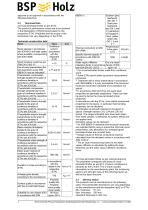
approval or an approval in accordance with the /Biocides Directive/. 2.3 Technical Data a) Cross-laminated timber as per ETAs The product's performance values are to be declared in the Declaration of Performance based on the respective /ETA/. Properties and the scope of the Declaration can vary depending on the /ETA/. Technical construction data’D 1) For cross-laminated timber made from coniferous wood 2> Some ETAs permit other equivalent measurement processes. 3) Treatment with a wood preservative in accordance with /DIN 68800-1/ is only permissible if the structural measures have been exploited...
Open the catalog to page 3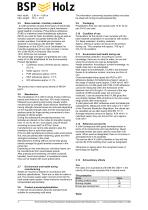
Fire protection Max. length: 16 m - 20 m 2.5 Base materials / Ancillary materials X-LAM comprises at least three layers of technically dried coniferous wood boards or plank laminations glued together crosswise. Polyurethane adhesives (PUR) or melamine-urea-formaldehyde adhesives (MUF) are used for basic duroplastic gluing as well as emulsion polymer isocyanate adhesives (EPI) in smaller quantities. Formaldehyde emissions are declared in accordance with /DIN EN 14080/. Substances on the /ECHA List of Candidates/ for including substances of very high concern in Annex XIV of the /REACH Directive/...
Open the catalog to page 4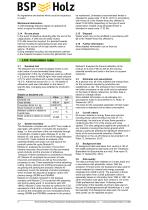
No ingredients are leached which could be hazardous to water. Mechanical destruction X-LAM breakage features display an appearance which is typical for solid wood. 2.14 Re-use phase In the event of selective rebuilding after the end of the usage phase, X-LAM can be easily reused. If X-LAM cannot be recycled, it is directed towards thermal recycling for generating process heat and electricity on account of its high calorific value of approx. 19 MJ/kg. During energetic recycling, the requirements outlined in the /Federal Immission Control Act (BlmSchG)/ must be maintained: Untreated cross-laminated...
Open the catalog to page 5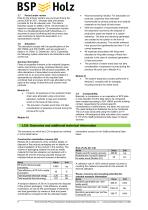
3.7 Period under review Data for the primary system was surveyed during the period 2009 to 2011, whereby data was always provided for the full calendar year. The data is therefore based on 2008 to 2010. All information is based on averaged data for 12 consecutive months. There is a Studiengemeinschaft Holzleimbau e.V. document in place confirming that the primary data used continues to depict the association in a representative manner. 3.8 Allocation The allocations comply with the specifications of the /EN 15804/ and /EN 16485/, and are explained in detail in /S. Ruter, S. Diederichs: 2012/....
Open the catalog to page 6
Waste heat used (per net flow of declared unit) The product is recycled in the form of waste wood in the same composition as the declared unit at the endof-life stage. Thermal recovery in a biomass power station with an overall degree of efficiency of 54.69 % and electrical efficiency of 18.09 % is assumed, whereby incineration of 1 tonne atro wood (mass value in atro, consideration of efficiency, yet ~18 % wood moisture content) generates approx. 968.37 kWh electricity and 7053.19 MJ useful heat. Converted to the net flow of the atro wood percentage included in Module D and taking consideration...
Open the catalog to page 7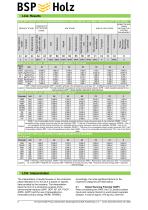
The interpretation of results focuses on the production phase (Modules A1 to A3) as it is based on specific data provided by the company. The interpretation takes the form of a dominance analysis of the environmental impacts (GWP, ODP, AP, EP, POCP, ADPE, ADPF) and the use of renewable/nonrenewable primary energy (PERE, PENRE). Accordingly, the most significant factors for the respective categories are listed below. 6.1 Global Warming Potential (GWP) When considering the GWP, the CO2 product system inputs and outputs inherent in wood require separate analysis. A total of approx. 876 kg CO2 enter...
Open the catalog to page 8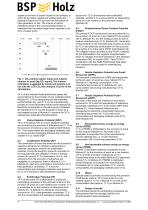
BSP^Holz system in the form of carbon stored in the biomass, of which 48 kg carbon dioxide are emitted along the upstream chains and 75 kg within the framework of heat generation on site. The volume of carbon ultimately stored in the cross-laminated timber is extracted from the system again when recycled in the form of waste wood. Fig. 1: CO2 product system inputs and outputs inherent in wood [kg CO2 equiv.]. The inverse indications suggested by inputs and outputs is in line with the LCO CO2 flow analysis in terms of the atmosphere. 34 % of the analysed fossil greenhouse gases are accounted for...
Open the catalog to page 9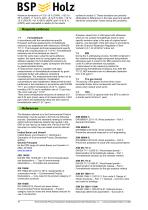
outlined in section 5. These deviations are primarily attributable to differences in the fuels used and specific electricity consumption values during the processes. BSP^Holz Maximum deviations of +3 %/-16 % (GWP), +102 %/55 % (ODP), +1 %/-6 % (AP), +9 %/-6 % (EP), +19 %/13 % (POCP), +91 %/-66 % (ADPE) and +3 %/-8 % (ADPF) were calculated in relation to the results 7.1 Formaldehyde In accordance with the manufacturer-specific European technical assessments, formaldehyde emissions are established with reference to /DIN EN 717-1/. The European technical assessments specify testing with a loading...
Open the catalog to page 10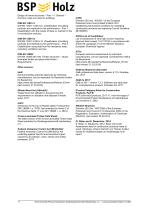
BSP^Holz Design of timber structures - Part 1-1: General -Common rules and rules for buildings /DIN EN 13501-1/ DIN EN 13501-1:2010-01, Classification of building products and methods by fire performance - Part 1: Classification with the results of tests on reaction to fire of construction products /DIN EN 13501-2/ DIN EN 13501-2:2016-12, Classification of building products and methods by fire performance - Part 2: Classification using data from fire resistance tests, excluding ventilation services /DIN EN 14080/ DIN EN 14080:2013-09, Timber structures - Glued laminated timber and glued solid...
Open the catalog to page 11All KLH Massivholz catalogs and technical brochures
 RIB ELEMENTS
20 Pages
 STRUCTURAL PRE-ANALYSIS TABLES
32 Pages
 WCTE_2016_Special
35 Pages
 Wooden feelings
13 Pages
 Environment and Sustainability
40 Pages
 Assembly & Installation
28 Pages
 Building Physics
32 Pages
 Cross-laminated Timber
20 Pages
 Lifting Systems
28 Pages


Archived catalogs
 Mission Statement
8 Pages