- Catalogs
- KLH Massivholz
- Environmental product declaration_2023

Environmental product declaration_2023
Environmental product declaration_2023
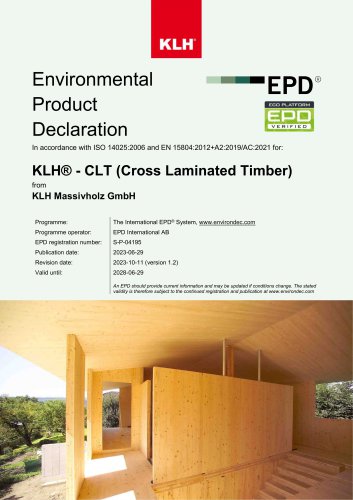
This document is an Environmental Product Declaration (EPD) for KLH® - CLT (Cross Laminated Timber) produced by KLH Massivholz GmbH. It adheres to ISO 14025:2006 and EN 15804:2012+A2:2019/AC:2021 standards and is registered under the International EPD® System.
General Information
The EPD is managed by EPD International AB, with registration number S-P-04195. Published on June 29, 2023, it remains valid until June 29, 2028. It includes details on Product Category Rules (PCR), Life Cycle Assessment (LCA), and third-party verification.
Company Information
KLH Massivholz GmbH, a leader in cross-laminated timber production, operates from two sites in Austria and holds ISO 9001 and 14001 certifications.
Product Information
KLH® - CLT is a wood-based construction material used for walls, ceilings, and roofs, made from softwood boards glued in layers. It is customized for specific projects and has a service life matching the building it is used in.
Life Cycle Assessment (LCA) Information
The LCA covers cradle-to-gate stages, including production, construction, and end-of-life scenarios, based on data from 2020 and 2021 from two Austrian sites.
Environmental Impact
The document details environmental impact data, such as global warming potential, ozone depletion, and resource use. The product shows significant biogenic carbon storage, resulting in a negative total global warming potential during production.
End of Life and Resource Recovery
Two scenarios are considered: thermal recovery and reuse. In thermal recovery, energy is recovered with specified efficiencies. In the reuse scenario, 100% of the product can be reused, benefiting future systems.
Conclusion
KLH® - CLT is a sustainable construction material with a comprehensive EPD outlining its environmental impacts and benefits, emphasizing its reuse potential and contribution to reducing carbon emissions.
Catalog excerpts
Environmental Product Declaration In accordance with ISO 14025:2006 and EN 15804:2012+A2:2019/AC:2021 for: KLH® - CLT (Cross Laminated Timber) from KLH Massivholz GmbH Programme: The International EPD® System, www.environdec.com Programme operator: Publication date: Revision date: Valid until: 2028-06-29 An EPD should provide current information and may be updated if conditions change. The stated validity is therefore subject to the continued registration and publication at www.environdec.com
Open the catalog to page 1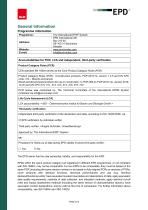
General Information Programme information The International EPD® System EPD International AB Box 210 60 SE-100 31 Stockholm Sweden www.environdec.com [email protected] Programme: Address: Website: E-mail: Accountabilities for PCR, LCA and independent, third-party verification Product Category Rules (PCR) CEN standard EN 15804 serves as the Core Product Category Rules (PCR) Product Category Rules (PCR): Third-party verification Independent third-party verification of the declaration and data, according to ISO 14025:2006, via: ☒ EPD verification by individual verifier Third-party verifier: Approved...
Open the catalog to page 2
Company information Owner of the EPD: KLH Massivholz GmbH, Gewerbestraße 4, A – 8842 Teufenbach-Katsch, E-Mail [email protected], www.klh.at, Tel +43 3588 8835 Contact: DI Andreas Wabl Description of the organisation: KLH is one of the global leaders in the production of cross-laminated timber (KLH® - CLT), having pioneered the product in collaboration with the Technical University of Graz in 1996. Since 1999, when the first production facility in Teufenbach-Katsch, Styria, was put into operation, production capabilities and plant expansion have been continuously improved. The newest cutting-edge...
Open the catalog to page 3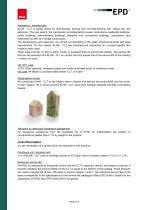
Application / intended use: KLH® - CLT is ideally suited for load-bearing, bracing and non-load-bearing wall, ceiling and roof elements. They are used in the construction of single-family houses, multi-storey residential buildings, public buildings, administrative buildings, industrial and commercial buildings, conversions and extensions as well as in bridge construction. The dimensioning and execution are carried out according to the static, structural-physical and legal requirements. For this reason, KLH® - CLT are manufactured exclusively on a project-specific and made-to-order basis. When...
Open the catalog to page 4
Time representativeness: The data for the KLH® - CLT are collected from the two factory sites in Teufenbach-Katsch and Wiesenau (Bad St. Leonhard). The production data for “Katsch” are mainly from 2020. The “Wiesenau” plant was newly built and the utilisation was very low at the beginning, the last 3 months of the declared data from August to October 2021 were considered more representative and extrapolated to 1 year. Database(s) and LCA software used: Data from /ecoinvent v3.8 (2021)/ for generic data and the Software SimaPro (Version 9.3.0.3 Multi user) has been used. Description of system...
Open the catalog to page 5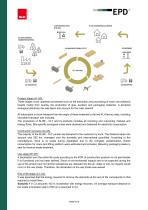
Product stage (A1-A3): These stages cover upstream processes such as the extraction and processing of sawn raw softwood boards mainly from Austria, the production of glue, auxiliary and packaging materials. A declared ecological electricity mix was taken into account for the main sawmill. All information on truck transport from the origin of these materials to the two KLH factory sites, including intra-plant transport was included. The production of KLH® - CLT and by-products includes all incoming and outcoming material and energy flows. Site-specific ecological mixes were declared and balanced...
Open the catalog to page 6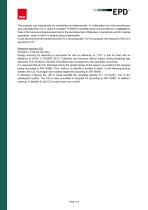
The products can theoretically be dismantled non-destructively. A confirmation from the manufacturer was submitted that 100 % reuse is possible. Therefore complete reuse is accounted for in scenario 2. It lies in the future and requires planning for the deconstruction of fasteners, connections and for material separation, some of which is already being implemented. It was assumed that the panels are taken to a recycling plant. For this purpose, the distance of 50 km is assumed in C2. Resource recovery (D): Scenario 1 Thermal recovery: Energy recovery for electricity is accounted for with an efficiency...
Open the catalog to page 7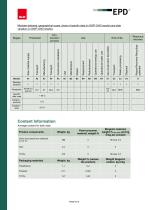
Modules declared, geographical scope, share of specific data (in GWP-GHG results) and data variation (in GWP-GHG results): Construction process Resource recovery Modules declared Waste processing De-construction demolition Construction installation Specific data used Variation – products Variation – sites Content Information Average content for both sites Weight, kg Post-consumer material, weight-% Biogenic material, weight-% dry mass and kg C/kg per produkt Sawn wood board from softwood (u=12 %) Weight-% (versus the product) Weight biogenic carbon, kg C/kg Product components Packaging materials...
Open the catalog to page 8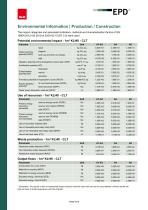
Environmental Information | Production / Construction The impact categories and associated indicators, methods and characterisation factors of EN 15804:2012+A2:2019 of 2020-02-15 (EF 3.0) were used Potential environmental impact - 1m³ KLH® - CLT Indicator Global warming potential (GWP) land use and land use change total Depletion potential of the stratospheric ozone layer (ODP) Acidification potential (AP) Eutrophication potential (EP) terrestrial Formation potential of tropospheric ozone (POCP) Abiotic depletion potential* for non-fossil resources (ADPE) fossil resources (ADPF) Water (user)...
Open the catalog to page 9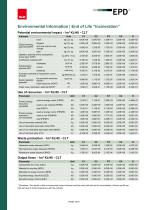
Environmental Information | End of Life “Incineration” Potential environmental impact - 1m³ KLH® - CLT Unit biogenic land use and land use change used as energy carrier (PERE) used as raw material (PERM) total (PERT) used as energy carrier (PENRE) total (PENRT) Use of renewable secondary fuels (RSF) Use of non-renewable secondary fuels (NRSF) Global warming potential (GWP) Depletion potential of the stratospheric ozone layer (ODP) Acidification potential (AP) Eutrophication potential (EP) terrestrial Formation potential of tropospheric ozone (POCP) for non-fossil resources Abiotic depletion (ADPE)...
Open the catalog to page 10All KLH Massivholz catalogs and technical brochures
 RIB ELEMENTS
20 Pages
 STRUCTURAL PRE-ANALYSIS TABLES
32 Pages
 WCTE_2016_Special
35 Pages
 Wooden feelings
13 Pages
 Environment and Sustainability
40 Pages
 Assembly & Installation
28 Pages
 Building Physics
32 Pages
 Cross-laminated Timber
20 Pages
 Lifting Systems
28 Pages


Archived catalogs
 Mission Statement
8 Pages