- Catalogs
- KLH Massivholz
- Environment and Sustainability

Environment and Sustainability
Environment and Sustainability
The document discusses the impact of climate change and the role of wood in reducing greenhouse gas emissions, targeting architects, planners, construction companies, and developers focused on environmental sustainability.
1.1. Consequences of Climate Change
Climate change is linked to increased greenhouse gas emissions, notably CO2, leading to melting ice caps, rising sea levels, and more natural disasters.
1.2. The Natural Greenhouse Effect
Natural greenhouse gases like CO2 and methane are crucial for maintaining Earth's temperature.
1.3. Anthropogenic Greenhouse Effect
Human activities have increased greenhouse gases, with CO2 being the most significant.
1.4. Agenda 21, Climate Convention, and Kyoto Protocol
These agreements aim to stabilize greenhouse gas concentrations, with the Kyoto Protocol requiring industrialized countries to reduce emissions by 5% from 1990 levels by 2012.
Criticism of the Kyoto Protocol
The protocol is criticized for emission trading benefits to wealthy nations and lack of limits on developing countries.
Two main approaches are reducing emissions and expanding carbon sinks. The EU committed to an 8% reduction in emissions during the Kyoto Protocol's first period. Measures include increasing energy efficiency, using renewable energies, and sustainable resource management.
Economic tools like emission trading and Clean Development Mechanism (CDM) projects are used to meet reduction targets.
Forests cover 31% of the world's land, with sustainable management crucial for carbon sinks. Deforestation is a concern in South America and Africa, while Europe and Asia show net growth.
Wood is a sustainable building material that reduces CO2 emissions. Each cubic meter of wood can save up to 2 tonnes of CO2, advocating for increased wood use in construction.
Wood significantly reduces CO2 emissions and offers energy savings over its lifecycle. Increasing wood use in construction by 10% in Europe could achieve a quarter of the Kyoto Protocol's CO2 reduction targets.
The wood industry is a major economic contributor in the EU, creating jobs and generating revenue.
Wood is versatile, contributing to climate protection by storing carbon and reducing fossil fuel reliance.
Wooden constructions are lighter, faster to build, and provide better insulation, leading to cost and energy savings.
Wood has a lower environmental impact compared to steel and concrete, aligning with guidelines for energy efficiency.
EPDs provide validated information on the environmental performance of building materials, following international standards like ISO 14025.
KLH panels are highlighted for their environmental commitment and role in climate change mitigation.
Definitions for technical terms related to environmental impact and wood products are provided.
Illustrations support the textual information with visual data on environmental impacts and construction methods.
Catalog excerpts

IMPRINT © KLH Massivholz GmbH Publisher and responsible for content: KLH Massivholz GmbH Version: Environment and Sustainability, Version 01/2013 The content of this brochure is the intellectual property of the company and is protected by copyright. Any type of reproduction is strictly forbidden and only permitted after written approval from the publisher.
Open the catalog to page 2
The climate change that has been experienced over the last decades, global warming, the increase in natural disasters and the possibility of using wood to usefully counteract greenhouse gas emissions, have prompted us to dedicate the first chapter of our handbook to the topic of environment and sustainability. makes a significant contribution to the attainment of climate goals. It is important for us to make an active contribution to the protection of our environment, in order for it to remain inhabitable for the next generations. With this brochure we address especially the architects & planners...
Open the catalog to page 4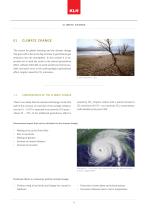
CLIMATE CHANGE The reason for global warming and the climate change that goes with it lies in the big increase in greenhouse gas emissions into the atmosphere. In this context it is important not to seek the cause in the natural greenhouse effect, without which life on earth would not even be possible, but much more in the anthropological greenhouse effect, largely caused by CO2 emissions. © picture -alliance / dpa CONSEQUENCES OF THE CLIMATE CHANGE caused by CO2. Experts reckon with a yearly increase in CO2 emissions of 0.5% – as a result the CO2 concentration could double by the year 2100....
Open the catalog to page 5
THE NATUR AL GREENHOUSE EFFECT In principle, the greenhouse gases of the atmosphere – especially water vapour (H2O), carbon dioxide (CO2), ozone (O3), nitrous oxide (N2O) and methane (CH4) – make life on earth possible in the first place. If the natural greenhouse effect did not exist, the average temperature on earth would be -18°C. Illustration 2 – Diagram of natural greenhouse ef fect, w w w. b i l d u n g s s e r v e r. h a m b u r g .d e The natural greenhouse gases in the atmosphere are responsible for warming the surface of the earth, starting at temperatures of -18°C to +15°C. This 33°C...
Open the catalog to page 6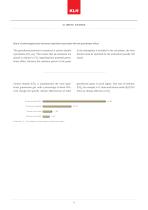
Share of anthropogenically released propellants associated with the greenhouse effect The greenhouse potential is measured in carbon dioxide equivalents (CO2-eq.). This means that all emissions are placed in relation to CO2 regarding their potential greenhouse effect. Because the retention period of the gases in the atmosphere is included in the calculation, the time horizon must be specified for the estimation (usually 100 years). Carbon dioxide (CO2) is quantitatively the most significant greenhouse gas, with a percentage of about 50%, even though the specific climate effectiveness of other...
Open the catalog to page 7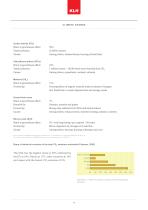
Share in greenhouse effect: Yearly emission: Causer: 50% 25 billion tonnes Among others, exhaust fumes, burning of fossil fuels Chloroflourocarbons (CFCs) Share in greenhouse effect: Yearly emission: Causer: 22% 1 million tonnes – 18,000 times more harmful than CO2 Among others, propellants, coolants, solvents Share in greenhouse effect: 13% Formed by: Decomposition of organic material under exclusion of oxygen, incl. fossil fuels, in waste disposal sites and sewage works Ground level ozone Share in greenhouse effect: Harmful for: Formed by: Causer: 7% Humans, animals and plants Strong solar...
Open the catalog to page 8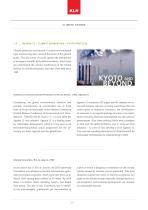
AGENDA 21 – CLIMATE CONVENTION – K YOTO PROTOCOL Climate protection has become a central environmental topic and has long since reached the notice of the general public. This has come, of course, against the background of divergent scientific and political positions, which have also determined the various Conferences of the United Nations on climate protection that have been held since 1992. Conference on Environmental Protection in Rio de Janeiro, 1992, Agenda 21 Agenda 21 comprises 359 pages and 40 chapters on social and business aspects, covering everything from the conservation of important...
Open the catalog to page 9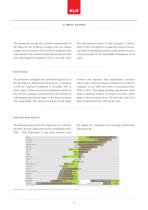
The agreement records the combined responsibility of the states for the problems resulting from the climate change. At the same time this Convention emphasises the responsibility of the industrial states that on the one hand emit anthropogenic propellants and on the other hand have the financial means to take measures. A further policy of this Convention is to take into account the special needs of developing countries and to aspire to a provisional principle for the sustainable development of all states. Kyoto Protocol The provisions, strategies and conventions agreed on in Rio de Janeiro in...
Open the catalog to page 10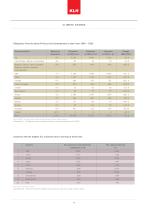
Obligations from the Kyoto Protocol and developments to date from 1990 – 2002 Contract parties Reduction obligations Liechtenstein, Monaco, Switzerland Bulgaria, Estonia, Latvia, Lithuania, Romania, Slovakia, Slovenia, Czech Republic Poland, Hungary Source: UNFCCC, the values relate to carbon dioxide equivalents without change in land use Countries with the highest CO 2 emissions due to burning of fossil fuels CO 2 emissions from fossil fuel combustion in mt Great Britain South Korea Illustration 8 – Countries with the highest CO2 emissions due to burning of fossil fuels
Open the catalog to page 11
Criticism of the Kyoto Protocol The logic of market forces means that sooner or later, a situation will arise where all available emission rights will either be used by the countries themselves or sold and used by others. The industrial nations, including the countries from the former Eastern Bloc, should reduce their emissions by an average of 5.2% by 2012. Even official positions in the UN have determined that in fact a reduction of 60 – 80% would be necessary. Other countries, however, can increase emissions as much as they want, which means an increased burden especially for those countries...
Open the catalog to page 12
CLIMATE PROTECTION AND RE ACHING CLIMATE TARGETS Within the term “climate protection” all possibilities for counteracting global warming are summed up, as well as all the measures for reducing the consequences – to prevent them is, according to numerous climate researchers and institutes, unlikely. In connection with climate protection, there are two main approaches – on the one hand, the reduction of greenhouse gas emissions and on the other, the expansion of carbon sinks. As well as an appropriate international climate policy, climate protection includes among other things: • increase in energy...
Open the catalog to page 13All KLH Massivholz catalogs and technical brochures
 RIB ELEMENTS
20 Pages
 STRUCTURAL PRE-ANALYSIS TABLES
32 Pages
 WCTE_2016_Special
35 Pages
 Wooden feelings
13 Pages
 Assembly & Installation
28 Pages
 Building Physics
32 Pages
 Cross-laminated Timber
20 Pages
 Lifting Systems
28 Pages






Archived catalogs
 Mission Statement
8 Pages