- Catalogs
- KLH Massivholz
- Cross-laminated Timber

Cross-laminated Timber

Cross-laminated Timber
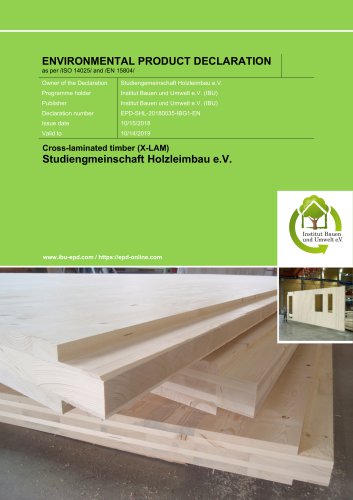
Cross-laminated timber (CLT), also known as KLH, is constructed from layers of spruce wood arranged crosswise and glued under high pressure. This design minimizes swelling and shrinkage while enhancing load capacity and stability. The wood is dried to a moisture content of 12% (+/-2%) to prevent pest and fungal damage.
KLH panels are ecologically sustainable, promote a healthy indoor climate, and offer architectural flexibility. They are used in residential, public buildings, and bridges, compatible with materials like steel and glass, and easy to install, reducing construction time.
The product is CE certified, with quality management per ISO EN 9001:2008 and environmental management per ISO EN 14001:2004. Certificates are available for download.
KLH panels are made from spruce, with a maximum size of 16.50 m in length, 2.95 m in width, and 0.50 m in thickness. They use formaldehyde-free PUR adhesive and have a thermal conductivity of λ = 0.13 W/(m*K).
Standard panel types and structures are available, with customization for enhanced rigidity and fire resistance upon request.
KLH panels come in non-visible, industrial visible, and domestic visible quality. Special surfaces can be requested, with quality definitions and usage instructions provided.
Surface quality is categorized into grades A, B, and C, with specifications for appearance and features. Non-visible quality is for load-bearing components, while industrial visible quality suits less demanding visible applications.
KLH panels are available in Industrial Visible Quality (IVQ) and Domestic Visible Quality (DVQ). IVQ panels are visible on one side only, while DVQ panels differ based on TL or TT panel use, with TL for ceilings and roofs and TT for walls.
Wood is valued for its properties and environmental impact. It is hygroscopic, absorbing and releasing moisture, which can cause swelling and shrinking. KLH panels minimize these effects, maintaining a moisture content of 12% (+/- 2%).
KLH panels may experience climate fluctuations during construction, affecting moisture levels. Once in use, moisture content stabilizes between 8-11%, which may alter surface appearance but not structural integrity.
KLH panels serve as structural elements for walls, ceilings, and roofs. The thickness of the cover lamella affects load-bearing capacity and appearance, with thicker lamellae potentially causing cracks or gaps.
Wood acts as a buffer for climate changes, absorbing or releasing moisture. Sudden changes can cause surface tension, leading to cracks or gaps, especially in light-colored surfaces.
KLH advises maintaining a stable room climate with 40-60% humidity to preserve wood moisture. Careful handling and assembly are crucial, and potential for cracks or gaps should be communicated to building owners.
Catalog excerpts

I M P RIN T © KLH Massivholz GmbH Publisher and responsible for content: KLH Massivholz GmbH Version: 01/2012, Cross-Laminated Timber The content of this brochure is the intellectual property of the company and is protected by copyright. Any type of reproduction is strictly forbidden and only permitted after written approval from the publisher.
Open the catalog to page 2
CROSSL AMINATED TIMBER CROS S - LAMINATED TIMBER Cross-laminated timber (German abbreviation: KLH) is produced from layers of spruce wood that are arranged crosswise on top of each other and glued to each other with a pressing power of 6 N/mm² to form large-sized solid wood elements. The crosswise arrangement of the longitudinal and transverse layers reduces the swelling and shrinkage of the wood in the plane of the panel to an insignificant minimum and considerably increases the static load-carrying capacity and dimensional stability. In order to rule out any damage caused by pests, fungi or...
Open the catalog to page 4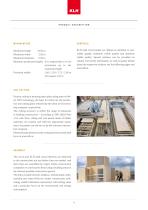
Maximum length 16.50 m Maximum width 2.95 m Maximum thickness 0.50 m Minimum production lengths m, respectively in 10 cm 8 increments up to the maximum length Produced widths 2.40 / 2.50 / 2.72 / 2.95 m On request 2.25 m KLH solid wood panels are offered as standard in nonvisible quality, industrial visible quality and domestic visible quality. Special surfaces can be provided on request. For further information, as well as quality details about the respective surfaces, see the following pages and www.klh.at. Factory cutting or beaming takes place using state-of-theart CNC technology, the basis...
Open the catalog to page 5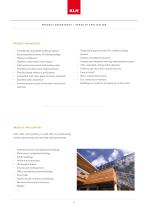
PRODUCT ADVANTAGES • Ecologically sustainable building material • Recommended in terms of building biology • Positive ecobalance • Healthy, comfortable room climate • Solid wood construction with lasting value • Freedom in architectural implementation • Flexible design without a grid pattern • Compatible with steel, glass and other materials • Excellent static properties • Increasing space thanks to slender construction elements KLH solid wood panels are used both as load-bearing, reinforcing elements and non-load-bearing elements. Detached houses and apartment buildings Multi-storey residential...
Open the catalog to page 6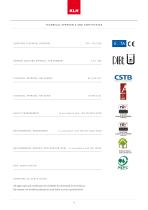
GENER A L BUIL DING A PPR OVA L FOR GER M A N Y All approvals and certificates are available for download at www.klh.at. By request, we would be pleased to send them to you in printed form.
Open the catalog to page 7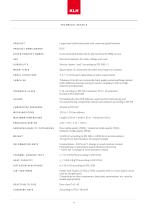
Large-sized solid wood panel with crosswise glued lamellae Cross-laminated timber (CLT), plywood boards (PBs), X-Lam Structural elements for walls, ceilings and roofs Service classes 1 and 2 according to EN 1995-1-1 Spruce (pine, fir, stone pine and other wood types on request) 3, 5, 7 or more layers depending on static requirements Thickness 10 to 40 mm, technically dried, quality-sorted and finger-jointed (with additional internal sorting to ensure compliance with our high material specifications) C 24 according to EN 338, maximum 10% C 16 permitted (compare ETA-06/0138) Formaldehyde-free PUR...
Open the catalog to page 8
S T ANDARD P ANEL S AND P ANEL S T RU C T URE S KLH STANDARD PANEL T YPES AND STRUCTURES COV ER ING L AY ER IN T HE T R A NS V ER SE PA NEL DIR ECT ION T T ( WA L L ) Nominal thickness in mm COV ER ING L AY ER IN T HE LONG I T UDIN A L PA NEL DIR ECT ION T L (CEIL ING/R O OF ) Nominal thickness in mm * * * Special panel types Special panel structures are available on request. By using double layers, for example the longitudinal or transverse rigidity of the panel can be further enhanced. The fire resistance of the KLH solid wood panel can also be influenced by modifying the structures and can...
Open the catalog to page 9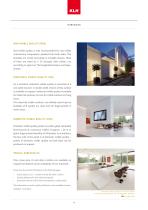
Non-visible quality is only recommended for non-visible construction components, planked from both sides. The lamellae are sorted according to strength classes. Most of them are rated as C 24 strength class timber, use according to approval. The longitudinal layers are fingerjointed. INDUSTRIAL VISIBLE QUALIT Y (IVQ) As a standard, industrial visible quality is executed in a one-sided manner. A double-sided version of this surface is available on request. Industrial visible quality is suitable for industrial surfaces, but not for visible surfaces in living areas. For industrial visible surfaces,...
Open the catalog to page 10
S URFA C E QUALI T Y A C C ORDING T O EN 1 3 0 1 7 - 1 No open glue joints Open joints: Wood type mixture Not permitted; in case of spruce, 10% fir permitted Well-balanced colour and texture Largely balanced colour and texture Healthy, intergrown knots in spruce up to 40 mm diameter permitted; individual black knots permitted Healthy, intergrown knots and individual black knots permitted Natural knot plugs permitted Resin pockets Repaired resin pockets Bark pockets Occasional pockets permitted Occasional surface cracks permitted Occasional surface cracks and end cracks up to a length of 50 mm...
Open the catalog to page 11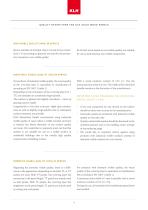
QUALI T Y DEFINI T ION S FOR K L H S OLID W OOD P ANEL S NON -VISIBLE QUALIT Y (NVQ) IN SPRUCE Spruce lamellae of strength class C 24 and in low proportions C 16 according to approval are used for the production of panels in non-visible quality. KLH solid wood panels in non-visible quality are suitable for use as load-bearing, non-visible components. INDUSTRIAL VISIBLE QUALIT Y (IVQ) IN SPRUCE With a wood moisture content of 12% (+/- 2%) the maximum joint width is 4 mm. The width of the individual lamella remains at the discretion of the manufacturer. For products of industrial visible quality,...
Open the catalog to page 12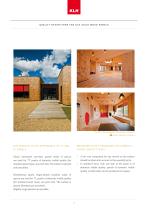
QUALI T Y DEFINI T ION S FOR K L H S OLID W OOD P ANEL S Architect: Hiendl Schineis Architek tenpar tnerschaf t Eckhar t Mat thäus Fotograf ie Glued, laminated one-layer panels made of spruce are used for TT panels of domestic visible quality (for standard panel types, see price list). The surface is planed and smoothed. • low cost component for any rework on the surface A should be taken into account in the assembly price • standard form, only one side of the panel is of In domestic visible quality; panels of domestic visible quality on both sides can be produced on request Breadthways glued,...
Open the catalog to page 13All KLH Massivholz catalogs and technical brochures
 RIB ELEMENTS
20 Pages
 STRUCTURAL PRE-ANALYSIS TABLES
32 Pages
 WCTE_2016_Special
35 Pages
 Wooden feelings
13 Pages
 Environment and Sustainability
40 Pages
 Assembly & Installation
28 Pages
 Building Physics
32 Pages
 Lifting Systems
28 Pages
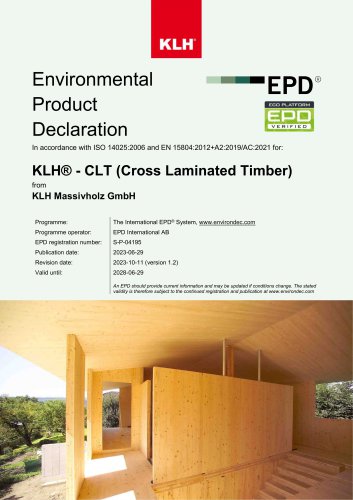


Archived catalogs
 Mission Statement
8 Pages