


Hinges and pivots
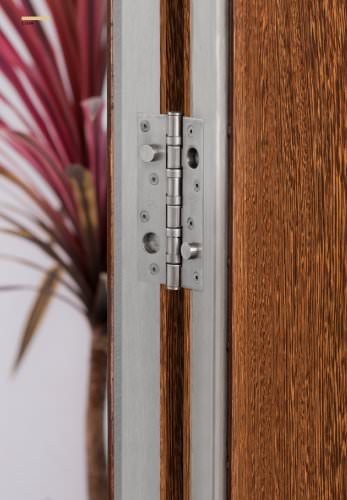
Hinges and pivots
The document provides detailed technical information on hinges and pivots, focusing on their classification based on door opening direction. For right-hand doors, add 'D' to the reference, and for left-hand doors, add 'E'.
Hinges must comply with European Standard EN1935:2002 under the EU directive on construction products (89/106/EEC). Single-axis hinges require a CE conformity certificate for use in fireproof/smoke doors and emergency exits. JNF conducts internal resistance tests according to this standard.
Hinges are designed to support specific loads, influenced by door weight, dimensions, usage frequency, and installed accessories. It is recommended to use at least three hinges per door for safety, with a potential fourth hinge depending on usage.
Step 1 involves determining the door's weight and necessary weight adjustments based on dimensions and usage. A formula is provided to calculate the percentage increase if the height-to-width ratio is less than 2. Step 2 involves selecting the hinge type based on the theoretical weight, which includes actual weight and increments for additional factors like door closers and usage frequency.
Hinges are classified according to their intended use, ranging from light to severe, considering factors such as frequency of use and potential for misuse, with grades assigned accordingly.
The document includes tables detailing the relationship between door dimensions and weight increments, as well as hinge classifications based on usage conditions and endurance tests.
1. Grade 1 - Light Use: Suitable for doors and windows in areas with low usage frequency and minimal public access.
2. Grade 2 - Medium Use: For doors and windows in domestic and office settings with average usage and some risk of misuse.
3. Grade 3 - High Use: Designed for public buildings with high usage and a higher likelihood of misuse.
4. Grade 4 - Severe Use: For doors subject to frequent and intentional misuse.
1. Mark hinge positions as per the provided diagrams.
2. Place the first and second hinges 237 mm from the door ends.
3. The third hinge should be 370 mm from the first hinge.
1. Conduct systematic inspections and maintenance, especially for emergency doors.
2. Lubricate hinges annually or every 25,000 cycles.
3. Ensure screws are secure and replace if necessary.
4. Check for corrosion and ensure proper door alignment.
1. Made from stainless steel EN 1.4372, suitable for most environments except coastal areas.
2. Economical due to lower nickel content and ISO 9001 quality control.
1. Made from stainless steel EN 1.4301 or EN 1.4401, offering high corrosion resistance.
2. Suitable for environments requiring high durability.
1. Designed for heavy-duty doors, allowing three-dimensional adjustments.
2. Made from stainless steel or aluminum, suitable for frameless architecture.
3. Features include a maximum opening angle of 180 degrees and self-lubricating washers.
- Materials: Most hinges and pivots are made from EN 1.4301 Satin stainless steel, ensuring durability and a satin finish.
- Load Capacities: The document specifies maximum load capacities for different models, ranging from 20 kg to 200 kg, depending on the hinge or pivot type.
- Dimensions: Detailed measurements are provided for each product, including thickness, width, and other critical dimensions.
- Standard Hinges: Includes building hinges and piano hinges, suitable for various door types with load capacities up to 60 kg.
- Spring Hinges: Designed for single or double action doors, featuring ball bearings and adjustable torsion springs for maintenance-free operation.
- Flush Hinges: Suitable for double action doors, available with different load capacities and designed for easy installation.
- Pivot Systems: Includes top and bottom pivots, as well as pivoting systems that do not require floor drilling, suitable for doors with thicknesses from 35 to 45 mm.
- Adjustability: Many products feature adjustable components, such as spring tension and height, to accommodate different installation requirements.
- Indoor Use: Some products are specifically designed for indoor use, with international patents protecting their design.
- Maintenance: The document highlights maintenance-free features, particularly for spring hinges with ball bearings.
- Products comply with EN1935 standards, ensuring quality and performance in door hardware.
- Some hinges and pivots include innovative systems like new torsion spring systems and adjustable power settings.
Catalog excerpts
www.jnf.pt C DOBRADIÇAS & PIVOTS / HINGES & PIVOTS / BISAGRAS & PIVOTES. C/325
Open the catalog to page 2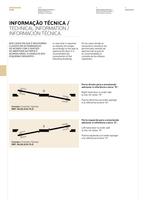
C/326 Dobradiças & Pivots / Hinges & Pivots / Bisagras & Pivotes Informação técnica / Technical information / Información técnica. INFORMAÇÃO TÉCNICA / TECHNICAL INFORMATION / INFORMACIÓN TÉCNICA. NOS CASOS EM QUE É NECESSÁRIO CLASSIFICAR AS DOBRADIÇAS DE ACORDO COM O SENTIDO DE ABERTURA DA PORTA É ACONSELHÁVEL A CONSULTA DOS ESQUEMAS SEGUINTES. In case that is required to classify the hinges accordingly to the way to opening the door it is recomended the consultation of the following drawings. En los casos donde es necessario classificar los pernios pelo sentido de apertura de la puerta es recomendable...
Open the catalog to page 3
Informação técnica / Technical information / Información técnica. C/327 Certificado de conformidade CE / Marcação CE Certificate of conformity / CE Certificado de conformidad / CE No âmbito da directiva UE relativa aos produtos de construção (89/106/CEE), a norma europeia EN1935:2002 – Anexo ZA suporta os requisitos do mandato, presumindo a aptidão de dobradiças de eixo simples em utilizações previstas conforme indicadas. Under the EU directive on construction products (89/106/EEC), European Standard EN1935: 2002 - Annex ZA supports the requirements of the mandate, assuming the ability of hinges...
Open the catalog to page 4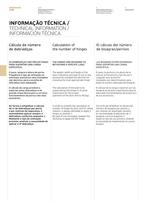
C/328 Dobradiças & Pivots / Hinges & Pivots / Bisagras & Pivotes Informação técnica / Technical information / Información técnica. www.jnf.pt INFORMAÇÃO TÉCNICA / TECHNICAL INFORMATION / INFORMACIÓN TÉCNICA. Cálculo do número de dobradiças Calculation of the number of hinges El cálculo del número de bisagras/pernios AS DOBRADIÇAS SÃO PROJECTADAS PARA SUPORTAR UMA CARGA ESPECIFÍCA. THE HINGES ARE DESIGNED TO WITHSTAND A SPECIFIC LOAD. LAS BISAGRAS ESTÁN DISEÑADAS PARA SOPORTAR UNA CARGA ESPECÍFICA. O peso, largura e altura da porta, frequência e tipo de utilização ou eventuais acessórios nela...
Open the catalog to page 5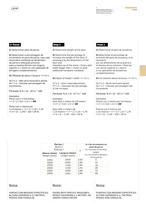
Informação técnica / Technical information / Información técnica. C/329 1º Passo Step 1 A) Determinar peso da porta. A) Determine weight of the door. A) Determinar el peso de la puerta. B) Determinar a percentagem de incremento ao peso da porta, caso seja necessário mediante as dimensões da porta e utilização prevista para a mesma (Portas com largura superior a 1 metro ou com aplicação de ferragens complementares). B) Determine the percentage to increase the weight of the door, if necessary by the dimensions of the door and intended use of the same. ( Doors with width bigger then 1 meter or with...
Open the catalog to page 6
C/330 Dobradiças & Pivots / Hinges & Pivots / Bisagras & Pivotes Informação técnica / Technical information / Información técnica. www.jnf.pt INFORMAÇÃO TÉCNICA / TECHNICAL INFORMATION / INFORMACIÓN TÉCNICA. B2) UTILIZAÇÃO PREVISTA: Instalação mola aérea: + 20 % Instalação mola aérea com paragem: + 75 % Frequência de utilização elevada: + 30 % Frequência de utilização abusiva: + 75 % B2) INTENDED USE: Install door closer: + 20% Install door closer with hold function: + 75% High frequency of use: + 30% Abusive use frequency : + 75% Peso teórico = Peso real + Incrementos Theoretical weight = weight...
Open the catalog to page 7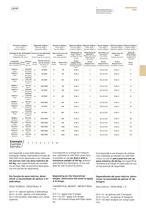
C/331 Informação técnica / Technical information / Información técnica. Primeiro digito / First digit / Primer dígito / Segundo digito / Second digit / Segundo dígito Categoria de utilização/ Ensaio de durabilidade (ciclos) / Use category / Endurance test (cycles)/ Categoría de uso / Terceiro digito / Third digit / Tercer dígito / Quarto digito / Quinto digito / Sexto digito / Sétimo digito / Oitavo digito / Fourth digit / Fifth digit / Sixt digit / Seventh digit / Eighth digit / Cuarto dígito / Quinto dígito / Sexto dígito / Séptimo dígito / Octavo dígito / Massa da porta de ensaio / Test door...
Open the catalog to page 8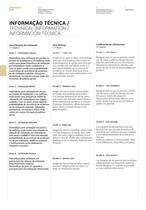
C/332 Dobradiças & Pivots / Hinges & Pivots / Bisagras & Pivotes Informação técnica / Technical information / Información técnica. www.jnf.pt INFORMAÇÃO TÉCNICA / TECHNICAL INFORMATION / INFORMACIÓN TÉCNICA. Classificação de utilização: ( 1º Digito ) User Rating: ( 1º Digit ) Calificación de utilizaccion: (1º Dígito) Grau 1 – Utilização Ligeira Grade 1 - Light use Grado 1 - Uso ligero Dobradiças para utilização em portas ou janelas de habitações e em edifícios onde exista uma baixa frequência de utilização por utilizadores muito cuidadosos e com os quais exista uma probabilidade muito baixa de...
Open the catalog to page 9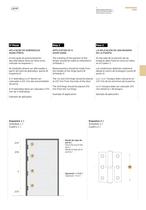
C/333 Informação técnica / Technical information / Información técnica. 3º Passo Step 3 Paso 3 APLICAÇÃO DE DOBRADIÇAS NUMA PORTA APPLICATION OF A DOOR HINGE LA APLICACIÓN DE UNA BISAGRA DE LA PUERTA A marcação do posicionamento das dobradiças deve ser feita como indicado no esquema 1. The marking of the position of the hinges should be made as indicated in Schedule 1. El marcado de la posición de las bisagras debe hacerse como se indica en el Cuadro 1. As medições devem ser efectuadas a partir do meio da dobradiça (ponto M esquema 2) Measurements should be made from the middle of the hinge (point...
Open the catalog to page 10All JNF catalogs and technical brochures
 GENERAL HARDWARE
44 Pages
 GEOMETRIC QUADRO
1 Page
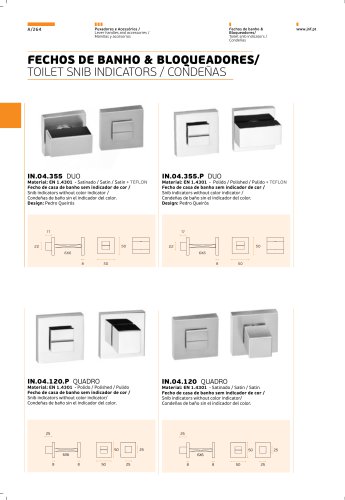 TOILET SNIB INDICATORS
1 Page
 times series
2 Pages
 connect systems
15 Pages
 FREE LINE
13 Pages
 COPLAN SERIES 150 / 175 / 245
12 Pages
 Link Silver Collection
2 Pages
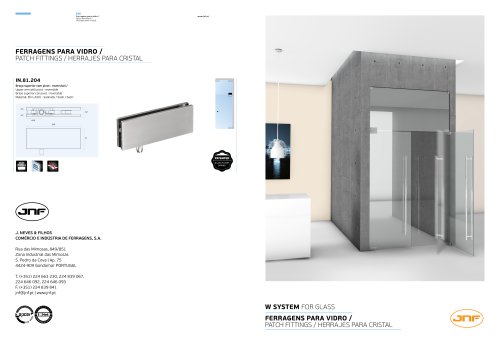 Hydraulic pivot - W System
2 Pages
 WIRE ROPE AND FITTINGS
28 Pages
 AIDS FOR DISABLED PEOPLE
30 Pages
 Glass hardware
190 Pages
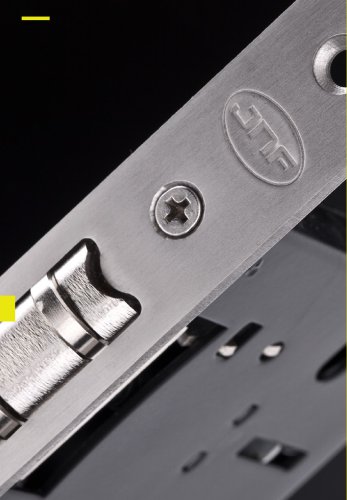 LOCKING SYSTEMS
266 Pages
 Access control systems
62 Pages
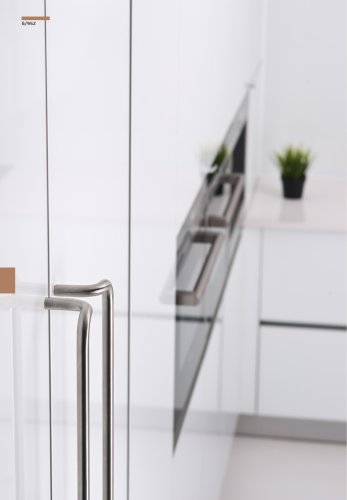 FURNITURE KNOB
38 Pages
 SLIDING AND FOLDING DOOR SYSTEMS
228 Pages
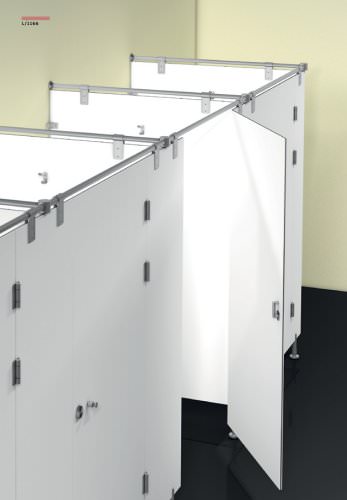 Sanitary booth hardware
24 Pages
 Bathroom Acessories
116 Pages
 pictograms
24 Pages
 Locks and Door Closers
178 Pages
 Furniture Hardware
28 Pages
 The company - JNF
38 Pages


Archived catalogs
 2017 LEVER HANDLES AND ACCESSORIES
268 Pages
 2017 HINGES & PIVOTS
80 Pages
 2015 LEVER HANDLES AND ACCESSORIES
250 Pages
 2015 HINGES & PIVOTS
74 Pages
 TIMES SERIES - JNF Bronze
2 Pages
 Sliding and folding doors
168 Pages
 JNF General hardware
64 Pages
 Pull handles
60 Pages
 ID JNF
38 Pages
 Lever Handles and acessories
228 Pages
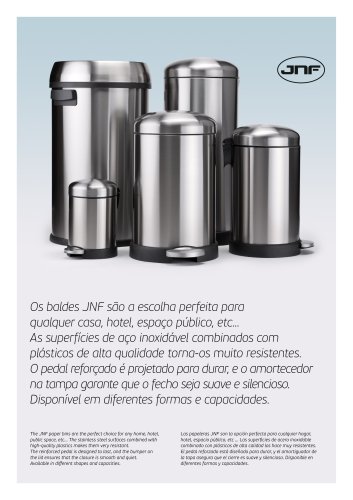 BASKET SERIES - JNF 2014
4 Pages
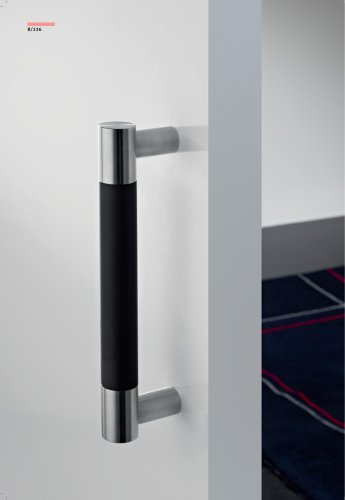
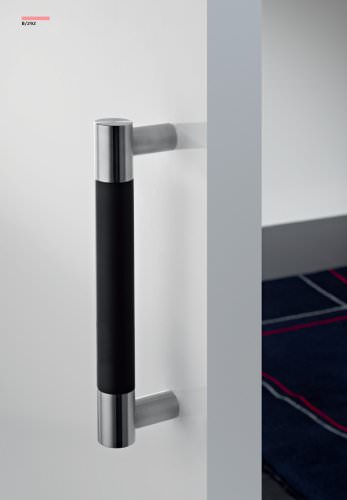
- Industrial knob
- Metal handle
- Door handle
- Contemporary handle
- Contemporary hinge
- Industrial soap dispenser
- Pull handle
- Metal pull handle
- Door pull handle
- Commercial soap dispenser
- Contemporary pull handle
- Metal hinge
- Window handle
- Manual soap dispenser
- Satin finish handle
- Wall-mounted soap dispenser
- Stainless steel handle
- Industrial furniture handle
- VirtualExpo Group
- Our Partners
- Careers
- Testimonials