
- Catalogs
- Jindao Floors
- HOW TO SELECT RAISED ACCESS FLOOR?

HOW TO SELECT RAISED ACCESS FLOOR?

HOW TO SELECT RAISED ACCESS FLOOR?
This document provides guidance on selecting a raised access floor by assessing the structural performance required. It emphasizes the importance of evaluating the loadings that will be imposed on the floor surface.
Concentrated loads are applied to a small area, typically by stationary furniture and equipment with legs. These loads cause deflection and permanent set on the panel surface. Recommended deflection is between 2.0 to 2.5 mm (KN on a 25mm indentor).
Rolling loads are caused by equipment on wheels moving across the floor. They are defined by the number of passes, wheel size and hardness, and the combined weight on each wheel. Rolling loads are critical as they can cause significant damage. Common conditions include move-in equipment, manual carts, and electric carts.
Ultimate loads refer to the point at which the panel structurally fails and can no longer support any load. It is often expressed as a multiple of concentrated load, with a recommended minimum safety factor of three.
Uniform loads are distributed over the entire panel area, typically by stationary furniture and equipment without legs. The uniform load rating is specified in KN/m2.
Catalog excerpts
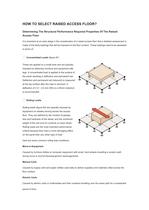
HOW TO SELECT RAISED ACCESS FLOOR? Determining The Structural Performance Required Properties Of The Raised Access Floor It is important at an early stage in the consideration of a raised access floor that a detailed assessment is made of the likely loadings that will be imposed on the floor surface. These loadings need to be assessed in terms of: Concentrated Loads (figure #1) These are applied on a small area and are typically imposed by stationary furniture and equipment with legs. A concentrated load is applied to the surface of the panel resulting in deflection and permanent set. Deflection and permanent set (rebound) is measured at the top surface after the load is removed. A deflection of 2.0 ~ 2.5 mm (KN on a 25mm indentor) is recommended. Rolling Loads Rolling loads (figure #2) are typically imposed by equipment on wheels moving across the access floor. They are defined by the number of passes, size and hardness of the wheel, and the combined weight of the cart and it’s contents on each wheel. Rolling loads are the most important performance criteria because they have a more damaging effect on the panel than any other type of load. Here are some common rolling load conditions: Move-in-Equipment Caused by furniture dollies or computer equipment with small, hard wheels travelling a random path during move-in and furniture/equipment rearrangements. Manual Carts Caused by supply carts and paper dollies used daily to deliver supplies and materials rolled across the floor surface. Electric Carts Caused by electric carts or mailmobiles and their contents travelling over the same path for a substantial period of time.
Open the catalog to page 1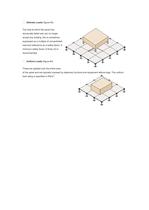
Ultimate Loads (figure #3) The load at which the panel has structurally failed and can no longer accept any loading. this is sometimes expressed as a multiple of concentrated load and referred to as a safety factor. A minimum safety factor of three (3) is recommended. Uniform Loads (figure #4) These are applied over the entire area of the panel and are typically imposed by stationary furniture and equipment without legs. The uniform load rating is specified in KN/m2.
Open the catalog to page 2All Jindao Floors catalogs and technical brochures
 LG® ESD Control Vinyl Tile
4 Pages
 MOVAFLOR
7 Pages
 Antistatic HPL
2 Pages
 Floor Diffusers
16 Pages
 Access Floor Products
3 Pages
 RAISED ACCESS FLOOR SYSTEMS
8 Pages


