
- Catalogs
- Jackon Insulation
- EnvironmEntal Product dEclaration

- Products
- Catalogs
- News & Trends
- Exhibitions
EnvironmEntal Product dEclaration

EnvironmEntal Product dEclaration
This document is an Environmental Product Declaration (EPD) for Extruded Polystyrene (XPS) Foam Insulation, issued by EXIBA and edited by the Environmental Construction Products Organisation (ECO). It adheres to ISO 14025 standards and covers the environmental impact of 1 m² of 100 mm thick XPS foam board.
XPS foam is a thermoplastic insulation material available in board form with a density range of 30 to 50 kg/m³. The EPD applies to boards with a reference density of 34.5 kg/m³. The boards are available in various compressive strengths (150 to 700 kPa) and surface finishes, including extrusion skin, planed, grooved, or thermally embossed. They are labeled with the CE-mark according to EN 13164 and are certified by various European bodies.
The document provides detailed environmental parameters for the production, construction, use, and end-of-life stages of XPS foam. Key metrics include primary energy consumption, global warming potential, and ozone depletion potential. The production stage is the most energy-intensive, while the end-of-life stage offers potential energy recovery.
XPS is produced by melting polystyrene granules and injecting a blowing agent under high pressure. The process results in a board with a homogeneous, closed-cell structure. Most off-grade material is recycled back into the production process.
XPS boards are easy to handle and install, with no special health or safety precautions required. They are resistant to water absorption and maintain their thermal insulation properties over time. The service life of XPS foam typically matches the lifespan of the building in which it is installed.
XPS boards can be reused, especially in applications like inverted roofs. They have a high calorific value, allowing for energy recovery in waste incinerators. Boards that cannot be reused are typically landfilled.
The life cycle assessment (LCA) covers cradle-to-gate production and end-of-life scenarios, including a 50% thermal recovery rate. Data quality is based on 2007 production data from major European manufacturers, and background data is sourced from the GaBi 4 database.
This EPD provides a comprehensive overview of the environmental impact of XPS foam insulation, highlighting its energy efficiency, durability, and potential for recycling and energy recovery.
The LCA results are divided into stages: Product Stage, Construction Process Stage, Use Stage, End-of-Life, and Next Product System. Key parameters include:
- Primary energy from non-renewable resources: 320.460 MJ
- Primary energy from renewable resources: 3.217 MJ
- Global warming potential (GWP 100): 14.154 kg CO2 eqv.
- Ozone depletion potential (ODP): 4.59 E-7 kg R11 eqv.
The document highlights the significant impact of raw material extraction and processing, particularly polystyrene production, on most environmental categories. The foam production process contributes notably to the photochemical oxidant creation potential (POCP) due to emissions during extrusion.
The end-of-life stage shows a high contribution to the global warming potential due to emissions from incineration. However, there are positive effects from thermal recovery, which substitutes electricity and thermal energy.
The document provides contact details for the Environmental Construction Products Organisation, the Institut Bauen und Umwelt e.V., and the European Extruded Polystyrene Insulation Board Association, among others.
Catalog excerpts

ths european XPS association ENVIRNMENTAL PRODUCT DECLARATION According to ISO 14025 .10 itor D۩claration num Date of issue Validi ronmental Construction Products Organisation (E O-XPS-010101-1007 07.07.2010 Extruded Polystyrne (XPS) Foam Insulation EXIBA
Open the catalog to page 1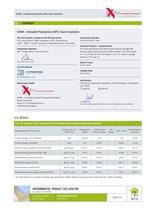
01 SUMMARY EXIBA - Extruded Polystyrne (XPS) Foam Insulation This Dclaration is based on the PCR document: PCR 詄Foam Plastics 2009" (reviewed as PCR Schaumkunst-stoffe", 2009-11 by IBU third party independent expert committee). Declaration Number ECO-XPS-010101-1007 Programme Operator IBU - Institut Bauen und Umwelt e.V. Declared Product / Declared Unit XPS (extruded polystyrene foam) boards without halogenated blowing agent produced by the EXIBA members. The EPD applies to 1 m2 of 100 mm thick XPS board, i.e. 0.1 m3, with an average density of 34.5 kg/m3. Date of Issue 07. 07. 2010 Validity...
Open the catalog to page 2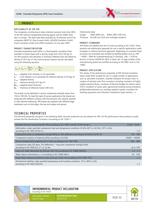
PRODUCT APPLICABILITY OF THE EPD The companies contributing to data collection produce more than 90% of the XPS without halogenated blowing agents sold by EXIBA mem-bers in Europe. The data have been provided by 18 factories out of five companies (BASF SE, Dow Europe GmbH, JACKON Insulation GmbH, Knauf Insulation GmbH and URSA Insulation S.A.) for year 2007. PRODUCT CHARACTERIZATION Extruded polystyrene foam (XPS) is a thermoplastic insulation foam available in board shape with a density range from 30 to 50 kg/m3. For XPS products with densities or thickness different from the reference density...
Open the catalog to page 3
2.1 PRODUCTION 02 MANUFACTURING XPS foams are mostly made of Polystyrne (90 to 95% by weight -CAS 9003-53-6), blown with carbon dioxide (CAS 124-38-9) and halogen-free co-blowing agents altogether up to 8% by weight. The drop in pressure at the exit die causes the polystyrene to foam into a board with homogeneous and closed cell structure. Then the boards' edges are trimmed, and the product is cut to dimensions. The smooth foam skin resulting from the extrusion process remains on the boards or is removed mechanically for particular board types to achieve better adhesive strength in combination...
Open the catalog to page 4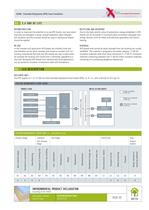
EXIBA - Extruded Polystyrne (XPS) Foam Insulation 2.4 end of life deconstruction In order to maximize the potential to re-use XPS boards, one must avoid that they are damaged or glued. Instead separation layers between the insulation and the concrete should be used or mechanical fixation should be applied. re-use In the inverted roof application XPS boards are installed loose laid and therefore can be easily removed and reused on another roof. For existing conventional flat-roofs the XPS boards can stay in place when for example the existing roof construction is thermally upgraded as a plus-roof....
Open the catalog to page 5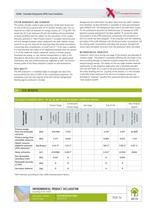
SYSTEM BOUNDARIES AND SCENARIOS The system includes cradle to gate production of the foam board and an end-of-life (EoL) scenario with 50 % thermal recovery rate. This corresponds to a mass of materials for energy recovery of 1.73 kg XPS. The remaining 50 % are disposed off with the building and are estimated as being landfilled with the rubble. For the calculation of EoL credits (recovery potential in "Next Product System"), European electricity grid mix and average European steam production are used. Neither compo-nents for re-use nor materials for recycling leave the system boundaries. Concerning...
Open the catalog to page 6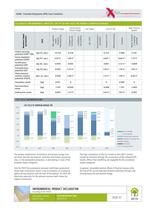
LCA RESULTS ENVIRQNMENTAL IMPACTST: 1M2 QF 100 MM THICK XPS BOARDS (EUROPEAN AVERAGE) Product Stage Construction Use St Process Stage End-of-Life Next Product System Resource input parameters Unit Raw material supply, Transport, Manufacturing Transport to building site Installation into building Use total Deconstruction / demolition Transport to EoL Waste processing Disposal Reuse, recovery or recycling potential Global warming potential (GWP 100) [kg CO2 eqv.] 14.154 0.526 0.223 5.960 -3.591 Ozone depletion potential (ODP) [kg R11 eqv.] 4.59 E-7 1.00 E-9 4.24 E-10 8.68 E-10 -1.74 E-7 Acidification...
Open the catalog to page 7
m Editor ECO - Environmental Construction Products Organisation Postfach 18 02 20 53032 Bonn Germany phone +49 (0)7000 86 93 58-0 fax +49 (0)7000 86 93 58-1 mail [email protected] web www.eco-europe.org ECO Institut Bauen und Umwelt e.V. Programme Operator Institut Bauen und Umwelt e.V. Rheinufer 108 53639 Knigswinter Germany phone +49 (0)2223 29 66 79- 0 fax +49 (0)2223 29 66 79- 0 mail [email protected] web www.bau-umwelt.com ^iba Ihe europen XPS association Declaration Holder EXIBA - European Extruded Polystyrene Insulation Board Association Avenue E. van Nieuwenhuyse, 4 1160 Brussels...
Open the catalog to page 8All Jackon Insulation catalogs and technical brochures
 JACKOBOARD® Catalogue N° 34
32 Pages
 JACKODUR® Catalogue N° 33
24 Pages
 JACKODUR® WA filter layer
2 Pages
 JACKODUR® Atlas
6 Pages
 JACKOBOARD® Flexo Plus
2 Pages


Archived catalogs
 JACKODUR® Plus 300 Gefiniert
2 Pages
 JACKOBOARD® Aqua
2 Pages
 JACKOBOARD® Plano NF
2 Pages
 JACKODUR Insulation strips
2 Pages
 JACKODUR Plus 300 FT FTR
2 Pages
 JACKODUR KF 300 500 700 FTD
2 Pages
 CFR 300 FT/FTR
2 Pages

- Wash stand
- Contemporary wash basin
- Rectangular sink
- Countertop sink
- Industrial wallcovering
- Interior wall-covering
- Domestic use wall-covering
- Panel insulation
- Modern wall-covering
- Bench
- Shower tray
- Contemporary bench
- Waterproofing membrane
- Angled shower base
- Synthetic insulation
- Wall insulation
- Above floor shower base
- High-performance insulation