

- Company
- Products
- Catalogs
- News & Trends
- Exhibitions
PVB

PVB
Interface has developed a process to recycle Poly Vinyl Butral (PVB) from car windscreens into carpet tiles, reducing the carbon footprint and extending the material's life.
Historical Innovations
Interface has a history of sustainable innovations, including the ReEntry® program for recycling carpet tiles, the introduction of recycled nylon, and the development of low-carbon footprint products like Microsfera®.
Mission Zero®
Launched in 1994, Mission Zero® aims for full sustainability by 2020, with all raw materials being 100% recycled or biobased. Significant progress includes a 90% carbon reduction in Europe and the use of renewable energy in manufacturing.
Life Cycle Assessment (LCA)
Interface uses LCA to measure environmental impacts, identifying raw materials, particularly yarn and latex precoat, as major contributors. Strategies to reduce impact include using less material, more recycled content, and alternative materials.
Recycled PVB in Carpet Tiles
PVB, a laminate used in car windows, is non-toxic, non-corrosive, and has good tensile strength. Using recycled PVB in carpet tiles reduces the precoat's carbon footprint by 80% compared to traditional latex.
Collaborative Process
The process involves collecting windscreen glass, separating and refining PVB, and using it in the precoat compound for carpet tiles. This collaboration ensures high performance and scalability.
Product Range and Expansion
The Scandinavian Collection was the first to use PVB precoat, and its use has expanded to all standard microtuft products, with plans for further expansion.
Conclusion
Interface's commitment to sustainability is evident in its innovative use of recycled materials, significant carbon footprint reductions, and ongoing efforts to achieve Mission Zero®.
Catalog excerpts
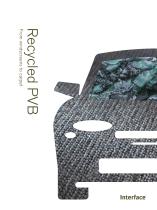
Recycled PVB From windscreens to carpet
Open the catalog to page 1
There are over one billion cars in the world. Annually, on average 5-6% of cars have a replacement window. The EU is pushing for recycling of these windscreens, but the laminate material (PVB) that prevents the windows from shattering has not been given a second life, until recently. Interface has partnered with the supply chain to process the laminate and use it in the production of carpet tiles. This means we are able to reduce the carbon footprint of our carpet tiles and extend the useful life of PVB at the same time.
Open the catalog to page 2
First post-consumer recycled content nylon. Launched the first carpet tile made with 100% recycled nylon yarn. Today more than 400 colourways with 100% recycled yarn are available. Introduced the ReEntry® programme, taking back used carpet tile. 2000 Pioneered microtuft carpet tile, using up to 50% less yarn. Cutting the umbilical cord to oil
Open the catalog to page 4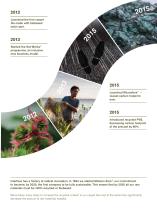
Launched the first carpet tile made with biobased nylon yarn. Started the Net-Works® programme, an inclusive new business model. 2015 Launched Microsfera® – lowest carbon footprint ever. 2015 Introduced recycled PVB, decreasing carbon footprint of the precoat by 80%. Interface has a history of radical innovation. In 1994 we started Mission Zero®, our commitment to become, by 2020, the first company to be fully sustainable. This means that by 2020 all our raw materials must be 100% recycled or biobased. We’ve taken many steps to increase the recycled content in our carpet tiles and at the same...
Open the catalog to page 5
Taking on the biggest impacts Since 2000, we have used Life Cycle Assessment (LCA) to measure the environmental impact of our products. LCA is the scientifically recognised way to measure the actual impact of a product throughout its lifecycle. About precoat The precoat is a key component of the carpet tile, as it’s what keeps the yarn stuck to the backing. Synthetic latex is the main component for precoat throughout the carpet industry. An LCA for a typical carpet tile shows that the raw material stage is responsible for most of the impact. More specifically, the yarn and the latex precoat are...
Open the catalog to page 6
Typical carpet tile construction Precoat Backing Compound Stabilising Glass Tissue Backing Cover
Open the catalog to page 7
There are three obvious ways to decrease the environmental impact associated with a raw material: • Use less material • Use more recycled material • Find an alternative material with lower impact At Interface, we are aggressively pursuing all these options. In 2008, we focused our attention on the precoat, a key component of the carpet tile. Seven years later we have multiple results. We have been able to remove the precoat entirely from our Microsfera product, but this solution is not viable for every carpet tile. Our answer for the others? Laminated glass from building glass and car...
Open the catalog to page 8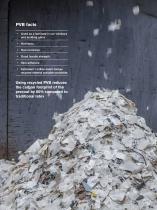
PVB facts • Used as a laminate in car windows and building glass • Non-toxic • Non-corrosive • Good tensile strength • Very adhesive • Estimated 1 million metric tonnes recycled material avaliable worldwide Using recycled PVB reduces the carbon footprint of the precoat by 80% compared to traditional latex
Open the catalog to page 9
Windscreen replacement Glass is sent to a recycling plant The PVB is refined into a dispersion The dispersion is used in the precoat compound
Open the catalog to page 10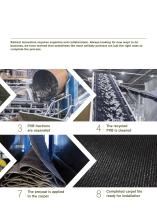
Radical innovation requires expertise and collaboration. Always looking for new ways to do business, we have learned that sometimes the most unlikely partners are just the right ones to complete the process. The precoat is applied to the carpet Completed carpet tile ready for installation
Open the catalog to page 11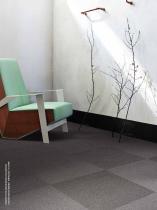
PRODUCT THE SCANDINAVIAN COLLECTION COLOUR 303105 MALMO INSTALLED 1/4 TURN
Open the catalog to page 12
Just like other raw materials, the properties of recycled PVB vary. That's why every batch of material is tested before it is shipped to Interface. The strict tolerances mean that the performance of a carpet tile with a PVB precoat completely matches that of a carpet tile with a traditional latex precoat. In 2015, the first product range to incorporate the PVB precoat was The Scandinavian Collection. This minimalistic microtuft offers a subtle linear design, creating a modern look that is suitable for a wide range of interiors. Just a year later, the recycled PVB precoat is used in all our standard microtuft...
Open the catalog to page 13
Mission Zero is our commitment to become, by 2020, the first company to be fully sustainable - which means having zero negative impact on the environment. Ultimately, we want to become restorative, giving back more than we take. 90% carbon reduction in Europe You can judge us by our actions. Since 1996, we have reduced our carbon footprint by 90% in Europe. Producing a carpet tile uses only half the energy it used to in 1996. Our manufacturing plant in Scherpenzeel, the Netherlands, uses 100% renewable energy, made from fish and chocolate waste. The manufacturing process uses virtually zero water,...
Open the catalog to page 15
www.interface.com Mission Zero: our promise to eliminate any negative impact our company may have on the environment by the year 2020.
Open the catalog to page 16All Interface catalogs and technical brochures
 CE200
CE2002 Pages
 Northern Grain | LVT
11 Pages
 Design Studio
6 Pages
 Urban Retreat 501
9 Pages
 On Line
24 Pages
 Fresco Valley
11 Pages
 Open Air Collection
17 Pages
 Open Air Transitions & Accents
17 Pages
 Heuga 580 II
11 Pages
 Brushed Lines
13 Pages
 Drawn Lines
13 Pages
 EMEA Casebook 5th Ed.
126 Pages
 Heuga 725
9 Pages
 Touch of Timber
9 Pages
 New Horizons II
9 Pages
 Employ Dimensions
9 Pages
 Human Nature Collection
17 Pages
 Barricade Collection
9 Pages
 Embodied Beauty Collection
21 Pages
 Dolomite
13 Pages
 Composure
19 Pages
 Interface Hospitality
48 Pages
 Employ Constant
9 Pages
 Employ Lines
9 Pages
 Employ Loop
13 Pages
 Flash Line
11 Pages
 Heuga 530 II
9 Pages
 Heuga 727
11 Pages
 Ice Breaker
17 Pages
 Iridescence
13 Pages
 Look Both Ways Carpet
15 Pages
 Look Both Ways LVT
15 Pages
 Level Set Stones
13 Pages
 Level Set Woodgrains
15 Pages
 Near & Far
13 Pages
 NY+LON Streets Collection
19 Pages
 On Line / Off Line
15 Pages
 Polichrome Solid & Stipple
11 Pages
 Recreation
11 Pages
 Studio Set
13 Pages
 Superflor II
11 Pages
 Touch & Tones II
13 Pages
 Unity
Unity9 Pages
 Urban Retreat One
11 Pages
 Works Balance
9 Pages
 Works Effect
9 Pages
 Works Element
9 Pages
 Works Flow
9 Pages
 Works Fluid
9 Pages
 Works Freestyle
9 Pages
 Works Geometry
9 Pages
 Works Sense
9 Pages
 World Woven Collection
21 Pages
 Woven Gradience
15 Pages
 Yuton Collection
15 Pages
 Equilibrium
12 Pages
 Conscient
20 Pages
 Human Connections
28 Pages
 Elevation III
12 Pages
 Contemplation
20 Pages
 Monochrome
12 Pages
 The Scandinavian Collection
8 Pages
 Transformation
9 Pages
 Yuton 104
5 Pages
 Yuton 105
6 Pages
Archived catalogs
 Net Effect One_March 2021
11 Pages
 Net Effect B602
7 Pages
 Net Effect B603
7 Pages
 World Woven
72 Pages
 World Woven Collection 2019
48 Pages
 Net Effect B601
7 Pages
 Human Nature 850
7 Pages
 Human Nature 830
7 Pages
 Human Nature 820
7 Pages
 Histonium
7 Pages
 Human Nature 810
7 Pages
 Composure_2017
20 Pages
 Barricade
16 Pages
 Employ Loop & Lines
20 Pages
 CIRCLE
7 Pages
 BIOSFERA
11 Pages
 WORLD TEXTILES
53 Pages
 AMBIANCE COLLECTION
41 Pages
 Net Effect One
6 Pages
 Vintage Reissue
6 Pages
 Net Effect Two
6 Pages
 Net Effect
19 Pages
 Vintage Ornate
6 Pages
 Walk the Plank
8 Pages
 Vermont
7 Pages
 Vintage Refine
6 Pages
 Urban Retreat 303
6 Pages
 Urban Retreat 302
6 Pages
 Urban Retreat 301
7 Pages
 Syncopation II
7 Pages
 Straightforward
8 Pages
 Urban Retreat 103
8 Pages
 Urban Retreat 102
7 Pages
 Urban Retreat 101
8 Pages
 Urban Retreat 203
6 Pages
 Urban Retreat 202
7 Pages
 Urban Retreat 201
7 Pages
 Superflor
7 Pages
 Tatami II
6 Pages
 Sherbet Fizz
9 Pages
 Scribble
7 Pages
 Sabi II
8 Pages
 Razzle Dazzle - Flare
6 Pages
 Razzle Dazzle - Bright Spark
7 Pages
 Precious Ground
7 Pages
 Polichrome
7 Pages
 Palette 2000
7 Pages
 Northern Light
8 Pages
 Paradox II
7 Pages
 Net Effect B703
7 Pages
 Net Effect B702
7 Pages
 Net Effect B701
7 Pages
 Mineral
6 Pages
 Microsfera
7 Pages
 Luxury Living
7 Pages
 Londinium
7 Pages
 Linear Tonal
6 Pages
 Mellopolis
7 Pages
 Lima
Lima7 Pages
 Knit One Purl One
8 Pages
 Hydropolis
7 Pages
 Heuga 727 SD + PD
9 Pages
 Heuga 723
7 Pages
 Heuga 580
8 Pages
 Pattern Collection
36 Pages
 Infuse & Composure
20 Pages
 Vintage - Nebbia
12 Pages
 Vintage - Refine
12 Pages
 Global Change Collection
44 Pages
 Multichrome
16 Pages
 Skinny Planks
32 Pages
 Current
12 Pages
 Works Dash & Hype
16 Pages
 Visual Code Collection
48 Pages
 Duet
Duet12 Pages
 aerial flying colors
56 Pages
 Equal Measure Collection
28 Pages


- Interface flooring
- Interface indoor flooring
- Interface tertiary flooring
- Interface plastic flooring
- Interface synthetic carpet
- Interface commercial carpet
- Interface tile flooring
- Interface non-slip flooring
- Interface gray flooring
- Commercial flooring
- Interface vinyl flooring
- Interface smooth flooring
- Interface tufted carpet
- Interface gray carpet
- Interface brown flooring
- Interface beige flooring
- Interface sustainable flooring
- Interface patterned carpet