

Premium Perlite

Premium Perlite
This document provides comprehensive guidelines on the design and application of perlite insulating concrete, primarily used for insulating roof decks and other semi-structural applications. It includes specifications, procedures, and standards for materials and installation.
- Perlite Insulating Concrete: A mix of perlite aggregate, Portland cement, air entraining agent, and water, with a dry density of 800 kg/m3 or less.
- Materials: Must conform to ASTM standards, including C 150 for Portland Cement and C 332 for lightweight aggregates.
- Control Joints: Should be made of a highly compressible, vapor-permeable material.
- Embedded Insulation: Expanded polystyrene board with a minimum density of 16 kg/m3.
- Reinforcing Mesh: Galvanized wire mesh with a minimum cross-sectional area of 0.17 cm2.
- Mixing: Use a mechanical mixer designed for lightweight insulating concrete. The mix should include water, air entraining solution, cement, and perlite aggregate.
- Yield Calculation: Ensure 100% yield by checking the wet density and adjusting the mix as necessary.
- Placement: Convey perlite concrete to the final deposit site without segregation or loss of material. Expanded polystyrene board should be placed in a minimum 3.1 mm wet slurry of insulating concrete.
- Curing: Under normal conditions, allow the concrete to air dry. In extreme dry conditions, additional water may be needed.
- Compressive Strength: Determined according to ASTM C 495.
- Oven Dry Unit Weight: A measure of insulation value, determined as per ASTM C 495.
- Consult the perlite aggregate manufacturer for information on air entraining agents and other additives.
- Ensure proper mixing and placement techniques to achieve desired properties and prevent loss of yield.
- Mix Ratio: Cement to perlite ratio affects density and strength.
- Thermal Conductivity: Varies with density and mix ratio.
- Compressive Strength: Ranges provided for different mix ratios.
The use of high early strength (Type III) Portland cement is recommended for perlite concrete. All materials, reinforcement, and forms should be free of frost, and no frozen materials or those containing ice should be used. If temperatures are expected to drop below 4°C within 24 hours of placing the concrete, the mixing water should be heated to a maximum of 48°C. Perlite insulating concrete should not be placed during freezing weather unless the contractor is experienced in the necessary techniques.
Built-up roofing should be applied once the perlite insulating concrete can support construction traffic and is dry enough for adhesion with hot asphalt or pitch. Roofing should proceed after the perlite concrete has cured for at least three days. Provision for perimeter or edge venting should be made using an open metal gravel guard or fascia.
Nailing or stapling are preferred methods for attaching the base sheet on perlite concrete applied over structural concrete.
- Variation of Plane: Deck thickness variation should not exceed 6.5 mm on a 3m straight edge, excluding substrate variations.
- Variation in Deck Thickness: Should not exceed 6.5 mm from the specified thickness, based on averaging measurements at three points on a 3m x 3m square.
- Rain or Freezing Damage: Allow the deck to cure for at least three days. After freezing or heavy rainfall, broom the surface if necessary before roofing. Excessively sealed areas should be removed and patched. Path additives may be used at the applicator's discretion. Minor scaling should be broomed before roofing. Perlite concrete exposed to extreme cold after setting will be strong enough for roofing if not mechanically damaged. Traffic should be prohibited to prevent damage.
Industrial Processors Limited, 70 Waitakere Road, Auckland, PO Box 36, Waitakere 0614, Auckland, New Zealand. Phone: +64 9 810 9627, Fax: +64 9 810 9037, Email: [email protected], Website: www.perlite.co.nz
Catalog excerpts

PERLITE INSULATING CONCRETE APPLICATION AND DESIGN INFORMATION FOR CONTRACTORS
Open the catalog to page 1
RECOMMENDED PRACTICES FOR WORKMANSHIP AND TOLERANCES 6.1 – Placement 7.1 – Variation of Plane Perlite concrete should be conveyed from the mixer to the place of final deposit by methods which will prevent segregation or loss of material. Equipment for conveying perlite concrete should be designed to ensure delivery without separation of materials or serous loss of air content. Variation in deck thickness should be no greater than 6.5 mm on a 3m straight edge. Pumping should be in accordance with recommendations of the perlite producer, and the perlite concrete shall meet the specified properties...
Open the catalog to page 2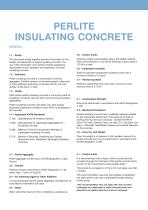
PERLITE INSULATING CONCRETE GENERAL 1.1 – Scope This document brings together pertinent information on the design and placement of perlite insulating concrete. The use of this information is for perlite concrete applicators responsible for the installation and application of perlite insulating concrete. Shall be a highly compressible vapour permeable material which will compress to one half its thickness under a load of 172 kPa or less. 1.2 – Definition Perlite insulating concrete is a combination of perlite aggregate, Portland cement, air entraining agent, water and/ or other additives producing...
Open the catalog to page 3
Refer to Table 5.1 below: TYPICAL PHYSICAL PROPERTIES OF PERLITE CONCRETE IN METRIC UNITS (Cement Density /Perlite) (Typical) Cement Perlite Entraining Density Density Conductivity Agent Range Range Range Compressive Density Strength when The use of the correct amount of air entraining agent is very important in successful perlite concrete construction. The air entraining agent produces countless tiny air bubbles in the concrete which reduces the density, increases the yield and contributes to the insulation factor of the dry concrete. Perlite insulating concrete should be mixed in a mechanical...
Open the catalog to page 4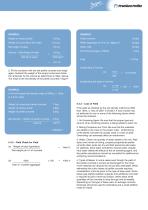
EXAMPLE: EXAMPLE: EXAMPLE: EXAMPLE: Weight of empty bucket: Weight of empty bucket: Weight of bucket filled with water: Weight of bucket filled with water: Net weight of water: Net weight of water: Volume = Net Weight of water Volume = Net Weight of water _________________ _________________ Density of water: Density of water: Perlite Cement: Perlite Cement: Perlite Aggregate (0.17m @ 128kg/m ): Perlite Aggregate (0.17m @ 128kg/m ): Air Entraining Agent: (700ml) Air Entraining Agent: (700ml) Total Total 0.01 m3 0.01 m3 Substituting in formula Substituting in formula 2. Fill the container with...
Open the catalog to page 5
Industrial Processors Limited 70 Waitakere Road, Auckland PO Box 36 Waitakere 0614, Auckland, New Zealand t. +64 9 810 9627 f. +64 9 810 9037 e. [email protected]
Open the catalog to page 6All Inpro catalogs and technical brochures
 Perlite Concrete
2 Pages
 The Perlite House
1 Page
 PERLITE INSULATING CONCRETE
2 Pages


- Industrial plaster
- Building coating
- Indoor coating
- Wall coating
- Thermal insulation
- Outdoor coating
- Wall insulation
- High-performance insulation
- Mineral insulation
- Non-flammable insulation
- Lightweight insulation
- Interior insulation
- Lime coating
- Gypsum plaster coating
- Ceiling insulation
- Insulating coating
- Plaster coating
- Swimming pool filter
- Flat roof insulation