- Catalogs
- IMPA Contemporary ideas
- Barrier fire protection coatings

Barrier fire protection coatings

Barrier fire protection coatings
IMPA, established in 1962 in Italy, is a prominent player in the paint and varnish industry, recognized for its dedication to quality and environmental standards. The company holds ISO 9001 and ISO 14001 certifications, ensuring efficient operations and minimized environmental impact.
For over 25 years, IMPA has been developing fire protection solutions, particularly focusing on intumescent paints that expand under heat to form an insulating layer. These solutions adhere to European standards EN 13501 and EN 13381 and possess CE marking.
Intumescent paints are applied in thin layers and can expand up to 70-80 times their original thickness, providing fire resistance. They are suitable for civil, commercial, and industrial buildings.
IMPA's intumescent paints preserve the aesthetic of structures, are easy to apply, and comply with building product regulations. They are used in various infrastructures such as railway stations, airports, and shopping centers.
IMPA has executed significant projects globally, including banks in Moscow and a thermo-nuclear plant in the Czech Republic.
Steel Structures: Barrier 87-1151 is used for steel protection, requiring clean, dry surfaces for application. Thickness is calculated based on fire resistance needs.
Reinforced Concrete Structures: Similar methods are used for concrete, with additional surface preparation and protective enamel layers.
IMPA's fire protection solutions meet rigorous standards, ensuring effective fire resistance while maintaining aesthetics. Their products are widely used across sectors, ensuring safety and compliance with international regulations.
The performance of intumescent paints is influenced by the massiveness of the sections they are applied to. Proper attention to covering thicknesses is essential for optimal fire resistance.
BARRIER paint is ready to use and should be applied in thick layers. It can be thinned with water if necessary. Application methods include airless spray, brush, roller, and conventional spray, with specific equipment recommendations for each method.
Drying time varies with thickness. At 25°C, a 600 μm wet layer can be repainted after a few hours and fully dries in about 24 hours. Proper thickness is crucial to avoid cracks.
Intumescent paint thickness can be equated to concrete thickness for fire resistance. Analytical methods are required for fire certification to verify expected results.
IMPA is a leading manufacturer in the paints and varnishes sector, specializing in intumescent paints for over 25 years, focusing on innovation across various markets.
Catalog excerpts

CONTEMPORARY IDEAS 4&£krier FIRE PROTECTION COATINGS www.fireprotectionbarrier.com
Open the catalog to page 1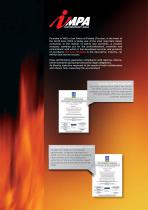
Founded in 1962 in San Pietro di Feletto (Treviso), in the heart of the North East, IMPA is today one of the most important Italian companies in the market of paints and varnishes. A modern company standing out for the professionalism, creativity and commitment with which it has developed services and products of excellence for over 50 years in the decorative, industry, car refinish and marine sectors. Impa certifications guarantee compliance with rigorous international standards going beyond purely legal obligations. Its Quality objective responds to the needs of both collaborators and clients,...
Open the catalog to page 2
PROTECTION AGAINST FIRE THE IMPA MISSION FOR THE FIRE PROTECTION Solutions based on the intumescent paints Where intumescent paints are used Main works carried out Some experiences DETAILS OF IMPA FIRE RESISTANCE SOLUTIONS Protection of the steel structures Application methods Covering thicknesses Protection of the reinforced concrete structures Application methods Covering thicknesses Application aspects
Open the catalog to page 3
THE IMPA MISSION FOR THE FIRE PROTECTION Fire can be an essential element when creating a good deal of the materials used in construction but it is also the first destructive factor. For more than 25 years, Impa has been researching and developing certified fire protection solutions. Our product line is subjected to the most rigid controls, conforms to the European EN 13501 – EN 13381 standards and has been attributed the European Technical Approval, affixing the CE marking, as it complies with the ETAG018 Guidelines. Starting with a careful assessment of the context and variables involved, the...
Open the catalog to page 4
Intumescent paints are applied combined with the building element to be protected, guaranteeing the necessary fire resistance. They are an example of reactive protection as their physical state expands when heated. They protect the element on which they are applied, due to the thermo-physical parameters of the modified product (decrease of the thermal conductivity) and to the effects of the heat absorption, deriving from the chemical reactions of transformation. The term “intumescent” comes from Latin and means “that starts to swell up”. Paints are applied with a layer that goes, from minimum...
Open the catalog to page 5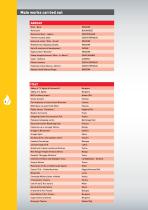
Main works carried out ABROAD
Open the catalog to page 6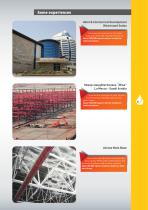
Some experiences Hotel & Commercial Development (Khartoum) Sudan Intumescent treatment of the Hotel’s steel and reinforced concrete structures. About 350,000 square metres treated on steel structures. Sheep slaughterhouses “Mina” La Mecca - Saudi Arabia Intumescent treatment of steel structures and various buildings used to slaughter sheep. About 300,000 square metres treated on steel structures. Aviano Nato Base Renovation and adjustment of several Hangars used for Military Plane Maintenance and of various buildings used for other purposes. About 50,000 square metres treated on steel structures....
Open the catalog to page 7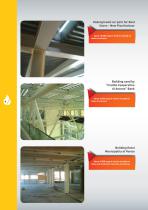
Underground car park for Boat Users - New Pisa Harbour About 10,000 square metres treated on steel structures. Building used by “Credito Cooperativo di Ancona” Bank About 5,000 square metres treated on steel structures. Building Hotel Municipality of Venice About 4,000 square metres treated on steel and reinforced concrete structures
Open the catalog to page 8
Hotel & Commercial Development in Khartoum, Sudan
Open the catalog to page 9
DETAILS OF IMPA FIRE RESISTANCE SOLUTIONS Protection of the steel structures Barrier 87-1151 is a product that allows you to effectively protect steel structural elements such as beams, columns, corrugated surfaces, etc. Internally: can be applied as a finish. Externally: can only be applied to surfaces that are not exposed to rain directly and are always protected by a protective water or solvent based enamel layer (0896 Top Lak, 1288 Top Coating Pro). The protective enamel layer must be just what is reasonably needed, with no excess, as a large thickness could stop foam from expanding freely...
Open the catalog to page 10
Nato base, Aviano- Italy
Open the catalog to page 11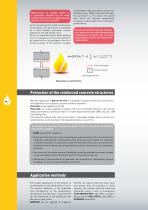
Massiveness or section factor is a parameter defined by the ratio between the surface of a body exposed to heat and its volume (S/V). For structural elements with a continuous, linear section, this parameter is calculated as a ratio between perimeter portion exposed to fire and section area. This is an important factor when defining the fire resistance of structural elements as, based on this, the passage of the fire’s thermal energy to the element changes considerably. That parameter can give you heating curves. Please note that the lower the parameter is, the slower the speed with which the...
Open the catalog to page 12
Covering thicknesses In a first phase you can consider the effect of intumescent paint by assimilating it to a concrete equivalent thickness. Through the tests carried out, those equivalences have been assessed for beams and columns, floors and walls based on the fire resistance class and on the protective coat thickness. Once you know the measurements of beams and iron cover, using tables you can calculate the missing iron cover thickness. That deficiency can be compensated by coating the element with a layer of intumescent paint, based on the table values, reported in the technical reports...
Open the catalog to page 13
CONTEMPORARY IDEAS IMPA is one of the most important manufacturing companies in the paints and varnishes sector and, since more than 25 years, it has been involving in the production of intumescent paints for the fire passive protection. The meaning of the word “innovation”, to IMPA, sums up the mission of a company really projected into the future. Impa divisions BUILDING Paints for Decorative, Wood, Marbles and for the Fire protection. INDUSTRY & REFINISH Products for Industry, Car refinish and Marine sector.
Open the catalog to page 15
www.fireprotectionbarrier.com IMPA SpA Via Crevada, 9/E 31020 • San Pietro di Feletto (Treviso), Italy tel +39 0438 4548 • fax +39 0438 454915 [email protected] www.impa.it PAINT AND COATING SOLUTIONS FOR DECORATIVE, FIRE PROTECTION, INDUSTRY, CAR REFINISH AND MARINE MARKET SECTORS
Open the catalog to page 16All IMPA Contemporary ideas catalogs and technical brochures
 Spray Repair Line
6 Pages
 1002 FONDOPAC EXTRA
1 Page
 0713 TURAPORI ALL' ACQUA
2 Pages
 1020 STUCCO SINTETICO
1 Page
 3005 PLASTUK LEGNO
3 Pages
 VEGAS
VEGAS2 Pages
 Magic HS
2 Pages
 linea_1000
2 Pages
 IDEALE
2 Pages
 BUILDING CATALOGUE 2017
132 Pages
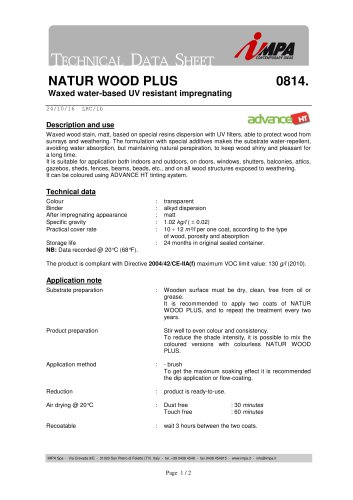 NATUR WOOD PLUS 0814
2 Pages
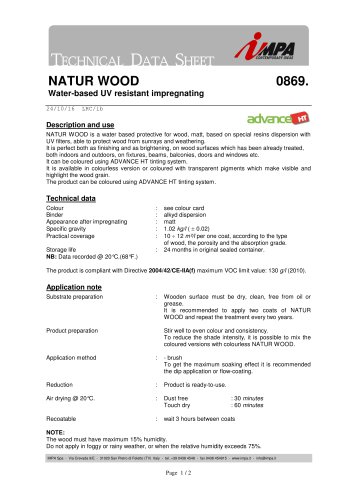 NATUR WOOD 0869
2 Pages
 POLY VA 0003
2 Pages
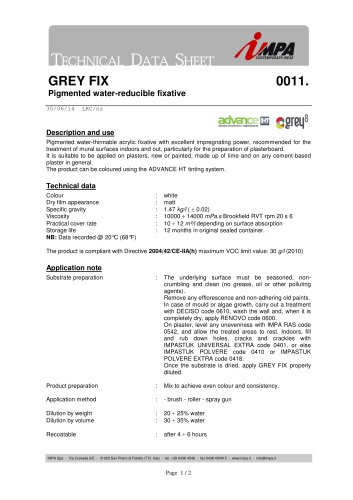 GREY FIX 0011
2 Pages
 ALBA
ALBA2 Pages
 Orizzonti Catalogue
44 Pages
 Mariner Catalogue
16 Pages
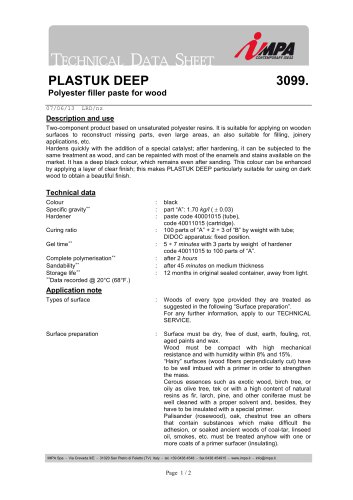 3099 PLASTUK DEEP
2 Pages
 0544 IMPA CEM
2 Pages
 BUILDING CATALOGUE 2016
136 Pages
 IMPA - COMPANY PROFILE
14 Pages