


- Products
- Catalogs
- News & Trends
- Exhibitions
How to apply IKO Roof Shingles?

How to apply IKO Roof Shingles?
IKO emphasizes the importance of proper application and roof preparation to prevent leaks. Shingles should not be installed directly over insulation, and mixing shingles from different production dates is discouraged. Proper handling and installation techniques are crucial for preventing damage and ensuring effective sealing.
The guide specifies the use of IKO products, including shingles, underlays, valley coverings, metal flashings, fasteners, bituminous mastic, vents, and starter strips. Each material has specific characteristics and applications to ensure durability and effectiveness.
Shingle requirements vary based on roof pitch and type. Additional materials should be ordered for hips, ridges, and starter strips. Local building codes should be consulted for specific regulations.
The roof deck must be smooth, firm, and dry, using quality materials like plywood or OSB. Proper ventilation is crucial for heat dissipation and moisture escape, with specific requirements based on roof pitch.
Nailing and sealing are critical for a secure roof. Nails must be positioned correctly, and manual sealing may be necessary in cold weather or high wind areas. Detailed instructions are provided for starter strips, first courses, and application procedures, including methods for valleys and eaves protection.
Underlay is recommended for certain slopes and climates to prevent water infiltration. Various methods for valley preparation are described, including open, woven, and closed cut methods, each with specific installation steps.
Proper installation of flashings around chimneys and other roof details is essential for water tightness. Reroofing guidelines are provided, with specific recommendations for different shingle types and roof slopes.
Adjustments and Cutting: Final courses of shingles should be adjusted to ensure the ridge capping covers the top courses equally on both sides. Rectangular and diamond-shaped shingles need to be cut into individual pieces at the cut-outs.
Application: Hip and ridge shingles should be applied in double thickness by stacking two pieces and bending them over the hip or ridge. In cold weather, shingles should be warmed before bending. Nails should be placed 16 cm from the tab edge and 2.5 cm from each side, with each piece exposed by 14 cm. Application should start from the end of the ridge opposite the prevailing winds.
Figures: Figures 9a and 9b provide visual guidance on the application process, including the positioning of nails and the exposure of shingles.
Catalog excerpts

General conditions Material requirements Terms 16 Estimating shingle requirements Roof preparation Shingle application Shingle application guide guide Shingle application - 13 -
Open the catalog to page 1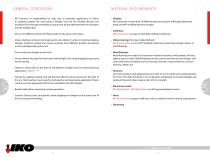
GENERAL CONDITIONS MATERIAL REQUIREMENTS • IKO assumes no responsibility for leaks due to improper application, or failure to properly prepare the roof surface. Shingles may not be installed directly over insulation; flow-through ventilated air space must be provided between the insulation and the nailable deck. • Shingles: IKO’s selection of more than 70 different types and colours of fibreglass based oxidised and APP modified bitumen shingles. • Do not mix different production dates/codes on the same roof surface. • Underlays: IKO Armourbase: a range of watertight roofing membranes. • Colour...
Open the catalog to page 2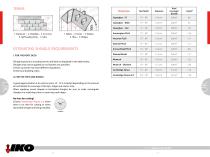
Roof pitch Roof coverage/ Bundle Superglass – Biber Armourglass PLUS Victorian PLUS Diamant PLUS ArmourShield PLUS Monarch – Diamant Cambridge Xpress Shingle type 1. Exposure • 2. Headlap • 3. Cut-outs 4. Self Sealing Strip • 5. Tabs 1. Rakes • 2. Eaves • 3. Valleys 4. Hips • 5. Ridges ESTIMATING SHINGLE REQUIREMENTS I. FOR THE ROOF DECK Shingle exposure is according to the roof pitch as displayed in the table below. Shingles may not be applied on roof pitches not specified. Certain countries may have different regulations. Check local building codes. II. FOR THE HIPS AND RIDGES A good approximation...
Open the catalog to page 3
ROOF PREPARATION The roof deck must be smooth, firm, dry and securely fastened. The deck should be made of good quality plywood, sheathing boards or nonveneer structural panels (wafer or strand board). Wooden boards can be maximum 15 cm wide. The thickness of the deck depends on the span between the beams. Check your local building code regulations. All wood products must be properly conditioned to be at moisture equilibrium. Decking should be installed in a staggered manner and sufficiently supported. Failure to use proper decking material, which can provide a rigid deck surface, can result...
Open the catalog to page 4
Attention: For low slope valleys use IKO Base for underlayment in the valley. This underlayment must be applied with good mechanical fastening (nails or screws every 20 cm in all directions). Afterwards the IKO Armourvalley must be fully torched on it. • Woven or Closed Cut Valley Preparation (Figure 8e, 8f) Prepare the valley with one layer of IKO Armourbase Stick adhesive underlay with 30 cm laps. Alternatively, use a layer of IKO Armourbase Pro, Pro Plus or Eco or an approved shingle underlay, nailed 2,5 cm from the edge. Laps should be 30 cm and glued. V. EAVES PROTECTION (Figure 4c) In climates...
Open the catalog to page 5
Attention: When applying laminated shingles, trim off 25, 50, 75 ... cm respectively from the left end of the first shingle in the second (5), the third (6) , the fourth (7), ... course. Note that other offsets between 10 - 25 cm are permitted. For Cambridge Xpress and Cambridge Xtreme 9,5° to obtain a 3D-effect apply capping shingles by stacking 2 pieces on top of one another (slightly offsetting the shingles by 2,5 cm in exposure). (Figure 9a - D) IV. FLASHINGS II. SHINGLE APPLICATION IN VALLEYS Chimneys (Figure 10a) - Step Flashing (Figure 10b) Open Valley Method (Figure 8b, 8c, 8d) Snap two...
Open the catalog to page 6All IKO catalogs and technical brochures
 LIQUID WATERPROOFING
12 Pages
 CLASSIC SHINGLES
2 Pages
 VICTORIAN PLUS
2 Pages
 ArmourShield PLUS
2 Pages
 Cambridge Xtreme 9.5°
2 Pages
 Cambridge Xpress
2 Pages
 IKO enertherm ALU TAP
2 Pages
 IKO enertherm BM
1 Page
 IKO enertherm ALU
1 Page
 PO UK weight
2 Pages
 IKO summa brochure
4 Pages
 PRODUCT OVERVIEW 2019
2 Pages
 LAMINATED SHINGLES
2 Pages
 ALU NF
24 Pages
 Complete Product Overview
2 Pages
 IKO roofing
29 Pages
 IKO enertherm
32 Pages
 IKO enertherm insulation
12 Pages
 Asphalt Types 1, 2 & 3
1 Page
 IKOThermIII_WEB
2 Pages
 ProTecto
2 Pages
 Grandeur
8 Pages
 Enerfoil
4 Pages
 Ener-Air
4 Pages
 Prevent
6 Pages
 Protectoboard Brochure
4 Pages
 RoofGard-Cool Grey
2 Pages
 IKO S.A.M. Adhesive LVC
2 Pages
 IKO Millennium Adhesive
2 Pages
 GOLDSHIELD
3 Pages
 AquaBarrier
4 Pages
 IKO Cold Gold Booklet
12 Pages
 IKO ArmourCool Granular
2 Pages
 Royal Estate
6 Pages
 Cambridge
8 Pages
 Marathon 3-Tab Shingles
2 Pages


Archived catalogs
 MODIFLEX/TORCHFLEX SBS
8 Pages
 RoofGard-SB
4 Pages
 ARMOURSHAKE
4 Pages
 Crowne Slate
4 Pages
 IKOTHERM
6 Pages
 ARMOURPLAST PPA
6 Pages
 WOOD FIBER PRODUCTS
6 Pages

- Industrial flooring
- Tertiary flooring
- Industrial plaster
- Building coating
- Panel insulation
- Outdoor paint
- Wall coating
- Thermal insulation
- Sustainable flooring
- Waterproofing membrane
- Outdoor coating
- Stone look flooring
- Synthetic insulation
- Black flooring
- Roll waterproofing membrane
- Protective paint
- Industrial wood paint
- Wall insulation
- High-performance insulation