- Catalogs
- Icobit Italia
- Keep Dry Metal

Keep Dry Metal
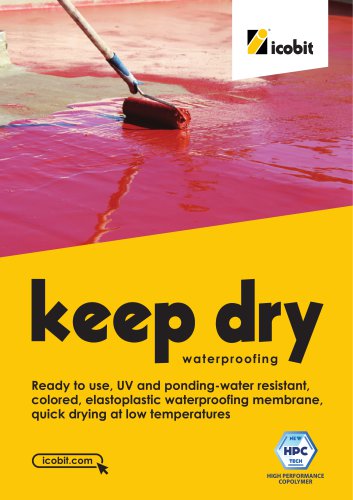
Keep Dry Metal
KEEP DRY is a versatile waterproofing membrane utilizing High Performance Copolymer (HPC) technology. It offers excellent cold flexibility, bonding strength, and crack bridging properties, suitable for various substrates and temperatures as low as -40°C (-40°F).
KEEP DRY is a one-component, solvent-based product available in multiple colors. It is mechanically resistant and has a Solar Reflectance Index (SRI) of 105% in white, ideal for cool roofs. It is CE marked according to EN 1504-2 and EN 14891 standards, ensuring protection against ingress and moisture control.
- Waterproof and anti-carbonation properties.
- Easy application with resealable packaging.
- Usable at temperatures as low as -5°C (+23°F).
- Hail resistance up to intensity H7 on the TORRO Scale.
- Highly UV resistant, no topcoat needed.
- Suitable for low-slope and flat roofs due to ponding water resistance.
Substrates must be clean, dry, and free from contaminants. Specific primers and treatments are recommended for different materials such as concrete, metal, and timber.
Apply two or more coats for new waterproofing with a minimum coverage of 2 kg/m². Reinforce mechanically strained areas with ICOARM TNT ROLL. Application methods include airless spray, roller, or brush.
- Ensure concrete is fully cured before application.
- Avoid application on moist substrates or during rain.
- Stir before use and apply within -5°C to +35°C.
KEEP DRY exceeds EN 14891 crack-bridging requirements, withstanding cracks up to 10.24 mm at standard temperature and 3.5 mm at -20°C in chlorinated water.
KEEP DRY prevents carbonation-induced corrosion by providing a CO2 barrier, meeting EN 1504-2 standards with a permeability of SD >50 m.
KEEP DRY enhances energy efficiency by reflecting solar heat, reducing air-conditioning costs, and improving indoor thermal comfort.
Cool roofs reflect more sunlight and absorb less heat. Key features include Solar Reflectance, Thermal Emittance, and Solar Reflectance Index (SRI). Benefits include improved comfort, energy savings, and enhanced solar efficiency.
KEEP DRY is classified as BROOF (t2) according to EN 13501-5, suitable for roofs with photovoltaic systems where fire performance is required.
KEEP DRY provides hail resistance up to H7 on the Torro Scale, as per EN 13583:2012 standards.
KEEP DRY is a one-component, solvent-based product with a density of 1.15 Kg/L and a solid content of 57%. It cures in 8 hours and operates in temperatures from -40°C to +90°C. Available in various colors, it can be applied using a brush, airless spray, or roller.
Catalog excerpts
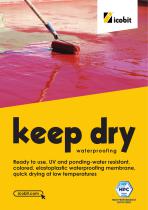
Ready to use, UV and ponding-water resistant, colored, elastoplastic waterproofing membrane, quick drying at low temperatures
Open the catalog to page 1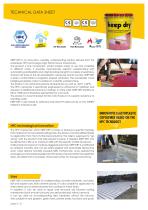
TECHNICAL DATA SHEET CE 14891 Solar reflective KEEP DRY is an innovative, versatile, waterproofing solution derived from the proprietary HPC Technology (High Performance Copolymer). The product is one component, solvent based, ready to use and available in different colors. It provides mechanically resistant waterproofing with outstanding cold flexibility and a high bonding strength to a variety of substrates. Thanks to its state-of-the-art elastoplastic copolymer and its viscosity, KEEP DRY is easily conformable to irregularly shaped substrates. The remarkable crack bridging properties make...
Open the catalog to page 2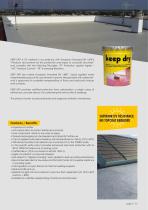
KEEP DRY is CE marked in accordance with European Standard EN 1504-2 “Products and systems for the protection and repair of concrete structures” and complies with the following Principles: “PI” Protection against Ingress -“MC” Moisture Control - “IR” Increasing Resistivity. KEEP DRY also meets European Standard EN 14891 “Liquid applied water impermeable products for use beneath ceramic tiling bonded with adhesives” and is approved for undertile waterproofing of floors and walls both indoors and outdoors. KEEP DRY provides certified protection from carbonation, a major cause of reinforced concrete...
Open the catalog to page 3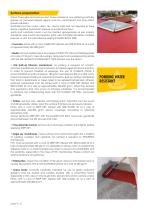
Surface preparation Clean thoroughly and remove dust, loose material or non-adhering particles, grease, oil, formwork release agents and any contaminant that may affect proper adhesion. Substrate must be cured, clean, dry, sound, solid and not exposed to rising damp, negative hydrostatic pressure or evaporative flows. Joints and substrate cracks must be treated appropriately as per industry standards: seal control and isolation joints with ICOJOINT MS silane modified polymer or with the self-adhesive sealing ICOARM BUTYL TAPE. • Concrete: prime with a coat of KEEP DRY diluted with 50% ICODIL...
Open the catalog to page 4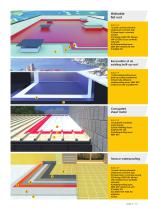
Walkable flat roof BUILD UP 1) Load carrying element: reinforced concrete slab 2) Slope layer: concrete screed 3) Priming: KEEP DRY diluted with ICODIL SX (or synthetic solvents) KEEP DRY reinforced with ICOARM TNT 1) Old waterproofing layer: built-up roofing membrane 2) New fully adhered waterproofing layer: KEEP DRY reinforced with ICOARM TNT 1) Substrate: insulated metal panels 2) Rust inhibiting layer: ICOPOX PM 102 3) Waterproofing layer: KEEP DRY 1) Load carrying element: reinforced concrete slab 2) Slope layer: concrete screed 3) Priming: KEEP DRY diluted with ICODIL SX (or synthetic solvents)...
Open the catalog to page 5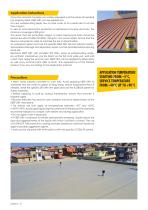
Once the substrate has been accurately prepared and the primer (if needed) has properly dried, KEEP DRY can be applied as is. For new waterproofing apply two or more coats at an overall rate of not less than 2 kg/m2. If used as anti-carbonation protection of reinforced concrete structures, the minimum coverage is 200 gr/m2. The areas that are potentially subject to extra mechanical strain should be reinforced with ICOARM TNT ROLL 100-gr/m2 non-woven fabric. Ensure that the fleece is saturated in order to minimize the risk of delamination. To waterproof green roofs use the specific KEEP DRY AR...
Open the catalog to page 6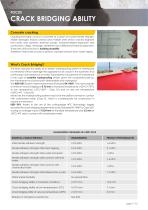
Cracking inevitably occurs in concrete as a result of its poor tensile strength. Visible damages (macro cracks) and invisible ones (micro cracks) originate from static and dynamic external causes, moisture-related expansion and contraction, creep, shrinkage, settlement and differential thermal expansion. Those are critical factors in building durability. Therefore it becomes crucial to protect cracked surfaces from water ingress. The term indicates the ability of an elastic waterproofing system or membrane to withstand without damage the appearance of cracks in the substrate, thus continuing...
Open the catalog to page 7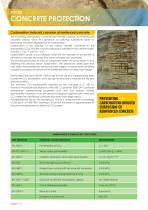
PREVENTING CARBONATION-INDUCED CORROSION OF REINFORCED CONCRETE Carbonation-induced corrosion of reinforced concrete The increasing atmospheric contamination entails a serious risk of reinforced concrete decay, since the presence of polluting substances leads to premature concrete degradation by carbonation. Carbonation is the reaction of the carbon dioxide contained in the atmosphere (CO2) with the calcium hydroxide contained in the cement paste: Ca(OH)2 + CO2 ^ CaCO3 + H2O. Carbonation usually occurs already within the first decade of service life of reinforced concrete structures that have...
Open the catalog to page 8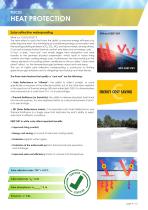
HEAT PROTECTION Solar reflective waterproofing What’s a “COOL ROOF”? The term refers to roofs that have the ability to improve energy efficiency by reflecting solar heat, thus minimizing air-conditioning energy consumption and the resulting polluting emissions (CO2, SO2, NOX and heavy metals, among others). Cool roofs increase indoor thermal comfort and help save on energy costs. In fact, a dark, “non-cool” roof entails bigger heat absorption and heat transfer to the premises situated underneath, which result in worse living comfort and high cooling energy costs. Furthermore, the heat buildup...
Open the catalog to page 9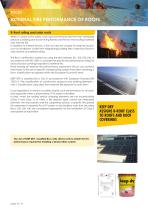
EXTERNAL FIRE PERFORMANCE OF ROOFS B-Roof rating and solar roofs When it comes to fire safety, roofs and roof terraces are the most vulnerable areas of a building due to both rising flames and the fact that roofing materials may fuel the fire. In addition to internal factors, a fire can also be caused by external factors, such as windblown cinder from neighboring building fires or electrical faults in solar systems and related wiring. The BROOF certification carried out using the test methods (t1), (t2), (t3), (t4), in accordance with EN 13501-5, provides the specific fire performance rating...
Open the catalog to page 10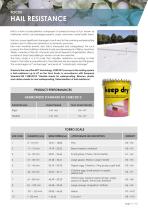
Hail is a form of precipitation composed of spherical lumps of ice, known as hailstones, which can damage property, crops, and even cause bodily harm. Hail can cause significant damage to roofs and to the overlying waterproofing systems due to their poor resistance to dynamic puncture. Like most weather events, also hail is measured and categorized. For such purpose the Torro Hailstorm Intensity Scale was developed in 1986 by Jonathan Webb, member of the UK's Tornado and Storm Research Organization (Torro), a research body specializing in severe convective weather. The Torro Scale is a 0-10 scale...
Open the catalog to page 11