

MIXTURE CATALOGUE

MIXTURE CATALOGUE
Document Overview:
This document appears to be a technical or engineering report containing a mixture of encoded or corrupted text, interspersed with some structured data and references to procedures, specifications, and standards. Due to the extensive presence of unreadable or corrupted content, the analysis focuses on identifiable patterns and inferred sections.
1. Specifications and Parameters
The document references various technical parameters and specifications, likely related to engineering or manufacturing processes. These include numeric codes, measurement units, and possibly calibration or configuration settings. However, the exact nature of these specifications is unclear due to text corruption.
2. Procedures and Methodologies
There are indications of procedural steps or workflows, possibly describing operational sequences or testing protocols. The presence of repeated sequences and structured numeric data suggests attempts to outline stepwise instructions or process flows.
3. Standards and Norms
Mentions of standards or normative references are implied, though specific standards cannot be identified. The document likely aims to align technical activities with established norms, ensuring compliance and quality assurance.
4. Data Tables and Graphical Elements
While the document contains references to tables or structured data blocks, the actual content is not decipherable. No clear graphical elements or charts are extractable from the provided text.
5. Limitations and Recommendations
Due to the corrupted nature of the text, explicit limitations or recommendations are not identifiable. The document may originally have contained best practices or guidelines, but these cannot be confirmed.
Critical Observations:
- The document is heavily corrupted or encoded, limiting the ability to extract meaningful technical content.
- Key sections such as specifications, procedures, and standards are only partially inferable.
- No clear tables, figures, or diagrams are accessible for data extraction.
- Further access to an uncorrupted version is necessary for a comprehensive summary.
Note: The summary is based on the partial and corrupted content available and may not fully represent the original document's intent or detail.
Catalog excerpts

SOLUCIONES TECNICAS HISBALIT [SEGURIDAD FRENTE AL RIESGO DE CAIDAS
Open the catalog to page 1
ACABADOS ANTIDESLIZANTES HISBALIT Las nuevas normativas internacionales de edificación prestan especial atención a la seguridad frente al riesgo de caídas. Hisbalit, siempre en constante evolución, ha desarrollado una completa gama de productos antideslizantes que garantizan la máxima seguridad y que además cumplen con todas las exigencias descritas en las normativas, sin por ello renunciar a la extensa gama de colores que nos diferencia. Ofrecemos 3 tipos de acabados antideslizantes que dan solución a todo tipo de necesidades. New international building standards and codes place special emphasis...
Open the catalog to page 2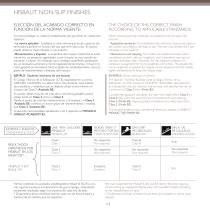
HISBALIT NON-SLIP FINISHES ELECCIÓN DEL ACABADO CORRECTO EN FUNCIÓN DE LA NORMA VIGENTE: THE CHOICE OF THE CORRECT FINISH ACCORDING TO APPLICABLE STANDARDS: A la hora de elegir un material antideslizante hay que tener en cuenta dos aspectos: - La norma aplicable: Establece la clase mínima que ha de usarse en de terminada superficie en función del uso que se le vaya a dar. El usuario puede utilizar la clase indicada o una superior. -Mantenimiento y limpieza: La superficie del mosaico tradicional es total mente lisa, no presenta rugosidades, y por lo tanto, es muy sencillo de mantener y limpiar....
Open the catalog to page 3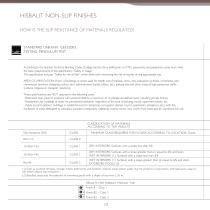
HISBALIT NON-SLIP FINISHES HOW IS THE SLIP RESISTANCE OF MATERIALS REGULATED? TESTING: PENDULUM TEST According to the Spanish Technical Building Codes (Codigo tecnico de la edificacion, orCTE), pavements and pedestrian areas must meet the basic requirements of the specification "Safety in Usage". This specification includes "Safety for risk of falls", which deals with minimising the risk of injuries during appropriate use. AREA OF APPLICATION: Floors of buildings or zones used for health care (hospitals, clinics, etc), education (schools, universities, etc) commercial (markets, shopping centres,...
Open the catalog to page 4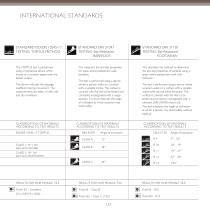
INTERNATIONAL STANDARDS: STANDARD ISO/DIS 10545-17 TESTING: TORTUS METHOD STANDARD DIN 51097 TESTING: Slip Resistance BAREFOOT: STANDARD DIN 51130 TESTING: Slip Resistance FOOTWEAR: The TORTUS test is performed using a mechanical device which moves at a constant speed over the tested surface. This measures the anti-slip properties for areas where pedestrians walk barefoot. This describes the method to determine the anti-slip properties of surfaces using in areas where pedestrians walk with footwear. The device indicates the slippage coefficient during movement. The measurements are taken in both...
Open the catalog to page 5All Hisbalit catalogs and technical brochures
 REEF
REEF8 Pages
 PETITE
36 Pages
 DOPPEL DESIGN
32 Pages
 welcome-to-palm-springs
48 Pages
 piscinas
176 Pages
 general-decoracion
184 Pages
 STARLIGHT MOSAIC SIGNALS
2 Pages
 aniversario
3 Pages
 CERO OBRAS
2 Pages
 GENERAL CATALOGUE
152 Pages
 TEXTURES CATALOGUE
8 Pages
 SWIMMING POOLS CATALOGUE
52 Pages

Archived catalogs
 CATALOGO GENERAL
136 Pages
 STARLIGHT MOSAIC
8 Pages
 IDENTYTY MOSAIC
10 Pages
 MIXTURES CATALOGUE
8 Pages
 HISBALIT DESIGN
14 Pages
 POOLS AND SPAS CATALOGUE
42 Pages