
- Catalogs
- HIANSA PANEL S.A
- GUÍA PARA OPERACIONES CON PANEL SANDWICH


GUÍA PARA OPERACIONES CON PANEL SANDWICH

GUÍA PARA OPERACIONES CON PANEL SANDWICH
When handling panels with a forklift, it is crucial to ensure that the package does not bend excessively due to the panel's length, which could damage the underside or cause breakage. Forklifts used should have sufficiently long and wide forks with rounded edges. Operators must wear appropriate personal protective equipment (PPE) in good condition, as per current regulations. Slings or similar aids can be used, provided they do not damage the panel edges. Tools that do not scratch or mark the panels should be used for unpacking. Panels should be removed individually from each package for installation, transported vertically to avoid excessive bending, which could affect the joint between sheets and internal insulation.
Packages must always be covered with a tarp or in a closed container, on a flat surface, and securely fastened with slings and corner protectors to prevent movement and friction between panels. No more than three packages should be stacked in height. Nylon slings with sufficient width and rigid protection longer than the package width should be used for unloading. Support points (at least two) must not move during handling, which should be done with extreme caution.
For packages longer than 6.00m, a spreader bar is necessary for unloading and positioning, with sufficient anchorage points spaced no more than 4.00m apart.
For closed container transport, measures such as spreading silica sand on the container base and equipping package support blocks with metal "U" shapes are taken to facilitate unloading. A "lost" nylon sling surrounds the package for mechanical extraction from the container.
Storage
Packages should not rest directly on the ground and must be placed on supports wide and long enough to avoid material damage. They should be stored on a flat, stable surface with a minimum 5% slope to prevent water accumulation from condensation. No more than three packages should be stacked, and prolonged storage should be avoided. Panels should be installed as soon as possible, within 60 days of manufacture, to maintain their original properties. The protective film should be removed immediately after installation.
Annual inspections of installed materials (panels and trims) are necessary to identify corrosion points and perform necessary paint touch-ups. Every two years, a complete inspection, including washing with a neutral detergent solution, should be conducted. Scratches or abrasions should be immediately protected with appropriate treatment or paint. Any loose fixations should be tightened or replaced immediately. In case of anomalies that pose a risk of further deterioration or safety hazards, affected areas should be dismantled and stored safely until repair or replacement.
Maintenance
After installation, a thorough cleaning of the panel surface is required to remove any metal shavings or edges that could initiate rust. All metallic and non-metallic objects should be removed from the panel surface. If necessary, wash the surface with a neutral detergent solution. Panels should be stored in a covered, ventilated, and dry place. If not possible, they should be protected with tarps or plastics, ensuring proper ventilation to prevent "white rust" from zinc reaction, which affects aesthetics but not material strength. Protective film should be removed as soon as possible, as it becomes harder to remove after 10 days, potentially damaging the panel coating.
HIANSA PANEL S.A. disclaims any responsibility for claims where this document's guidelines are not strictly followed.
Catalog excerpts
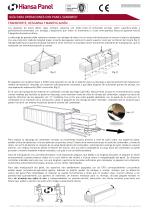
GUÍA PARA OPERACIONES CON PANEL SANDWICH TRANSPORTE, DESCARGA Y MANIPULACIÓN Los paquetes de panel deben viajar siempre cubiertos con toldo o bien en contenedor cerrado, sobre superficie plana y perfectamente amarrados con eslingas y esquineras que eviten el movimiento y roces entre paneles. Nunca se apilarán más de 3 paquetes de panel en altura. La descarga de paneles debe realizarse siempre con eslingas de nylon con un ancho suficiente para no marcar el panel y equipadas con una protección rígida de longitud mayor al ancho del paquete, tanto por la parte superior como por la inferior del mismo (fig.1). Indispensable que los puntos de apoyo (siempre 2 como mínimo) no se puedan mover durante las maniobras de manipulación, que se realizarán con extrema precaución y cautela. En paquetes con longitud mayor a 6,00m será necesario el uso de un balancín para su descarga y posicionamiento del material por medios de elevación, realizado con material suficientemente resistente y que debe disponer de suficientes puntos de anclaje, con una separación máxima de 4,00m. entre ellos (fig.2). En el caso de transporte del material en contenedor cerrado tipo High Cube (HC), Hiansa Panel incluye en el momento de la carga ciertas medidas que facilitan su posterior descarga, como extender arena de sílice en la base del contenedor, equipar los tacos de soporte inferiores de los paquetes con "U" metálicas (con el fin que estas puedan deslizarse con la ayuda de la arena por el contenedor en el momento de la extracción) y dotar el paquete de una eslinga de nylon "perdida", rodeando todo el conjunto para poder tirar de él con medios mecánicos desde el exterior del contenedor. Para realizar la descarga de contenedor cerrado, se recomienda situarlo primero a nivel de suelo sobre una superfície plana, estable y libre de obstáculos. Una vez abiertas las puertas, situar 2 tubos de la misma altura que el suelo del contenedor, a modo de raíles, con el fin de deslizar el conjunto de la carga desde dentro del contenedor, estirando de la eslinga de nylon citada en el punto anterior, con medios mecánicos desde el exterior del mismo. Una vez esté la totalidad de la carga fuera del contenedor se puede proceder a moverla mediante medios manuales, con grúa o con carretilla elevadora. Caso de manipulación con carretilla elevadora, será importante asegurar que debido a la longitud del panel, el paquete no flecte excesivamente y pueda provocar daños en la cara inferior del mismo o incluso rotura o resquebrajado del panel. Se utilizarán carretillas indicadas para este uso, con una longitud y apertura de las palas suficientes para manipular el paquete correctamente, siendo éstas suficientemente largas y anchas, con los cantos redondeados. Para toda manipulación del panel, los operarios irán debidamente equipados con los EPI's correspondientes y en perfecto estado, según normativa de aplicación vigente. Además se podrán ayudar de eslingas o similar, siempre que no dañen los cantos del panel. Para desembalar el material se usarán herramientas o útiles que no puedan rayar, marcar o afectar a los paneles total o parcialmente. Los paneles se extraerán, de manera individual para su montaje, de cada paquete recibido en obra sin arrastrar uno sobre el otro y transportándolos en posición vertical, para evitar una flecha excesiva y por tanto una flexión que pudiera afectar a la unión entre chapas y aislamiento interior. HIANSA PANEL S.A. Poligono Ind. Dehesa de las Cigüeñas. Parc A-1 14420 Villafranca de Córdoba Telf 957198900 FAX
Open the catalog to page 1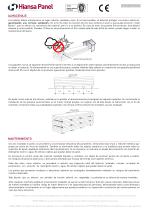
ALMACENAJE Los paneles deben almacenarse en lugar cubierto, ventilado y seco. Si no fuera posible, se deberán proteger con lonas o plásticos, garantizando una correcta ventilación, con el fin de evitar la reacción del zinc que contiene el acero y que puede provocar "óxido blanco", que no afecta a la resistencia del material, pero sí a su estética. En caso de tener los paneles film protector, éste deberá retirarse lo antes posible. Pasados 10 días de almacenamiento el film resulta cada día más difícil de retirar y puede llegar a dañar el revestimiento del panel. retirar film protector Los paquetes...
Open the catalog to page 2All HIANSA PANEL S.A catalogs and technical brochures
 GENERAL PRODUCT CATALOGUE
66 Pages
 CATALOGUE OF PRODUCTS - RESUME
10 Pages
 PANEL CUBIERTA CUB 2GR
3 Pages
 PANEL CUBIERTA AGRO 3GR
3 Pages
 PANEL CUBIERTA EASY CUB 3GR
4 Pages
 PANEL CUBIERTA EASY CUB 5GR
4 Pages
 PANEL DIVISORIO MURO
3 Pages
 PANEL FRIGO
4 Pages
 PANEL ILUMINACIÓN HEXAGONA
2 Pages
 PANEL ILUMINACIÓN POLIMER
2 Pages
 PANEL ILUMINACIÓN HIANSAPLUS
2 Pages
 MO-18 MINIONDA
2 Pages
 MT-44 IBIZA
2 Pages
 MT-32
MT-322 Pages
 MT-32F
2 Pages
 MT-42
MT-423 Pages
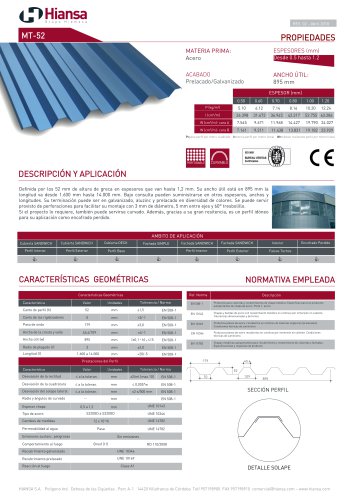 MT-52
MT-523 Pages
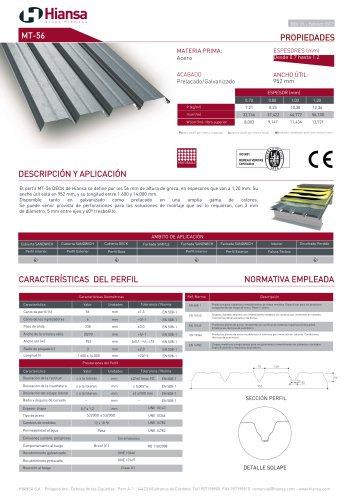 MT-56 DECK
2 Pages
 MT-68 DECK
2 Pages
 BANDEJA 90.380
2 Pages
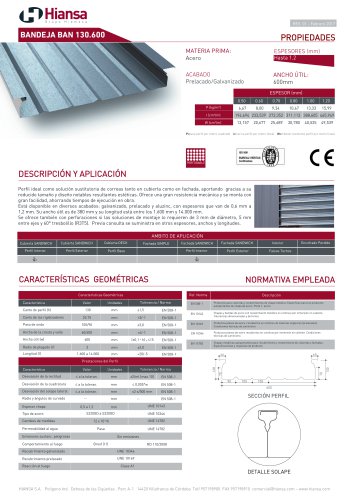 BANDEJA 130.600
2 Pages
 FORJADO MT-60
2 Pages
 FORJADO MT-76
2 Pages
 FORJADO MT-100
3 Pages
 PANEL TEJA
7 Pages


- Profiled sheet
- Steel sheet metal
- Roofing
- Facade profiled sheet
- Metal roofing
- Metal facing sandwich panel
- Roof acoustic sandwich panel
- Facade acoustic sandwich panel
- Wall sandwich panel
- Ribbed sheet metal
- Roof sheet metal
- Roof tile look roofing
- Industrial polycarbonate sheet
- Building polycarbonate sheet
- Aluminum facing sandwich panel
- Partition wall acoustic sandwich panel
- Fire protection sandwich panel
- Colored sheet metal
- Fire-resistant sandwich panel
- Industrial floor