


Underfloor Air

Underfloor Air
Catalog excerpts
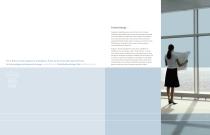
Fresher Design Developers, building owners and architects face a complex challenge: build buildings that are not only pleasing aesthetically, but are also efficient, flexible and smart. Designers and builders must create structures that can be constructed economically, operated efficiently and be ready to change at a moment’s notice. Distributing air through the floor can go a long way toward accomplishing those objectives. For a floor to truly support a workspace, it has to do more than just sit there. As technology and tenants change, underfloor air distribution keeps the building fresh. Popular...
Open the catalog to page 2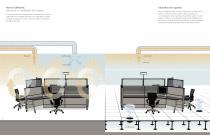
How It’s Different: Overhead vs. Underfloor Air Systems Underfloor Air Systems With an underfloor system, the cavity created by the installation of the raised access floor is used as a supply air plenum. Conditioned air is introduced to the occupied space through floor outlets. The floor outlets, or “diffusers,” are designed to rapidly mix the conditioned air with the room air. Rather than being forced, the new air rises naturally, carrying heat and pollutants upward and out the ceiling air return. In a conventional system, conditioned air is introduced from or near the ceiling and mixed completely...
Open the catalog to page 3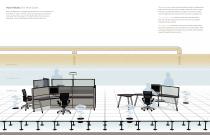
How It Works: The Three Zones When conditioned air is supplied through the floor, room air stratifies into three layers or “zones.” The hot, stale air is always kept on the topmost level, away from the occupants. The depths of these three zones are dependent on the ceiling height and type of floor outlet used. The mixing zone is three to four feet above the floor. Conditioned air enters at the bottom of this zone, rapidly mixing with room air, which minimizes uncomfortable drafts for occupants near the floor outlets. Then, through natural convection, the air rises to the occupied zone. The occupied...
Open the catalog to page 4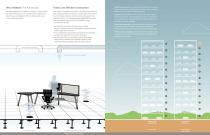
Faster, Cost Effective Construction The design objective for underfloor air systems is simple: achieve the optimal temperature and air quality in the occupied space, allow for easy reconfiguration of the air delivery system, and reduce operating expenses. At first glance, raised floors may appear to be slightly more expensive than conventional floors. But when you use the space below the floor for air distribution and power and data cabling, that apparent cost premium vanishes. In fact, overall cost per square foot for an access floor-based system may be as much as two dollars less than conventional...
Open the catalog to page 5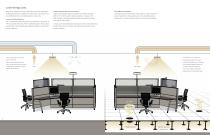
Lower Energy Costs Lower Operating Costs Lower Operating Costs Aside from reducing the costs of the HVAC system and subsequent building maintenance, underfloor air systems also use energy much more efficiently than conventional systems. Here’s why: Greater Opportunities for Free Cooling – Supply air is typically introduced at about 63° to 68°F, compared with the 53° to 58°F used for overhead systems. In regions with mild humidity, it also allows longer periods during which outdoor air is used for free cooling. More Efficient Ventilation – Less ductwork also leads to lower static pressures, which...
Open the catalog to page 6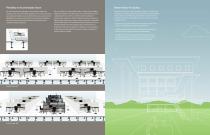
Flexibility to Accommodate Churn The International Facility Management Association estimates the average annual churn rate in office buildings is 41% or more. Associated costs are about $32 billion per year. Much of those costs are due to the inflexibility of conventional construction, where ductwork alterations, electrical rewiring and business downtime can cause the costs of workplace change to skyrocket. Better Indoor Air Quality But, an underfloor air system adapts easily to change. Simply installing additional air diffusers in the floor panels can accommodate increased cooling requirements....
Open the catalog to page 7
Where is Underfloor Air Appropriate? • New construction, or retrofitting an existing space • Anywhere a raised flooring system is considered or installed to house utilities • High-density open office areas • Anywhere individual temperature control is a concern or issue • Environments with a high rate of churn • Wherever indoor air quality is a concern • Facilities with high ceilings • Single as well as multi-storied buildings • Everywhere energy savings is im
Open the catalog to page 8
For more information call 800.344.2600 or 616.393.3000. Download additional copies at haworth.com. This brochure is printed on FSC certified U2®:XG™ paper, manufactured with electricity in the form of renewable energy (wind, hydro, biogas) and contains a minimum of 30% post-consumer recovered fiber. FSC is the global benchmark for responsible forest management. / 4 Product group from well-managed g,30%\ Vf _ - J for«Q, controlled IOUCM and « ■ ■ «o^»*v ~ recycled wood orflber ^m*~ Haworth is a registered trademark of Haworth, Inc. Printed in USA ©Haworth, Inc. 2010 02.10 Item #0734 haworth.com...
Open the catalog to page 9All Haworth catalogs and technical brochures
 Nivél
Nivél2 Pages
 fiche tarifaire
290 Pages
 Resonate
7 Pages
 Lyda
Lyda5 Pages
 Pergola
7 Pages
 Veda
Veda6 Pages
 HAWORTH 20/20
16 Pages
 HAWORTH 20/20 SPECIAL EDITION
18 Pages
 Zody
Zody6 Pages
 Improv Side Brochure
4 Pages
 Compose Information
2 Pages
 Haworth Power
42 Pages
 CLOUD
CLOUD2 Pages
 NC-B Resonate
2 Pages
 V-Series-Product
2 Pages
 V_Series_Casegoods_Storage
5 Pages
 Brazo PEDS
4 Pages
 Brazo Product
2 Pages
 Contour
2 Pages
 LIM PEDS
4 Pages
 LIM Product
3 Pages
 Patterns PEDS
4 Pages
 enclose-insight_mk_p1
52 Pages
 Architectural Walls
11 Pages
 Enclose PEDS
4 Pages
 Enclose
8 Pages
 trivati-product
2 Pages
 X Series Recycling Bins
2 Pages
 X-Series-Storage
2 Pages
 Raised Access Flooring
9 Pages
 450 Series Tables
2 Pages
 Compose
7 Pages
 Planes
6 Pages
 HI PAD STOOL
2 Pages
 HI PAD
2 Pages
 GEOMETRIE
5 Pages
 GOOD FOR WOOD
2 Pages
 GINGER
1 Page
 GALERIE LOUNGE SEATING
2 Pages
 FRONZONI '64
2 Pages
 FRED
FRED5 Pages
 ENCOURAGE
3 Pages
 ENCLOSE INSIGHT
44 Pages
 ENCLOSE
20 Pages
 Casssis
2 Pages
 Reside™ Desking
15 Pages
 Lotus
Lotus16 Pages
 Fern
Fern4 Pages
 Chancellor
2 Pages
 Downtown
2 Pages
 Very Task
5 Pages
 workware Product Sheet C5
7 Pages
 US Communities
9 Pages
 ToDo
ToDo2 Pages
 X99
X9914 Pages
 York
York9 Pages
 Monaco
10 Pages
 Suite ™
2 Pages
 Tilt ™
2 Pages
 Feather
2 Pages
 Chick
Chick2 Pages
 Harbor Work Lounge ™
5 Pages
 Haworth
29 Pages
 seating
385 Pages
 q_bic
q_bic8 Pages
 ltb
ltb24 Pages
 avenue
7 Pages
 epure
epure28 Pages
 t_up
t_up24 Pages
 tibas
tibas20 Pages
 kiron
kiron52 Pages
 meet you
20 Pages
 vados
vados32 Pages
 mobile storage
11 Pages
 Comforto 90
8 Pages
 Lively
16 Pages
 PREMISE
16 Pages
 PLACES
12 Pages
 LOOK
LOOK10 Pages
 Improv Seating
14 Pages
 Zody
Zody10 Pages
 X Series Storage
9 Pages
 950 Series
4 Pages
 V Series Casegoods & Storage
5 Pages
 BRAZO
BRAZO2 Pages
 K700
K7002 Pages
 DCS Axis 106
2 Pages
 Castelli for Haworth
16 Pages
 b_sit
b_sit2 Pages
 Compose and Enclose
26 Pages
 Lively Task & Side
14 Pages
 New & Cool
2 Pages
 Tuxedo Brochure
2 Pages
 Planes Product Sheet_BON
2 Pages
 Accolade Seating Brochure
2 Pages
 Lively Ergonomics
19 Pages
 Planes Brochure
11 Pages
 Very Brochure
15 Pages
 Lively Product Sheet Final
2 Pages
 Reside Product Sheet
5 Pages
 Reside Product Sheet
2 Pages
 Compose Brochure
18 Pages
 Patterns Product Sheet Final
3 Pages
 Product Sheet Reside Desking
2 Pages
 LifeSPACE ERA Brochure
10 Pages
 Beside Storage Product Sheet
2 Pages
 Belong Product Sheet
2 Pages
 very out of the office
16 Pages
 se04
se042 Pages
 x series
9 Pages
 very task
5 Pages


Archived catalogs
 prescott
2 Pages
 m-sit
m-sit2 Pages
 hello
hello2 Pages
 lim
lim2 Pages
 look
look10 Pages
 forenze
4 Pages
 vancouver
7 Pages
 unigroup
14 Pages
 scamps
2 Pages
 orlando - ls
5 Pages
 s-con
s-con8 Pages
 conference
7 Pages
 Power Base Brochure
7 Pages
 Enclose Brochure
20 Pages
 HAWORTH Collection 2018
19 Pages
 HAWORTH Collection 2019
18 Pages
 Haworth Collection 2021
55 Pages