
- Catalogs
- HAVER & BOECKER OHG
- METAL WIRE MESH

- Company
- Products
- Catalogs
- News & Trends
- Exhibitions
METAL WIRE MESH
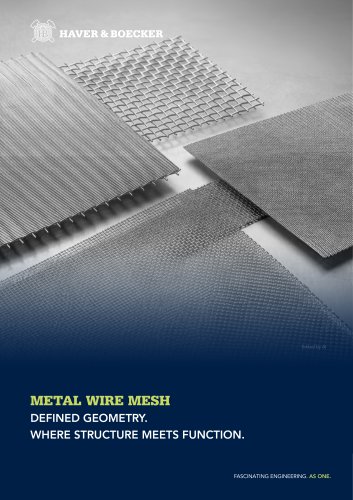
METAL WIRE MESH
HAVER & BOECKER is a family-owned company established in 1887, specializing in wire mesh products and machinery. The company focuses on enhancing safety, efficiency, and sustainability through innovative solutions and global collaboration.
Metal Wire Mesh Overview
Wire mesh is a precision-engineered material made by weaving metal wires, offering high functionality and predictable performance. It is suitable for various industrial applications due to its high-temperature resistance, corrosion resistance, long service life, precise filtration, and customization options.
Defining Characteristics of Wire Mesh
- Materials: Options include carbon and stainless steels, nickel and copper alloys, titanium, and specialty materials, chosen for their resistance and strength.
- Geometry: Specifications include aperture size, pitch, wire diameter, and open area for consistency and reliability.
- Precision: Wire diameters range from 11 μm to millimeter-scale sizes for various applications.
- Variety: Different weave patterns meet specific process requirements.
- Manufacturing Depth: In-house production ensures quality from development to finished products.
Materials and Geometry
Performance is influenced by material selection, wire geometry, and processing characteristics, affecting resistance, conductivity, and strength. Geometries include round, flat, square, cylindrical, stranded, and polygonal shapes.
Wire Cloth Terminology
International standards define terms like warp, weft, open area, weave type, aperture width, wire diameter, pitch, mesh count, and area weight, crucial for performance and engineering calculations.
Types of Weave and Apertures
Wire mesh designs include open or visually closed filter meshes. Different weaves, such as plain, twilled, and satin, affect surface characteristics and performance.
Conclusion
HAVER & BOECKER's wire mesh products are engineered for precision and reliability, offering diverse materials, geometries, and weave types to meet industrial needs, with a commitment to quality and innovation.
Specifications include aperture width, wire diameter, mesh per inch, open area, and area weight, crucial for determining wire mesh suitability.
Filter Mesh Characteristics
MINIMESH® filter meshes offer exceptional filtration accuracy, mechanical stability, uniform flow, and reduced clogging risk, ideal for high purity and consistent filtration applications.
Filtration and Separation Metrics
Metrics such as porosity, geometric pore size, filtration rate, breaking load, and pressure loss coefficient are essential for evaluating flow characteristics and separation efficiency.
Engineering Services
HAVER & BOECKER provides CFD services to simulate and optimize wire mesh designs, including 3D models for flow behavior and pressure loss evaluation.
Manufacturing Expertise
The company offers comprehensive manufacturing capabilities, from development to finished products, with integrated engineering, advanced technologies, and certified quality management.
Conclusion
HAVER & BOECKER delivers advanced wire mesh solutions focused on precision, reliability, and quality, supported by extensive engineering and manufacturing expertise.
Catalog excerpts
METAL WIRE MESH DEFINED GEOMETRY. WHERE STRUCTURE MEETS FUNCTION.
Open the catalog to page 1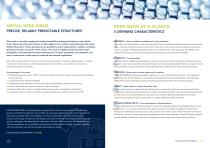
METAL WIRE MESH WIRE MESH AT A GLANCE PRECISE, RELIABLY PREDICTABLE STRUCTURES Wire mesh is a precision-engineered material created by weaving metal wires on specialized looms. Warp and weft wires intersect at right angles to form uniform mesh openings with clearly defined dimensions. These openings can be specified to exact requirements, creating a consistent geometric structure across the entire surface. The result is a highly functional material with predictable, measurable performance characteristics. Durable, repeatable, and adaptable, wire mesh is used across a wide range of industrial...
Open the catalog to page 2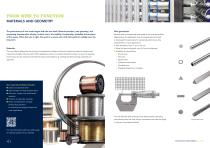
The performance of wire mesh begins with the wire itself. Material selection, wire geometry, and processing characteristics all play a critical role to the stability, functionality, durability and precision of the weave. When the wire is right, the result is a woven wire cloth that performs reliably over the long term. The wire material determines the corrosion and temperature resistance, thermal conductivity, electrical resistance and mechanical strength of the wire cloth. When designing a solution, our experts therefore consider not only the operating environment, but also mechanical and thermal...
Open the catalog to page 3
WIRE CLOTH TERMINOLOGY DEFINED BY STANDARDS, DESCRIBED IN TECHNICAL TERMS Mesh count All wires running parallel to the weaving direction. The number of mesh openings within a specified unit of length (n), such as a centimeter, decimeter, or inch. The number of openings per inch (25.4 mm) is commonly All wires running perpendicular to the weaving direction referred to as the mesh count or simply mesh. (at right angles to the warp wires). ■ Mesh: openings per inch (25.4 : p*) ■ n/cm: openings per centimeter (10 : p) International standards provide a common framework for specifying, measuring, and...
Open the catalog to page 4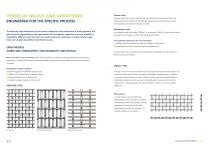
The diversity and performance of wire mesh is shaped by the combination of mesh geometry and type of weave. Depending on the requirements for throughput, separation accuracy, stability or cleanability, different mesh structures are used. In general, a distinction is made between open mesh and visually closed filter mesh (Dutch weave). OPEN MESHESWHEN HIGH THROUGHPUT AND DURABILITY ARE CRITICAL Square mesh A square mesh has a uniform, symmetrical mesh structure for precise separation and reproducible results. Warp and weft wires generally have the same diameter, and the mesh openings are identical...
Open the catalog to page 5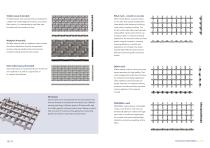
Twilled weave (4-bonded) In twilled weaves, warp and weft wires are interlaced in a pattern that creates diagonal structures. As a surface filter medium, it is characterized by rapid filter cake formation and a low tendancy to clog. Multiplex (4-bonded) Multiplex weave is used as a distributor mesh to ensure the uniform distribution of liquids. Its specialized structure enhances capillary action and promotes consistent wetting across the entire surface. EGLA mesh - smooth on one side EGLA meshes feature a smooth surface on one side. They provide excellent flow characteristics and resistance to...
Open the catalog to page 6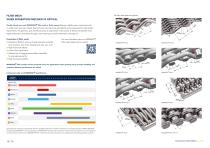
FILTER MESH WHEN SEPARATION PRECISION IS CRITICAL All filter mesh types at a glance: Visually closed wire mesh (MINIMESH® filter mesh or Dutch weave) features a tightly woven construction with no visible mesh openings. Instead, they form pore channels whose permeability can be engineered to meet specific requirements. The geometric pore size (Xmax) serves as a parameter in this context. It defines the diameter of the largest sphere that can still pass through a mesh opening. For further information, see page 16. Properties of filter mesh: For more information about our MINIMESH® ■ Exceptional...
Open the catalog to page 8
KEY VALUES FOR FILTRATION & SEPARATION METRICS FOR DESIGN AND PROCESS Breaking load The maximum tensile strength that a wire or wire cloth can withstand before failure occurs. Breaking load is an important indicator of mechanical strength and helps assess the ability of a woven structure to withstand tensile stresses during operation. Pressure loss coefficient (ζ) The pressure loss coefficient is a dimensionless parameter derived from fluid dynamics. Whenever a medium flows through a filter medium (HAVER & BOECKER typically uses air during testing) a pressure difference develops between the upstream...
Open the catalog to page 9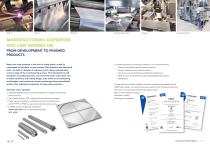
Stamping / Deep drawing Automated production MANUFACTURING EXPERTISE YOU CAN DEPEND ON FROM DEVELOPMENT TO FINISHED PRODUCTS Metal wire mesh products in the form of rolled goods, as well as customized coil products, screen sections, filter elements and fabricated parts, are built on decades of experience and a deep understanding of every stage of the manufacturing process. From development and production to quality assurance, we control the entire value chain. Our in-house machinery and tooling design, state-of-the-art manufacturing technologies, and continuous process monitoring ensure reproducible...
Open the catalog to page 10
Ennigerloher Straße 64 ∙ 59302 Oelde ∙ Germany E-mail: [email protected] Internet: www.haverboecker.com P 17 E 608 092026 0,5 Fe ©HAVER & BOECKER. Jede Art der Vervielfältigung, auch auszugsweise, nur mit Genehmigung. FLEX-MAT® und OptimumWire® sind eingetragene Handelsmarken von MAJOR WIRE INDUSTRIES Ltd. Fotos: Fototeam Walkenhorst, Knut Reimann, iStock, Fotolia
Open the catalog to page 11All HAVER & BOECKER OHG catalogs and technical brochures
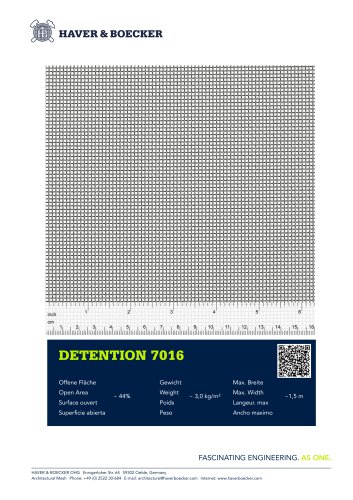 DETENTION 7016
1 Page
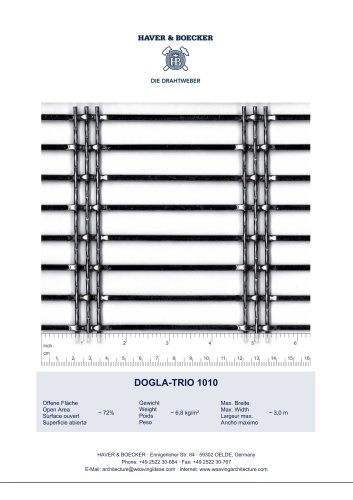 DOGLA-TRIO 1010
1 Page
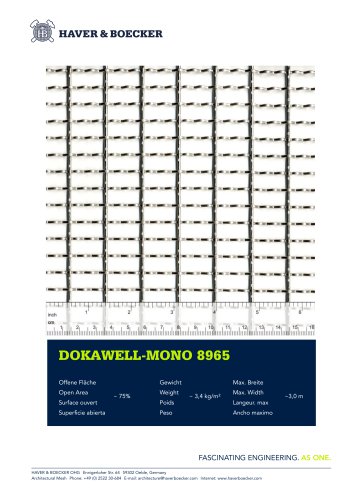 DOKAWELL-MONO 8965
1 Page
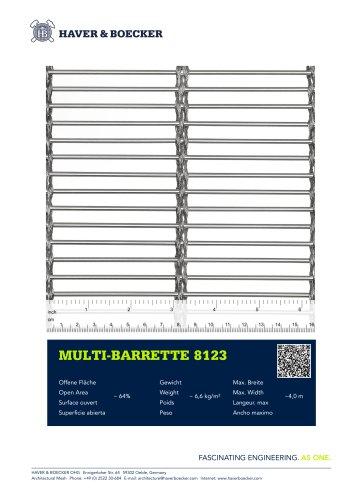 MULTI-BARRETTE 8123
1 Page
 LARGO-TWIST 2045
1 Page


- Decorative panel
- HAVER & BOECKER cladding
- Industrial wallcovering
- Interior wall-covering
- Wall-mounted decorative panel
- HAVER & BOECKER railing
- Commercial wall-covering
- Cover decorative panel
- Modern wall-covering
- HAVER & BOECKER suspended ceiling
- HAVER & BOECKER outdoor railing
- HAVER & BOECKER stainless steel wire mesh
- HAVER & BOECKER metal railing
- Metal cladding
- Textured decorative panel
- HAVER & BOECKER decorative wire mesh
- Textured wall-covering
- HAVER & BOECKER building wire mesh
- Fire-retardant wall-covering