

FASERFIX
FASERFIX
FASERFIX® concrete is a sustainable, recyclable, and durable material used for manufacturing drainage products. It is resource-friendly, watertight, emission-free, non-combustible, and performs well hydraulically. The material is energy-efficient and suitable for various applications, including commercial, public, and extreme load areas.
Concrete is produced sustainably, using by-products from other industries like slag sand and fly ash, reducing energy requirements. Cement production has shifted towards using secondary fuels, preserving natural resources and reducing landfill material. Concrete is fully recyclable, with demolition concrete being reused in construction.
Concrete is a robust material with a long history of use in construction. FASERFIX® concrete is reinforced with fibres, enhancing its strength, impact resistance, and wear resistance. This makes it suitable for heavy-duty applications and environments with high dynamic forces.
FASERFIX® concrete is watertight and resistant to rust, making it ideal for use in fuel stations, logistics facilities, and coastal environments. It is durable and reliable, even in corrosive conditions, and is extensively used in infrastructure projects.
Concrete is classified as non-combustible, offering effective fire protection. It does not release harmful substances, making it suitable for areas where rainwater is returned to the natural cycle.
The hydraulic efficiency of drainage channels is determined by their size and shape rather than surface roughness. FASERFIX® channels have a high Strickler coefficient, ensuring efficient flow.
FASERFIX® concrete has a positive energy balance compared to other building materials, with lower energy requirements and CO2 emissions. The production process is certified and controlled to ensure high quality.
FASERFIX® channels are produced in Germany under certified processes, ensuring consistent quality. They comply with DIN EN 1433 and DIN V 19580 standards and are CE marked.
FASERFIX® drainage channels have been successfully used in various projects, demonstrating their durability and reliability over time.
Catalog excerpts
NATURALLY SUSTAINABLE.
Open the catalog to page 1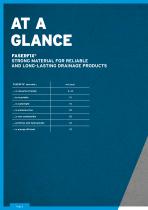
AT A GLANCE FASERFIX® STRONG MATERIAL FOR RELIABLE AND LONG-LASTING DRAINAGE PRODUCTS FASERFIX® concrete… … performs well hydraulically
Open the catalog to page 2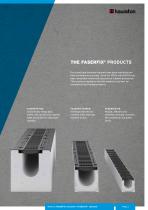
THE FASERFIX® PRODUCTS For a long time drainage channels have been manufactured from conventional concrete. Since the 1970s, HAURATON has been using fibre-reinforced concrete for channel production. This brochure highlights why this material is perfect for manufacturing drainage products. FASERFIX®BIG Channels for heavy duty traffic with ductile iron channel edge protection for maximum stability. FASERFIX®SUPER Drainage channels for extreme loads and high dynamic forces. Material FASERFIX® concrete | FASERFIX® channels FASERFIX®KS Robust, efficient and aesthetic drainage channels for commercial...
Open the catalog to page 3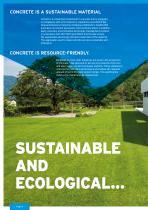
CONCRETE IS A SUSTAINABLE MATERIAL Cement is an important component in concrete and is produced in compliance with strict statutory regulations specified in the Federal Emissions Protection Ordinance (BImSchV). HAURATON purchases its cement exclusively from factories which, in addition, apply voluntary environmental and energy management systems in accordance with ISO 14001 and 50001 and thereby ensure the sustainable and energy-efficient production of the material. The aggregates used to make concrete are also sustainable and ecological. CONCRETE IS RESOURCE-FRIENDLY. By-products from other industries...
Open the catalog to page 4
Material FASERFIX® concrete | Sustainability and ecology
Open the catalog to page 5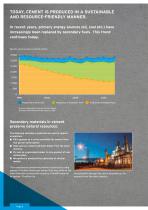
TODAY, CEMENT IS PRODUCED IN A SUSTAINABLE AND RESOURCE-FRIENDLY MANNER. In recent years, primary energy sources (oil, coal etc.) have increasingly been replaced by secondary fuels. This trend continues today. Specic use of energy in kJ/kg of cement 2005 Proportion of secondary fuels 2010 Proportion of standard fuels Source: Association of German Cement Works Brochure: Overview of cement industry, 2012 Secondary materials in cement preserve natural resources. The following secondary materials are used in cement production: REA gypsum as a curing controller for cement from flue gas de-sulfurization...
Open the catalog to page 6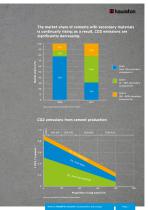
The market share of cements with secondary materials is continually rising; as a result, CO2 emissions are significantly decreasing. 100 12,9 Source: Association of German Cement Works CO2 emissions from cement production 1,0 Proportion of slag sand in % Source: Association of German Cement Works Material FASERFIX® concrete | Sustainability and ecology
Open the catalog to page 7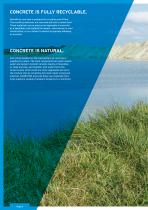
CONCRETE IS FULLY RECYCLABLE. Demolition concrete is prepared by crushing and sifting. The resulting materials are concrete grit and crushed sand. These materials can be used as an aggregate in concrete, as a secondary raw material in cement, used loosely in road construction, or as a binder to absorb oil spillage following an accident. CONCRETE IS NATURAL. Everything needed for the manufacture of concrete is supplied by nature. The main components are sand, gravel, water and cement. Cement consists mainly of limestone or chalk and clay, and together with water forms the cement paste which binds...
Open the catalog to page 8
…NATURAL AND RECYCLABLE Material FASERFIX® concrete | Recyclability
Open the catalog to page 9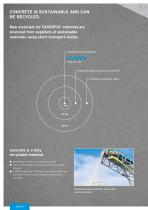
CONCRETE IS SUSTAINABLE AND CAN BE RECYCLED. Raw materials for FASERFIX® concrete are procured from suppliers of sustainable materials using short transport routes. HAURATON plant Ötigheim Radius of sand and gravel procurement Cement procurement radius Concrete is a fully recyclable material. Demolition concrete is crushed and sifted. The recycled products are used in the construction industry. In 2010, more than 78.4% of construction rubble and more than 95% of road demolition material was recycled! Concrete being recycled for use in road construction etc.
Open the catalog to page 10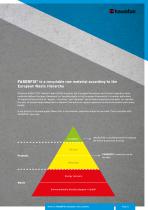
FASERFIX® is a recyclable raw material according to the European Waste Hierarchy Directive 2006/12/EC (dated 5 April 2006) issued by the European Parliament and Council regarding waste materials defines the legal framework for handling waste in the European Community. It contains definitions of important terms such as “waste”, “recycling” and “disposal” and includes important principles, for example the duty to handle waste materials in a manner than does not impact negatively on the environment and human health. A top priority is to avoid waste. Where this is not possible, materials should be...
Open the catalog to page 11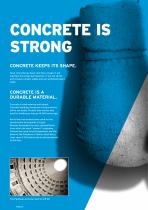
CONCRETE IS STRONG CONCRETE KEEPS ITS SHAPE. Once concrete has been cast into a shape, it will maintain this shape permanently. It will not shrink and remains reliably stable and can withstand heavy loads. CONCRETE IS A DURABLE MATERIAL. Concrete is hard-wearing and robust. Concrete buildings hundreds of years old are still in use today. Durable lime mortar was used for building as long as 14,000 years ago. Burnt lime had already been used for the construction of pyramids in Egypt. Romans developed the opus caementitium, from which the word “cement” originates. Cement was used to build aqueducts...
Open the catalog to page 12
Material FASERFIX® concrete | Strong and durable
Open the catalog to page 13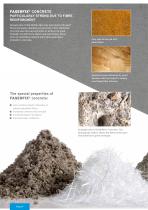
FASERFIX® CONCRETE PARTICULARLY STRONG DUE TO FIBRE REINFORCMENT Already back in the Middle Ages clay was mixed with plant fibres and used in building construction. Fibre-reinforced concrete uses the same principle to achieve its great strength. As with trees, plants and even bones, fibres form an interlinked network which gives enormous strength to concrete. Clay wall reinforced with plant fibres. Woodchip board achieves its great strength with the help of a closely interlinked fibre network. The special properties of FASERFIX® concrete: micro-reinforcement consisting of twisted polyolefin fibres...
Open the catalog to page 14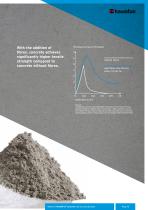
With the addition of fibres, concrete achieves significantly higher tensile strength compared to concrete without fibres. without fibres Deflection in mm Source: Institute for Construction Materials, University of the Federal Forces, Munich, brochure “Special types of concrete – fibre concrete”, spring term 2010. The test was carried out to check the deflection of concrete beams without fibres compared to concrete beams with DOLANIT fibres Material FASERFIX® concrete | Strong and d
Open the catalog to page 15All HAURATON catalogs and technical brochures
 Aqua
Aqua16 Pages
 CUSTOMISED DRAINAGE
48 Pages
 Railway Infrastructure
4 Pages
 HAURATON CIVILS
320 Pages
 2021 Landscaping
264 Pages
 Civil engineering
320 Pages
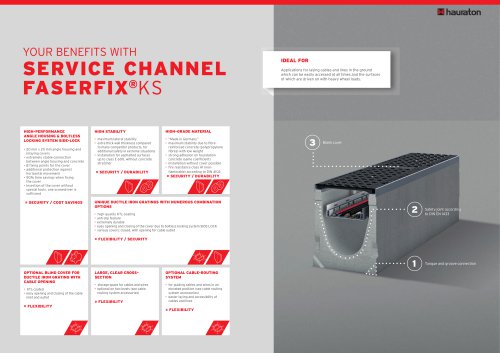
 Produktnutzen_FF_KS_EN
1 Page
 Brochure_Facade_Drainage_EN
52 Pages
 Produktnutzen_RF_NC_EN
1 Page
 RECYFIX NC
24 Pages
 RECYFIX®NC
24 Pages
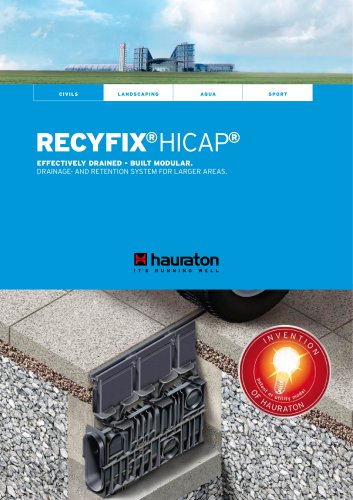 Recyfix® HICAP®
28 Pages
 TOP X
TOP X12 Pages
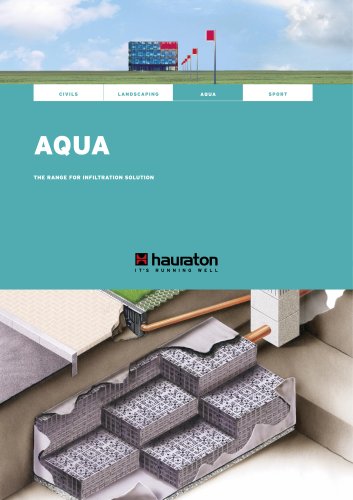 HAURATON AQUA
40 Pages
 HAURATON SPORT
22 Pages
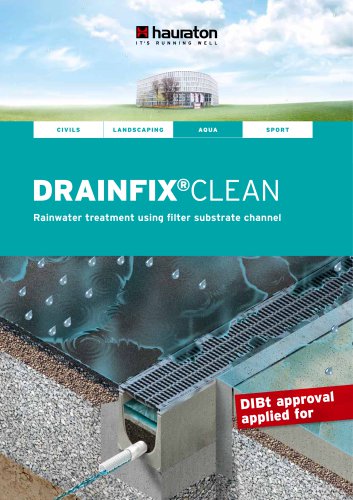 Drainfix clean
8 Pages
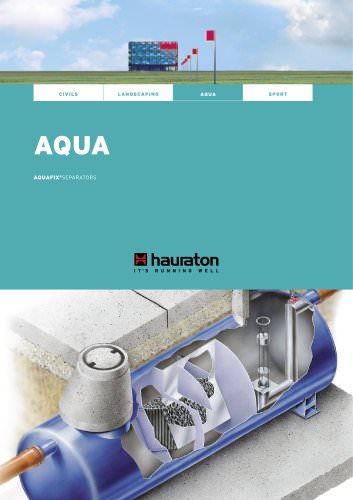 AQUAFIX Separator
136 Pages


Archived catalogs
 2014 LANDSCAPING
100 Pages
 2015 RECYFIX® MONOTEC
24 Pages
 2021 RECYFIX® MONOTEC
24 Pages
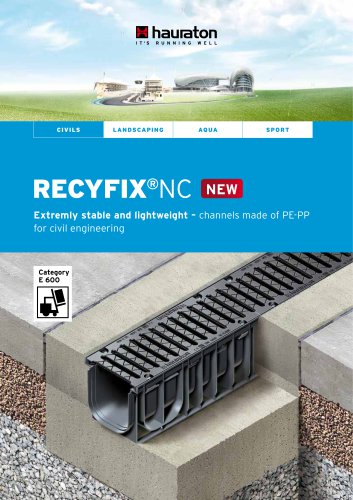 Recifix NC
16 Pages
 HAURATON LANDSCAPING
166 Pages
- Public space drainage channel
- Drainage channel with grating
- Metal grate drainage channel
- Slot drainage channel
- Concrete drainage channel
- Building drainage channel
- Pedestrian area drainage channel
- Manhole
- Light traffic drainage channel
- Cast iron grate drainage channel
- Drain connector
- Grass protection mesh
- Industrial grease trap
- Street drainage channel
- Heavy traffic drainage channel
- Plastic drainage channel
- Safety drainage channel
- Black drainage channel
- Plastic manhole