


Halton FDC

Halton FDC
Catalog excerpts

Fire Damper for Circular Ducts • Type-approved and compliant with the EN 1366-2 and EN 13501-3 standards. • Design for installation in separating concrete and masonry walls and ceilings and lightweight plasterboard walls of fire compartments with fire resistance class EIS 30 to EIS 120. • Readiness for installation with all wall options as delivered - no additional frames needed. • Manufacture in accordance with the ISO 9001 quality system. • VTT, the Technical Research Centre of Finland, is responsible for external quality control. • Installation in circular ducts with diameter 160 to 500 mm. • Double sealing, ensuring that the blades are tight when the fire damper is closed before and during a fire. • Fire damper casing complying with the tightness requirements for Class C, EN 1751. • Fire damper tightness meeting smoke damper requirement S of standard EN 1366-2. • Suitability for use in ducts with a maximum pressure of 3100 Pa. • Damper closing tests performed at 15 m/s duct velocity. Product models and Accessories • Models equipped with either manual or electric actuators. Halton CARE FOR INDOOR AIR FDC - Fire Damper for Circular Ducts 1
Open the catalog to page 1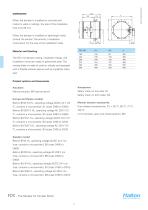
When the damper is installed on concrete and masonry walls or ceilings, the size of the installation hole is D+50 mm. When the damper is installed on lightweight walls, consult the section 'Documents / Installation Instructions' for the size of the installation holes. Material and finishing The FDC fire damper casing, installation flange, and installation frame are made of galvanised steel. The closing blade is made of calcium silicate and equipped with a flexible silicone seal as well as a graphite mass seal. Product options and Accessories Actuators Manual actuator, MA (spring return) Europe...
Open the catalog to page 2
Function The FDC is a circular fire damper of fire resistance class EIS 30 to EIS 120, which prevents fire and smoke from spreading in ventilation ducts. The fire damper is equipped with either a motorised actuator or manual actuation arrangement. Both actuators have a visual position indicator. If the power in the motorised actuator system is switched off, the blade closes automatically. Europe and Russia models: In both actuator options, a fuse reacts to a rise in temperature, causing a spring-return blade to close. The motorised fire damper is delivered complete with a spring-return actuator...
Open the catalog to page 3
Installation on concrete and masonry walls When the fire damper is installed on concrete and masonry walls and ceilings between fire compartments, the blade shaft is always horizontal. An opening is always left in the separating element for the fire damper, and the product subsequently is grouted into this. To make installation easier, all products come with an installation flange, which is used to fasten the fire damper to the concrete surface with screws before grouting. During installation, the fire damper and actuator must be protected with, e.g., a plastic cover. The correct operation of...
Open the catalog to page 4
A fire damper of class EIS 30 to EIS 120 shall have a double sealing solution that ensures fire-gas resistance at all temperatures when the fire damper is closed. In motorised models, the fuse shall be activated at 72 °C (E and R models). In the manually operated system, the fuse activation temperature corresponds to the specifications (50, 65, 72, 100 °C). The fuse shall be located inside the damper, and it shall be possible to replace it from the outside. The fire damper shall have means for external opening / triggering of the release and closing. The fire damper shall include a position indicator. The...
Open the catalog to page 5All HALTON catalogs and technical brochures
 Halton USS
8 Pages
 Halton Vita Cell Room (VCR)
2 Pages
 Halton Rex Expander (RXP)
16 Pages
 Halton CBD
8 Pages
 FS Halton AHUs
28 Pages
 Halton KCD
3 Pages
 KVE-CM
7 Pages
 KMC - MobiChef
5 Pages
 Halton MobiChef
12 Pages
 R6B
R6B9 Pages
 Halton Vario
20 Pages
 Halton FDS
7 Pages
 Halton FDR
6 Pages
 Halton FDI
6 Pages
 Halton FDE
8 Pages
 ALE/ALU
8 Pages
 AHF
AHF5 Pages
 JTH
JTH4 Pages
 FDC
FDC5 Pages
 AFB
AFB7 Pages
 TCG 2013
4 Pages
 FCU 2013
6 Pages
 HFB - Airflow Management Damper
17 Pages
 VHB - Active VAV Diffuser
7 Pages
 TLD - Wall Diffuser Unit
9 Pages
 FDB2 -
4 Pages
 CPA - Passive Chilled Beam
13 Pages


Archived catalogs
 KCJ
KCJ12 Pages
 HALTON-KSK
6 Pages
 HALTON-KVD
6 Pages
 FCU Vertical Fancoil Unit
4 Pages
 Halton ? Chilled Beams
12 Pages
 Halton ? Ventilation fire safety
12 Pages
 Halton ? AdaptableClimate
12 Pages
 HALTON-POLLUSTOP
4 Pages
 HALTON-KCE
10 Pages
 UNIPOINT
4 Pages
 Halton - universal grilles
46 Pages
 Halton - beam design guide
31 Pages


- Extractor hood
- Range hood with built-in lighting
- Industrial range cooker
- Ventilation grill
- Metal ventilation grill
- Electric range cooker
- Rectangular ventilation grill
- Commercial range cooker
- Industrial air diffuser
- 1 oven range cooker
- Exterior ventilation grill
- Aluminum ventilation grill
- Hatch
- Island range hood
- Metal access hatch
- Facade ventilation grill
- Square ventilation grill
- Ceiling-mounted air diffuser
- Industrial fan coil
- White ventilation grill