


Halton - air diffusion design guide

Halton - air diffusion design guide
Mixing ventilation aims to distribute supply air evenly across a space to maintain uniform thermal conditions and contaminant concentrations. Airflow rates are determined by heat or humidity balance calculations or by diluting air contaminants through air exchange. Compliance with building codes for outdoor air ventilation rates is essential. Effective air diffusion is crucial to avoid stagnant zones and ensure proper ventilation efficiency.
- Sufficient supply and exhaust air flow rates
- Appropriate diffuser and jet type selection
- Adaptable positioning of supply and exhaust units
- Vertical or horizontal zoning to limit air diffusion
Air diffusion depends on factors such as airflow rate, temperature difference, diffuser type, location, and interaction with other air currents. Various diffuser types include perforated, jet, conical, swirl, linear slot, and floor diffusers. The selection aims to achieve good ventilation effectiveness, acceptable air velocity, and comfortable thermal conditions while respecting acoustic requirements. Installation options include ceiling, wall, floor, and window sill installations.
Jet behavior is influenced by jet type, direction, airflow rate, and temperature difference. Important factors include interaction with other jets and air flows, and obstacles in the airflow path. Jet types can be adapted to specific applications, such as radial to compact or plane to compact. Key design values for air jets include throw length, distance of jet detachment, minimum distance between diffusers, and air velocity and temperature differences in the occupied zone.
Quick-selection tables provide characteristics like throw length, distance of jet detachment, and minimum distance between diffusers. Diffuser size is selected based on throw length relative to the distance to walls. Design considerations ensure that jets do not detach from the ceiling prematurely and that distances between diffusers and obstacles are adequate. An example scenario includes room dimensions, airflow rate, temperature, sound level requirements, and diffuser specifications.
Catalog excerpts

Air diffusion solutions for various applications in commercial buildings and industrial facilities. >
Open the catalog to page 1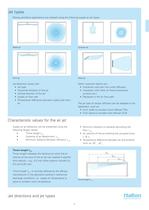
Mixing ventilation applications are realised using the following supply air jet types: > Radial jet Compact jet Swirl jet Plane jet Jet behaviour varies with Jet type Օ Horizontal direction of the jet Vertical direction of the jet Օ Supply air flow rate Temperature difference between supply and room air Other important factors are: Օ Interaction with jets from other diffusers Interaction with other air flows (convective currents etc.) Օ Obstacles in the air flow pathThe jet type of certain diffusers can be adapted to the application, such as: From radial to compact (swirl diffuser TSA) Օ From...
Open the catalog to page 3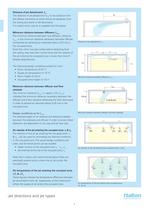
Distance of jet detachment, L > d The distance of jet detachment (L > d ) is the distance from the diffuser centreline at which the air jet detaches from the ceiling and starts to fall downward. It is useful when cool air is supplied into the space. Minimum distance between diffusers, L > min The minimum distance between two diffusers, distance, L Minimum distance between diffuser and flow obstacle The minimum distance (L > min , is the minimum distance necessary between diffuser centrelines for achieving air velocities below 0.25 m/s in the occupied zone. Note that when two jets collide before...
Open the catalog to page 4
Acceptable selection is studied : Check that L DKR-200-450 (R4) > d is sufficiently long in respect of the room width Օ Check that the distance between diffusers is greater than L Total sound pressure level: 33 dB(A) Օ Total pressure drop: 13 Pa L > d = 3.6 m OK; distance from diffuser to occupied zone limit = 3.3 m, 2.9 m 2.2 m Օ v > min Check that there are no flow obstacles closer than distance L > 1 =0,10 m/s v > 3 =0,20 m/s Օ > obs => approx. 0.5 x L > min from the diffuser Check the air velocity of the jet entering the occupied zone, v $ T > v1 = 0,1 հC $ T > v3 = 0,5 C OK; on both sides...
Open the catalog to page 6All HALTON catalogs and technical brochures
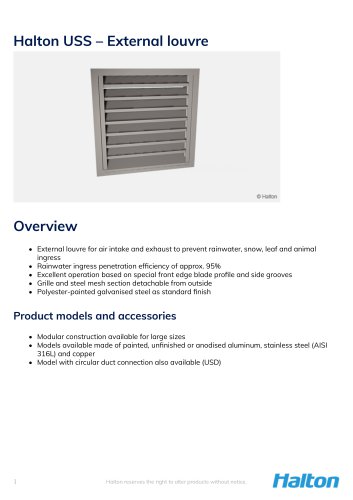 Halton USS
8 Pages
 Halton Vita Cell Room (VCR)
2 Pages
 Halton Rex Expander (RXP)
16 Pages
 Halton CBD
8 Pages
 FS Halton AHUs
28 Pages
 Halton KCD
3 Pages
 KVE-CM
7 Pages
 KMC - MobiChef
5 Pages
 Halton MobiChef
12 Pages
 R6B
R6B9 Pages
 Halton Vario
20 Pages
 Halton FDS
7 Pages
 Halton FDR
6 Pages
 Halton FDI
6 Pages
 Halton FDE
8 Pages
 Halton FDC
5 Pages
 ALE/ALU
8 Pages
 AHF
AHF5 Pages
 JTH
JTH4 Pages
 FDC
FDC5 Pages
 AFB
AFB7 Pages
 TCG 2013
4 Pages
 FCU 2013
6 Pages
 HFB - Airflow Management Damper
17 Pages
 VHB - Active VAV Diffuser
7 Pages
 TLD - Wall Diffuser Unit
9 Pages
 FDB2 -
4 Pages
 CPA - Passive Chilled Beam
13 Pages


Archived catalogs
 KCJ
KCJ12 Pages
 HALTON-KSK
6 Pages
 HALTON-KVD
6 Pages
 FCU Vertical Fancoil Unit
4 Pages
 Halton ? Chilled Beams
12 Pages
 Halton ? Ventilation fire safety
12 Pages
 Halton ? AdaptableClimate
12 Pages
 HALTON-POLLUSTOP
4 Pages
 HALTON-KCE
10 Pages
 UNIPOINT
4 Pages
 Halton - universal grilles
46 Pages
 Halton - beam design guide
31 Pages


- Extractor hood
- Range hood with built-in lighting
- Industrial range cooker
- Ventilation grill
- Metal ventilation grill
- Electric range cooker
- Rectangular ventilation grill
- Commercial range cooker
- Industrial air diffuser
- 1 oven range cooker
- Exterior ventilation grill
- Hatch
- Aluminum ventilation grill
- Island range hood
- Metal access hatch
- Facade ventilation grill
- Square ventilation grill
- Ceiling-mounted air diffuser
- Industrial fan coil
- White ventilation grill