

GRUNDFOS CONTROLS GUIDE

GRUNDFOS CONTROLS GUIDE
The Grundfos Controls Guide is intended for engineers and technicians involved in pump system design and installation. It highlights the importance of controls for optimal pump operation, reliability, and data monitoring, structured into chapters focusing on different applications and pump systems.
The guide includes a table of contents with system applications such as heating, district heating, air-conditioning, pressure boosting, and wastewater management, providing detailed information on each application area.
For heating systems in medium to large buildings, speed-controlled pumps like MAGNA3 and TPE3 are recommended for energy savings, eliminating the need for external pressure sensors and motor protection.
Mixing loops manage heat demand variations across building zones. Speed-controlled pumps in these loops help achieve energy savings and hydraulic balance, with recommendations for differential pressure control.
- Speed-controlled pumps ensure high efficiency and low energy consumption.
- Proportional pressure can be achieved without external sensors.
- External sensors and motor protection are necessary for pumps above 22 kW.
- System design should consider the entire heating system for optimal performance.
The guide serves as a comprehensive resource for selecting and implementing controls in pump systems, enhancing efficiency, reliability, and cost-effectiveness.
The document discusses various pump systems, including TPE, TP/NK, and boiler shunt pumps, with recommendations for temperature transmitters and remote control setup.
Boiler shunt pumps are recommended for temperature control, supporting various communication options and operations.
Heat recovery systems optimize flow between heating surfaces, highlighting the use of controlled pumps for energy savings.
Heat surfaces are managed by pumps like MAGNA3 and TPE2, emphasizing constant flow and variable temperature.
DHW systems are divided into heating and storage units, with pump control based on storage tank temperature, ensuring minimum flow requirements.
DHW recirculation ensures hot water availability near tapping points, reducing water waste and enhancing comfort.
The document outlines control systems like Control MPC series 2000, CUE frequency converters, and MP204 motor protection, with key parameters for optimal operation.
Describes the use of booster pumps for maintaining constant static pressure and the renovation of air-conditioning systems.
Recommends using treated water and installing water shortage detection on the suction side of boosters.
Includes a life cycle cost analysis highlighting the benefits of variable speed pumps in energy savings and operational efficiency.
Discusses pressure boosting in large buildings, break tank systems, direct connection systems, roof tank systems, and zone divided systems.
Focuses on drainage, surface water, sewage, and fire pump systems, outlining requirements for pump installations and control systems.
Offers electric and diesel fire pump systems with global approvals, featuring modular and packaged systems for quick installation.
Lists various communication interfaces and control options for efficient system management.
Highlights Grundfos' solutions for wash and cleaning systems, filter applications, and industrial water treatment.
Lists several data communication protocols facilitating seamless communication and integration of pump systems.
Details processes of flocculation and sedimentation, offering solutions for efficient water management.
Grundfos provides a wide range of products and systems for water supply and wastewater management, emphasizing efficiency and sustainability.
Catalog excerpts

CONTROLS GUIDE APPLICATIONS I
Open the catalog to page 1
GRUNDFOS CONTROLS – INTRODUCTION FOREWORD Do you need controls? The demands for controls increase and are often requested on pumps, when it comes to optimum operation, high reliability and monitoring of data. Therefore, Grundfos has updated the Controls Guide, which gives in a simple manner an overview about applications and the related controls of speed controled pumps and pump systems. We have elaborated a Guide for engineers and technicians who work with design and installation of pumps and pump systems, containing answers to a wide range of controls for pumps. The handbook can either be read...
Open the catalog to page 2
GRUNDFOS CONTROLS – CONTENT TABLE OF CONTENT System Application area Application area 8. Const. pressure & On/Off 21. Solar water solution Further information
Open the catalog to page 3
GRUNDFOS CONTROLS - H EATING 1. HEATINGMEDIUM/LARGE BUILDINGS Plan heating systems from the outside in Knowing the flows and temperatures required for radiators, under-floor heating, etc., lets you design your system based on known demands on central equipment. Our external controls and integrated frequency converters ensure maximum system intelligence, flexibility and the lowest costs. Think about the whole system In heating systems, energy efficient pumps are only half the story. With the right system design, you can minimise energy consumption, increase comfort levels and future-proof your...
Open the catalog to page 4
GRUNDFOS CONTROLS - H EATING Boiler shunt pump The primary task of the boiler shunt pump is to ensure that the temperature differences between top and bottom of the boiler are not too big, big temperature differences cause tension in the material and thus reduce the life of the boiler. For certain types of fuel there is a risk of corrosion at too low temperatures at the bottom of the boiler. Maximum safety is ensured when using a controlled pump, and the energy saving is optimal. TPE: The pumps have an integrated frequency converter and motor protection. A temperature transmitter with an output...
Open the catalog to page 5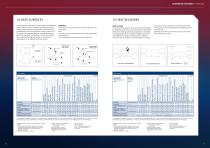
GRUNDFOS CONTROLS - H EATING 1.4 HEAT SURFACES 1.5 HEAT RECOVERY The pump is set at uncontrolled, and the signal from the central control unit is connected to the analog entry (0-10V or 0/4-20 mA). Grundfos GO remote control must be used in connection with setting up the pump. Heat recovery The purpose of the system is to recover the heat of the outlet air. The primary task of the pump is to ensure an optimal flow between the heating surfaces. The pump/valve is controlled from the general control unit of the ventilation system. The saving potential of using a controlled pump in stead of a three-way...
Open the catalog to page 6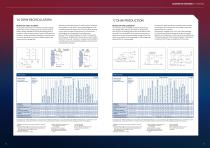
GRUNDFOS CONTROLS - H EATING District hot water circulation The purpose of the system is domestic hot water heating. The function of the circulator pump is to ensure that hot water is always available as close to the tapping point as possible, in order to reduce waste of water and increase the comfort. In certain installations (loading circuits) the pump can at the same time ensure the circulation between the inverter and the storage tank. Normally uncontrolled pumps are used, because usually the flow variation is only small. It may be advantageous to use controlled pumps for adjustment of the...
Open the catalog to page 7
GRUNDFOS CONTROLS - DISTRICT HEATING 2. DISTRICT HEATINGCAMPUS/ LARGE SCALE DH 1 > Power plant 2 > Boiler houses 3 > Substation in distribution net 4 > Local substation with DHW production 5 > Local substation in the building 6 > Mixing loop in the building 2.1 MAIN PUMPS Main Pumps Due to variations in heating demand and flow, we recommend that the main pumps be speedregula ted and installed in parallel. Install a maximum of 3 pump s plus 1 as a standby. The use of speed-regulated pumps maximises the potential energy saving. It is important to check the efficiency at the duty point at which...
Open the catalog to page 8
GRUNDFOS CONTROLS - DISTRICT HEATING 2.2 BOOSTER PUMPS 2.3.DISTRIBUTED PUMPS In Instead of using a large closed pressure tank, one or more pumps together with an open storage tank will maintain constant static pressure in the system. If the system pressure exceeds the allowable level, a relief valve will lead the water back to the tank. It is recommended that treated water be used. The set point will be the static pressure of the system. It is recommendable always to install a standby pump. If the system is used for refilling the system please note that there is a risk of cavitation in the pump...
Open the catalog to page 9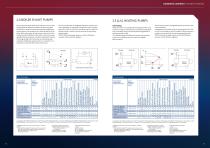
GRUNDFOS CONTROLS - DISTRICT HEATING TPE: The pumps have an integrated frequency converter and motor protection. A temperature transmitter with an output signal of 0/5-10V or 0/4-20 mA should be used. Grundfos GO remote control is used for start-up and later for extracting operating data. TP/NK: These pump types require an external frequency converter and an external regulator. 2.4 BOILER SHUNT PUMPS The primary task of the boiler shunt pump is to ensure that the temperature difference between the top and bottom of the boiler is kept low. Excessive temperature differences cause tension in the...
Open the catalog to page 10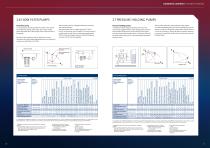
GRUNDFOS CONTROLS - DISTRICT HEATING 2.6 FLOW FILTER PUMPS 2.7 PRESSURE HOLDING PUMPS Flow filter pump It is necessary to continuously filter the water in the system to maintain the quality of the water. This is done using a partial flow filter with a flow of 10% of the maximum flow in the system. By measuring the pressure drop in relation to a known resistance and using a speed-regulated pump, it is possible to maintain constant flow in the filter. TPE:The pumps have an integrated frequency converter and motor protection. A Ap transmitter with an output signal of 0/5-10V or 0/4-20 mA should...
Open the catalog to page 11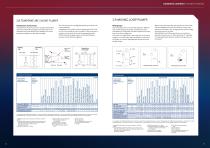
GRUNDFOS CONTROLS - DISTRICT HEATING Temperature shunt pumps TPE: The pumps have an integrated frequency converter and A temperature shunt must ensure a constant temperature motor protection. at the top of the heat exchanger to avoid tension on the A temperature transmitter with an output signal of 0/5-10V material and to minimize the risk of leakage. The correct or 0/4-20 mA should be used. Grundfos GO remote control is temperature depends on the heat exchanger. used for start-up and later for extracting operating data. TP/NK: These pump types require an external frequency converter...
Open the catalog to page 12All Grundfos catalogs and technical brochures
 Product Brochure
6 Pages
 Conex® DIA-G, DIS-G
2 Pages
 COMFORT PM AUTOADAPT
2 Pages
 CMBE BOOSTER
2 Pages
 GRUNDFOS CMBE TWIN BOOSTER
2 Pages
 GRUNDFOS CIM/CIU
3 Pages
 BMS hs, BMS hp, BMST, BMSX
5 Pages
 PURIFY YOUR BUSINESS
9 Pages
 GRUNDFOS BACMON
16 Pages
 ALPHA2, ALPHA2 L
19 Pages
 ALPHA2 L, Model A
2 Pages
 ALPHA1 L
2 Pages
 ALPHA1
2 Pages
 Grundfosliterature-5141099
8 Pages
 Grundfosliterature-3223346
4 Pages
 Grundfosliterature-3579569
8 Pages
 Grundfosliterature-5616210
8 Pages
 Grundfosliterature-5565188
7 Pages


- Cold water dispenser
- Grundfos water pump
- Commercial water dispenser
- Grundfos metal pump
- Grundfos stainless steel pump
- Grundfos submersible pump
- Electric pump
- Water treatment plant
- Grundfos cast iron pump
- Public space water dispenser
- Grundfos centrifugal pump
- Small community water treatment plant
- Wastewater settling tank
- Solar pump