
- Catalogs
- gonzagarredi
- Montessori

- Company
- Products
- Catalogs
- News & Trends
- Exhibitions
Montessori
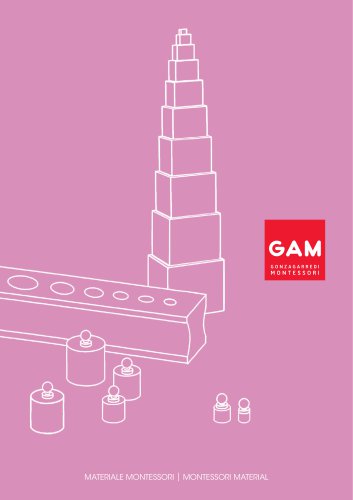
Montessori
The document provides an overview of the history and development of Montessori materials, emphasizing the collaboration between Maria Montessori and Gonzagarredi. It highlights the origins of these educational tools and their connection to Montessori's pedagogical principles.
Maria Montessori, in collaboration with Gonzagarredi, developed the first Montessori materials in the early 20th century. The partnership was facilitated by her friendship with Marchioness Maria Maraini Guerrieri Gonzaga. The first Montessori school, "Casa dei Bambini Carlo Guerrieri Gonzaga," was a product of this collaboration. The Montessori Museum (MEMO) at the new GAM headquarters showcases these early materials.
GAM continues to develop Montessori materials, adhering to the principles established by Maria Montessori. The company, now part of the i’M Group, focuses on high-quality products that promote children's autonomy and freedom. GAM collaborates with experts to ensure their products meet educational needs and Montessori standards.
GAM's products are designed with a focus on pedagogy, quality, safety, and ethics. The materials are approved by the Association Montessori Internationale, ensuring compliance with Montessori principles. The company emphasizes the importance of ethical manufacturing practices and worker rights.
GAM has established partnerships with organizations like the Opera Nazionale Montessori (ONM) and the Association Montessori Internationale (AMI) to ensure their materials align with Montessori's educational philosophy. These collaborations help promote and preserve Montessori's legacy.
The document underscores GAM's commitment to maintaining the integrity of Montessori materials and their educational value. Through continuous innovation and adherence to Montessori principles, GAM aims to support the holistic development of children worldwide.
The document provides descriptions of various educational toys and materials designed for infants and toddlers, focusing on developing hand-eye coordination, fine motor skills, and cognitive abilities. Each item is described with its purpose, functionality, and dimensions.
Each puzzle and material is designed with realistic images and proportions to help children differentiate between sizes and objects. The puzzles include themes such as vegetables, fruits, animals, and everyday objects, each with specific product codes for identification.
The materials are made from durable wood and textiles, ensuring longevity and practicality. The designs are child-friendly with rounded edges and washable fabrics.
These materials are intended to support practical life skills, encouraging children to engage in activities that develop their coordination, concentration, and independence. The realistic images and interactive elements also aid in vocabulary development.
This document describes a series of 12 Dressing Frames designed to help children develop coordination, concentration, and independence. Each frame is constructed from beechwood with a durable textile, ensuring longevity and practicality. The frames measure 30x30 cm and include various fastening types such as buttons, laces, hooks, and Velcro.
The document also lists various practical life tools and stands, including:
- Dressing Frames Stand
- Wash Stand and Scrub-Board
- Complete Practical Life Stand
- Cleaning Tools Stand
- Indoor Broom
- Corn Broom
- Squeegee
- Scrubber
- Rug Beater
- Shoe Polishing Brush Set
- Small Dusting Brush
- Feather Duster
- Mini Dustpan
- Dish Brush
- Small Metal Bucket
- Small Watering-Can
- Brush for Table Washing
- Hand Washing Table
- Dish Washing Table
- Floor Mats
- Wooden Trays
- Mat Racks
The document provides a comprehensive overview of practical life tools and accessories designed to aid in the development of children's motor skills and independence. Each item is crafted with durability and ease of use in mind, making them suitable for educational environments.
This document provides a detailed description of various Montessori educational materials designed to enhance sensory perception and introduce mathematical and geometric concepts to children. The materials are crafted to develop visual, tactile, and sensory discrimination skills.
- Pink Tower
- Brown Stair
- Cylinder Blocks
- Red Rods
- Color Tablets
- Rough and Smooth Boards
- Fabric Box
- Baric Tablets
- Thermic Bottles and Tablets
- Smelling and Tasting Bottles
- Pressure Cylinders
- Constructive Triangles
Each material is designed to be used in specific exercises that enhance sensory perception and introduce foundational concepts in mathematics and geometry. The materials are crafted from high-quality wood and other materials to ensure durability and effectiveness in teaching.
These materials are recommended for use in Montessori educational settings to support the development of sensory and cognitive skills in children. They provide hands-on learning experiences that are essential for early childhood education.
This document provides a detailed description of various Montessori educational materials, focusing on sensory, geometric, and musical learning tools. Each item is designed to enhance specific skills in children, such as auditory discrimination, geometric understanding, and musical notation.
- Blue Triangles
- Sound Boxes
- Circles, Squares, and Triangles
- Inscribed and Concentric Figures
- Geometric Insets
- Metal Insets
- Wicker Basket
- Bells Set
- Note Position Material
- Tone Bars
- Metal Insets
- Colored Pencil Holders
The document outlines a comprehensive range of Montessori materials designed to support various aspects of child development, including sensory perception, geometric understanding, musical skills, and language proficiency.
This document provides a detailed description of Montessori educational materials designed to teach children the decimal system and basic arithmetic operations through hands-on activities. The materials include various sets of golden beads, number cards, and wooden trays, each serving a specific educational purpose.
The Golden Bead Material introduces children to the decimal system using tangible representations of numbers. It includes a variety of components such as gold beads, bead bars, squares, and cubes, along with number cards ranging from 1 to 9000. These materials are used to teach addition, subtraction, multiplication, and division.
This mat is used in conjunction with the Golden Bead Material to help children understand place value. It features colored columns that correspond to the Montessori hierarchy of numbers and is designed for floor use.
Following the introduction to the decimal system, the Stamp Game allows children to practice arithmetic operations. It includes stamps organized by hierarchical colors and numbers, along with additional components like skittles and tokens.
These boards help children learn numbers from 11 to 99. They include bead quantities and corresponding numeral boards, facilitating the understanding of number sequences and place value.
These materials are used to teach multiplication tables and number sequences. They include control charts for self-correction and additional exercises for practice.
The document also describes various trays, rugs, and cards used to support the learning activities, including the Golden Bead Chain of 1000 for counting practice and multiplication preparation.
This document provides a detailed description of various educational materials designed to teach mathematical concepts to children. The materials focus on counting, addition, subtraction, multiplication, division, and the introduction of negative numbers using bead chains, boards, and charts.
- Golden Bead Chain of 100
- Short Bead Chains
- Bead Material
- Addition Snake Game
- Addition Strip Board
- Subtraction Snake Game
- Multiplication Board
- Unit Division Board
- Each material set includes specific components such as boards, beads, and charts, designed to facilitate hands-on learning and memorization of mathematical concepts.
- Materials are stored in wooden boxes or trays for organization and ease of use.
- Use these materials to provide a tactile and visual approach to learning mathematics, enhancing understanding and retention.
- Incorporate these tools into a structured curriculum to progressively build mathematical skills from basic counting to complex operations.
This document provides a detailed description of various Montessori educational materials designed to teach mathematical concepts through hands-on activities. The materials are primarily focused on arithmetic operations, fractions, and the decimal system, using color-coded beads, charts, and other manipulatives.
A wooden box with plastic chips is used for teaching division problems for numbers 1-81. It includes a set of problems and corresponding answers.
This set includes a wooden box with compartments for storing color-coded plastic squares and rectangles. It helps children arrange these shapes by size and color to complete the decanomial square.
A set of 10 printed forms with bead outlines for practicing decanomial concepts.
Used to isolate number combinations from 1 to 10, this set includes plastic cards shaped like houses and a wooden storage box.
Contains bead bars for constructing multiplication tables from 1 to 10 in geometric form.
Introduces multiplication tables from 1x1 to 10x10 using bead bars.
Used for addition, subtraction, and multiplication activities, available in sets of 1 or 10.
Sets of 100 individual beads in various colors (gold, green, red, blue) for arithmetic exercises.
Rubber stamps representing the Montessori hundred square and bead bars for supplementary practice.
These frames serve as a bridge to abstraction for addition and subtraction exercises, with color-coded beads indicating number hierarchies.
Used for short and long multiplication with the decimal system, requiring additional bead bars and number tiles.
Materials representing number hierarchies in geometric form, aiding in understanding decimal values.
Introduce children to fractions, including terminology, equivalency, and arithmetic functions, with additional exercises available.
Reinforces long multiplication concepts through role-playing exercises with plastic number cards.
Bridges to abstraction for division exercises, including boards, beads, and skittles for practical learning.
This set includes additional exercises for use with Cut-Out Labeled Fraction Circles, comprising exercise cards, divider tabs, and a wooden storage box.
Used with Fraction Circles to demonstrate angle measurement in degrees, this tool is a metal plate calibrated to 360 degrees with a recessed circle for positioning a fraction piece.
Demonstrates conversion of fractions to decimals using a metal plate calibrated from 0 to 100, with a recessed circle for positioning the fraction piece.
Introduces decimal number formation and operations (addition, subtraction, multiplication) with decimal and whole numbers.
Includes color-coded cubes and decimal number cards for various decimal operations, stored in a wooden box.
Facilitates multiplication of whole and decimal numbers using a board with 49 colored squares representing hierarchical values.
Wooden stand for storing Fraction Skittles, which represent divisors of whole numbers and are used for division exercises.
Used for demonstrating square root extraction, consisting of a board with 900 holes and accompanying pegs and cups.
Used by children to build squares and extract square roots, featuring 225 indentations and colored beads.
Guides for square root extraction on the Algebraic Peg Board, consisting of plastic cards with color-coded patterns.
Transition material between bead bars and solid material, consisting of 20 bars for each quantity 1-10, stored in a wooden box.
Used to construct cubes and explore relationships, preparing children for abstract analysis of binomial and trinomial cubes and cube roots.
Demonstrates the power of two using cubes and prisms, each representing the square of the previous piece.
Represents the equation (a + b + c)³ with color-coded components for hierarchical values, aiding in arithmetic value association.
Concrete representation of (a + b)³, smaller than the version used in the Children's House, facilitating sensorial construction of higher powers.
Used for studying lines, angles, and geometric shapes, consisting of color-coded sticks and accessories stored in a wooden box.
Teaches geometric shapes, angles, and fractions using rubber bands, with included activity books and accessories.
Used for geometry exercises involving equivalent, identical, and similar figures, consisting of metal frames and insets.
Facilitates the study of equivalent figures, leading to the discovery of areas and theorems, consisting of metal frames and insets.
This section describes three cases of the Pythagorean theorem using green metal plates and colored inset pieces. The cases include triangles with two equal sides, triangles with sides in a 3:4:5 ratio, and a general Euclidean demonstration.
Various geometric materials are described, including small triangles, quatrefoils, trapezoids, and inscribed figures. These materials are used for studying geometric properties and are stored in specially designed cabinets.
Materials such as yellow prisms and cubes are used to teach volume calculation. These include wooden prisms and cubes stored in wooden boxes, facilitating hands-on learning.
The document details botany-related educational materials, including leaf shape insets, puzzles of trees, leaves, flowers, and roots, and corresponding cards for learning and classification. These are stored in wooden cabinets and are designed to aid in the understanding of plant biology.
Animal puzzles, including horse, frog, fish, turtle, and bird, are described. These puzzles come with nomenclature and control cards for educational activities, stored in a beech plywood cabinet.
This section describes the Animal Puzzle components, which include a wooden box with compartments and a lid. The components are designed for educational purposes, allowing children to engage with various animal shapes such as horse, frog, fish, turtle, and bird.
- Sandpaper Globe
- Painted Globe
- Continents Globe
- Geography Puzzle Maps
Wooden bases with national flags of various continents, each flag measuring 10x16 cm with a 30 cm pole height. These stands are available for North and South America, Europe, Asia, and Africa.
- Large Chart of the World
- Land and Water Form Trays
- Animal Continent and Ocean Boxes
Includes additional exercises for use with the Tellurium, featuring exercise cards and a wooden box.
This model is designed to demonstrate the movement of the Earth and the Moon around the Sun. It serves as an educational tool to explain the principles of day and night, seasons, and the Moon's position. The Tellurium is a simplified representation of the solar system, aimed at visualizing the rotational movements within the Sun-Earth-Moon system for children.
This stand is used to hold pin flags during the Stars Exercise. It is made from a self-healing material, ensuring durability during repeated use.
This set includes two sets of nomenclature cards with images, one with separate labels and one control set. The cards are made of durable plastic and come with a wooden storage box.
This exercise helps children understand the universe and familiarize themselves with the starry sky. It includes maps of the northern and southern hemispheres, flags, and labels, with names in Latin and English. The exercise is based on the Montessori concept of introducing the universe as a whole.
This model allows builders to explore the principle of the keystone in arch support. It is crafted from beech wood.
A 46-meter black canvas used for various educational activities, such as creating timelines and visual histories. It is designed to help children understand historical and cosmic concepts.
This timeline illustrates the evolution of life from simple organisms to humans, covering major eras like the Paleozoic, Mesozoic, and Cenozoic. It serves as a foundation for lessons in various scientific disciplines.
This book provides an overview of evolution over 46 billion years, with cards depicting prehistoric animals and early humans, designed for use with the Black Ribbon.
Depicts human development from Australopithecines to modern Hominids, including climate and technological changes. It is updated with the latest research.
This timeline places all other timelines into perspective, covering events from the Big Bang to the Human Genome Project, based on the Clock of Eras.
Covers the period from 5000 BC to 300 AD, showing the rise and fall of empires across continents. Made from durable, waterproof material.
Highlights major milestones in the fields of Biology, Chemistry, Physics, Astronomy, and Geology, allowing students to see the influence of scientific exploration.
This document describes a product designed for educational purposes, specifically focusing on a small robot called Bee-Bot. The robot is used in a structured environment to facilitate learning in various subjects such as language, mathematics, geometry, and botany, following Montessori principles.
The Bee-Bot operates on a grid printed on a durable, roll-up plastic mat measuring 125 x 125 cm. The mat can be placed on the ground or on a specially ordered table. The product is designed by Donatella Bruno and is intended to help children learn independently.
The mat is part of a logical-procedural path that allows children to engage in new experiences and experiments related to educational robotics. It aligns with the Montessori principle of "help me do it by myself," encouraging autonomous learning.
The document lists various replacement parts for the product, including different cylinders and a pink tower cube, each with specific dimensions and identifiers.
The product is manufactured by GAM GonzagArredi Montessori srl in Italy. The company reserves the right to modify designs and technical specifications without prior notice. All rights are reserved, and duplication of the catalog is prohibited without authorization.
GAM GonzagArredi Montessori Srl, 46023 Gonzaga (MN) - Italy. Tel. +39 0376 518 200, Fax +39 0376 528 127, Website: www.gonzagarredi.com, Email: [email protected]
Catalog excerpts
MATERIALE MONTESSORI MONTESSORI MATERIAL
Open the catalog to page 1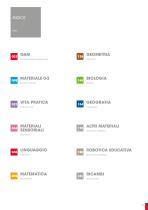
INDICE INDEX MATERIALE 0-3 INFANT & TODDLER VITA PRATICA PRACTICAL LIFE MATERIALI SENSORIALI GEOMETRIA GEOMETRY BIOLOGIA BIOLOGY ALTRI MATERIALI ROBOTICA EDUCATIVA ADDITIONAL MATERIALS EDUCATIONAL ROBOTICS
Open the catalog to page 3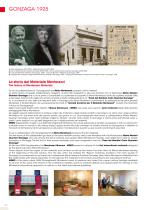
biopuico "DioniEssoHi.. 1. Maria Montessori (1870-1952) - Maria Montessori (1870-1952) 2. Donna Maria Maraini Guerrieri Gonzaga (1869-1950) - Donna Maria Maraini Guerrieri Gonzaga (1869-1950) 3. "Casa dei Bambini", Palidano di Gonzaga, 1928 - "Casa deiBambini", Palidano di Gonzaga, 1928 4. Catalogo del materiale e degli arredi Montessori prodotti a Gonzaga, 1938 - Catalogue of Montessori materials and furniture made in Gonzaga, 1938 La storia del Materiale Montessori The history of Montessori Materials Fu con la collaborazione di Gonzagarredi che Maria Montessori produsse i primi materiali. Le...
Open the catalog to page 4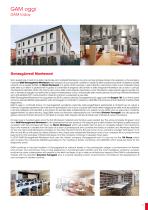
GonzagArredi Montessori Sono passati più di cent’anni dalla nascita dei primi materiali Montessori, ma sono ancora gli stessi principi che regolano e che spingono l’azienda GAM GonzagArredi Montessori nello sviluppo di nuovi prodotti. L’obiettivo è quello di offrire ai bambini prodotti di altissima qualità coerenti con le regole dettate da Maria Montessori e in grado di farli crescere in piena libertà e autonomia. Ogni nuovo materiale nasce dalle idee di un team di professionisti in grado di combinare le esigenze dei bambini e delle insegnanti Montessori da un lato e i principi montessoriani...
Open the catalog to page 5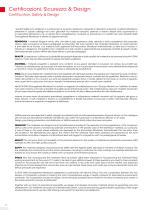
Certificazioni, Sicurezza & Design Certification, Safety & Design I prodotti GAM sono sottoposti a numerosi test di sicurezza, resistenza e atossicità in laboratori autorizzati. I materiali Montessori presentati in questo catalogo non sono giocattoli ma materiali educativi, destinati a essere utilizzati sotto supervisione di un educatore Montessori o di un adulto. Per la progettazione, l’acquisto, la produzione e la vendita dei nostri prodotti GAM GonzagArredi Montessori si attiene ai seguenti principi: PEDAGOGIA. I materiali tengono conto, oltre che della lunga esperienza della azienda e della...
Open the catalog to page 6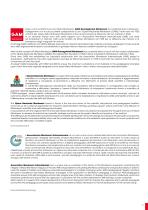
Dopo i primi contatti avuti con Maria Montessori, GAM GonzagArredi Montessori ha costantemente mantenuto i collegamenti con le sue più strette collaboratrici e con l’Opera Nazionale Montessori (ONM), l’ente nato nel 1925 a Roma per volere della dottoressa Montessori al fine di promuovere la diffusione del suo metodo in Italia. In un secondo tempo sono stati stretti rapporti con l’Association Montessori Internationale (AMI) con sede ad Amsterdam in Olanda, l’altro ente fondato da Maria Montessori nel 1929 per la diffusione del metodo e la formazione degli insegnati nel mondo. A tutt’oggi GAM collabora...
Open the catalog to page 7
GAM GonzagArredi Montessori Srl è iscritta al Mercato Elettronico (MePa) CONSIP MATERIALE 0-3 INFANT & TODDLER “La mano è quell’organo fine e complicato nella sua struttura, che permette all’intelligenza non solo di manifestarsi, ma di entrare in rapporti speciali con l’ambiente: l’uomo, si può dire, «prende possesso dell’ambiente con la sua mano» e lo trasforma sulla guida dell’intelligenza, compiendo così la sua missione nel gran quadro dell’universo.” “The human hand, so delicate and so complicated, not only allows the mind to reveal itself but enables the whole being to enter into special...
Open the catalog to page 9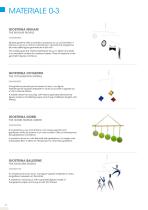
MATERIALE 0-3 GIOSTRINA MUNARI THE MUNARI MOBILE GMN048800 Questa giostrina offre al bambino qualcosa su cui concentrarsi. Il bianco e nero è un ottimo contrasto per i neonati che reagiranno alla vista delle figure geometriche e dei volti. This mobile gives the child something to focus on. Black and white is an excellent contrast for newborn babies. They will respond to the geometric figures and faces. GIOSTRINA OCTAEDRO THE OCTAHEDRON MOBILE GMN048900 Una giostrina pensata per la messa a fuoco, con figure tridimensionali sospese realizzate in carta luccicante e appese ad un filo a diverse altezze....
Open the catalog to page 10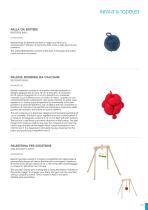
INFANT & TODDLER PALLA DA BATTERE BATTING BALL GMN049400 Questa Palla da Battere lavorata a maglia contiene una campanellino. Stimola il movimento delle mani e delle braccia del bambino. This knitted Batting Ball contains a little bell. It stimulates the baby’s hand and arm movement. PALLINA MORBIDA DA CALCIARE KICKING BALL GMN049700 Questo materiale consiste in una palla morbida realizzata su disegno giapponese di circa 15 cm di diametro. È composta da 12 cuscini triangolari 9 x 5 x 5 cm imbottiti con materiale morbido, cuciti insieme e con un motivo in rilievo. La palla ha una campanella fissata...
Open the catalog to page 11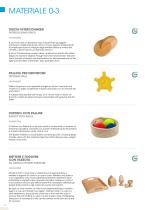
MATERIALE 0-3 DISCHI INTERCONNESSI INTERLOCKING DISCS GM305N000 A circa sei mesi un bambino inizia a esaminare gli oggetti attraverso il trasferimento da mano a mano. Questo trasferimento ha implicazioni per lo sviluppo degli emisferi destro e sinistro del cervello. I dischi hanno un diametro di 5 cm. A set of 2 interlocking wooden discs. At about six months the infant begins to examine objects through hand-to-hand transfer. Hand-tohand transfer of objects has implications for the development of the right and left sides of the brain. Disc diameter: 5 cm. PALLINA PER DENTIZIONE TEETHING BALL GM306N000...
Open the catalog to page 12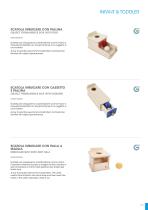
INFANT & TODDLER SCATOLA IMBUCARE CON PALLINA OBJECT PERMANENCE BOX WITH TRAY GM250000H Scatola per sviluppare la coordinazione occhio-mano e acquisire familiarità con la permanenza di un oggetto in una scatola. A box to practice eye-hand coordination and become familiar with object permanence. SCATOLA IMBUCARE CON CASSETTO E PALLINA OBJECT PERMANENCE BOX WITH DRAWER GM251000H Scatola per sviluppare la coordinazione occhio-mano e acquisire familiarità con la permanenza di un oggetto in una scatola. A box to practice eye-hand coordination and become familiar with object permanence. SCATOLA IMBUCARE...
Open the catalog to page 13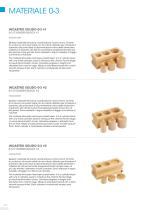
MATERIALE 0-3 INCASTRO SOLIDO 0-3 #1 0-3 CYLINDER BLOCK #1 GM266100H Questo materiale stimola la coordinazione occhio-mano. Si tratta di un blocco di incastri solidi con tre cilindri utilizzato per introdurre il bambino alla prima fase di discriminazione visiva delle dimensioni. L’altezza e il diametro dei cilindri aumentano progressivamente dal più piccolo al più grande. Sono realizzati in legno massello di faggio con finitura al naturale. This material stimulates hand-eye coordination. It is a cylinder block with only three cylinders used to introduce the child to the first stage of visual...
Open the catalog to page 14All Gonzagarredi catalogs and technical brochures
 CATALOG Learning Is In The Details
408 Pages
 SPAZIO ZERO6
100 Pages
 Office
55 Pages
 Edugreen
64 Pages
 Library
188 Pages
 6-18 years
71 Pages
 0-6 years
131 Pages
 06 Space
51 Pages
Archived catalogs
 Magis
Magis2 Pages