
- Catalogs
- Glashütte Lamberts Waldsassen
- restauro®UV / IR

restauro®UV / IR

restauro®UV / IR
This document discusses the use of restauro®UV and restauro®IR glass types, produced by LambertsGlas®, for the protection of historical and valuable objects from ultraviolet (UV) and infrared (IR) radiation. These specialized glasses are used in various historical sites to preserve art and cultural heritage.
Specifications
restauro®UV and restauro®IR are mouth-blown glass types that contain UV and IR protection filters within their chemical composition. They are not coated or laminated, ensuring their aesthetic qualities and effectiveness in preservation. These glasses are produced in thicknesses from 2 to 3mm and can be installed in narrow glazing rebates of historic wooden windows. They can also be manufactured in double and triple insulated glass units.
Applications
1. St. Marien Church, Wittenberg: Installed in 2014 to protect Lucas Cranach the Elder’s altar.
2. Large Parlour, Brentano House, Oestrich-Winkel: Installed in 2016 to protect early 19th-century interiors.
3. York Minster, Great East Window: Installed in 2017 as external protection glazing.
4. St. Nicholas Church, Wolfsbach/Bavaria: Installed in 2016 to protect a baroque altar.
Performance
restauro®UV protects against UV rays up to 380nm, preventing bleaching and structural damage to organic dyes and binding agents. restauro®IR protects against IR radiation between 780 and 1500nm, reducing thermal effects that cause dehydration and accelerated aging. The glass reduces the passage of infrared radiation by up to 80%, with increased effectiveness in thicker samples.
Production Process
The production of restauro® glass involves traditional mouth-blown technology. Glassmakers shape the glass into an elongated balloon, which is then cut, opened, and flattened. This process results in glass with slight distortions, bubbles, and streaks, integrating well into historic structures.
Conclusion
restauro®UV and restauro®IR provide effective protection for historical and valuable objects against harmful UV and IR radiation, preserving cultural heritage while maintaining aesthetic integrity.
Catalog excerpts

restauro®UV restauro®IR Mouth-blown special glass Historically valuable objects, furniture and interior decorations are under the constant influence of natural light and, therefore, are exposed to the harmful effect of ultraviolet and infrared rays. The shorter the wave lengths of these rays, the more energy and, as such, the more damaging their effect on the respective materials. UV rays bleach organic dyes and destroy the structure of binding agents and layers of paint. IR rays lead to dehydration and accelerated ageing due to their thermal effects. Over time painted surfaces crack and flake when exposed to repeated temperature changes and associated expansion and contraction. Entry of radiation into interior spaces primarily takes place through window openings. Simple window glass offers little protection. On the other hand, the specialized mouth-blown restauro®UV and restauro®IR glass types produced by LambertsGlas® contain UV and IR protection filters in their chemical composition. In addition to their aesthetic qualities, these unique glasses contribute effectively to the preservation and preventive conservation of valuable art and cultural heritage. restauro®UV and restauro®IR are not coated or laminated. The protection filters are within the glass. St. Marien Church, Wittenberg; Martin Luther’s place of activity and mother church of the Reformation; restauro®UV as small-scale stained glass to protect the Lucas Cranach the Elder’s altar inaugurated in 1547; installation 2014 © Foto Preiss Large Parlour, Brentano House, OestrichWinkel (Rheingau); restauro®UV installed in the historic muntin windows to protect the valuable interior of the early 19th Century; installation 2016 restauro®UV and restauro®IR, just like restauro® Light and restauro® Classic, are produced by traditional mouth-blown technology. Therefore they have the same typical characteristics (distortions, little bubbles, streaks) and visually integrate perfectly into historic building structures. restauro®UV and restauro®IR are produced in thicknesses from 2 to 3mm and can also be easily installed in narrow glazing rebates of historic wooden windows. restauro®UV and restauro®IR can be manufactured in double and triple insulated glass units having insulating values close to conventional insulating glass. restauro®UV and restauro®IR are ideal for external protection glazing as well as suitable for the production of laminated glass and stained glass. Glashütte Lamberts Waldsassen GmbH - Schützenstraße 1 - 95652 Waldsassen Tel.: +49 (0)9632 / 9251-0 - Fax.: +49 (0)9632 / 9251-100 - [email protected] York Minster, Great East Window; largest example of medieval stained glass in England; external protection glazing with restauro®UV as stained glass with replicated lead lines; installation 2017 St. Nicholas Church, Wolfsbach/Bavaria; restauro®IR as honeycomb glazing to protect the baroque al
Open the catalog to page 1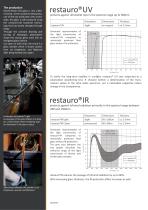
Mouth-blown flat glass is real craftsmenship. At the Lamberts Glassworks, one of the last production sites worldwide, this glass is still produced using the centuries-old handcraft technology that has hardly changed through today. Through the constant blowing and turning of blowpipes, glassmakers shape the viscous glass mass into an elongated glass balloon. Cut open on both ends, the result is a glass cylinder which is slowly cooled, then cut lengthwise, and flattened after being heated once again. protects against ultraviolet rays in the spectral range up to 380nm Distortions Schematic representation...
Open the catalog to page 2All Glashütte Lamberts Waldsassen catalogs and technical brochures
 restauro® Classic / Light
2 Pages
 IT´S COLOURED LIGHT
28 Pages
 LambertsGlas® sample
2 Pages
 Flyer "restauro®"
2 Pages
 Brochure "architecture"
2 Pages
 PROJECT WITH LAMBERTS
124 Pages
 RESTORATION GLASS
2 Pages
 LAMBERTS BROCHURE
48 Pages


- Architectural glass
- Interior glass panel
- Building glass panel
- Patterned glass panel
- Transparent glass panel
- Laminated glass panel
- Safety glass panel
- Joinery glass panel
- Colored glass panel
- Translucent glass panel
- Flat glass panel
- Door glass panel
- Insulating glass panel
- Window glass panel
- Double-glazed glass panel
- Furniture glass panel
- Structural glass panel
- Customizable color glass panel
- Textured glass panel
- UV-resistant glass panel