
- Catalogs
- Glasfabrik Lamberts GmbH & Co. KG
- LINIT U-Glas - Technical Introduction

LINIT U-Glas - Technical Introduction

LINIT U-Glas - Technical Introduction
Glasfabrik Lamberts, established in 1887, is a family-owned company specializing in rolled glass production. It is the only medium-sized European manufacturer of cast glass, producing U-profile glass, patterned glass, solar glass, and wired glass. The company is noted for its environmentally sustainable production methods using an oxygen-fired melting furnace.
The document details the production process of LINIT U-profiled glass, highlighting its ecological benefits and high-quality standards. The glass is formed into a U shape and cooled, resulting in unique optical characteristics. The product range includes various types of LINIT glass, each with specific production requirements and availability based on demand.
LINIT U-profiled glass is praised for its load-bearing capacity and aesthetic appeal. It is available in different surface structures, such as LINIT clarissimo and LINIT solar, offering unique visual effects and energy efficiency. The document also mentions the use of LINIT glass in prestigious architectural projects worldwide.
Technical details on dimensions, production tolerances, and special production conditions for LINIT glass are provided. It outlines different production categories (Normal Production, Special Production) and the conditions under which each type is manufactured.
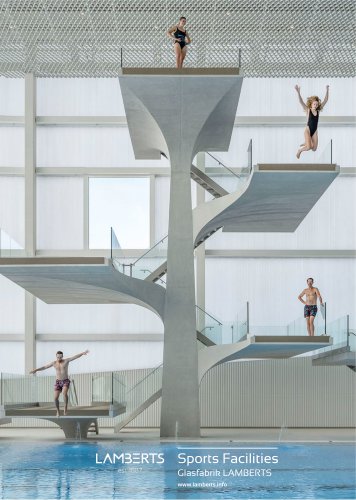
Examples of architectural projects using LINIT glass are provided, showcasing its versatility and appeal in various settings, including museums, shopping centers, and sports facilities.
The document concludes by emphasizing the company's commitment to quality and innovation, encouraging architects and builders to consider LINIT glass for their projects due to its ecological benefits and aesthetic qualities.
LINIT Prismasolar is a unique surface structure developed by Lamberts, designed to provide both seasonal shading and light penetration when installed horizontally. It creates interesting lighting effects and optical illusions, making it a distinctive choice in the rolled glass market.
LINIT offers various glass surface designs including clarissimo, cord, Ice, 504 perl, solar, and prismasolar. Each design is produced under studio conditions, which may differ from actual site conditions, and production tolerances must be considered.
LINIT U-Profiled glass can be aesthetically enhanced through sandblasting, which scatters light diffusely, creating a soft, whitish color. The use of low iron LINIT can further enhance the optical appearance by reducing the greenish tint of standard glass.
LINIT color involves burning ceramic colors into the glass, allowing for a variety of RAL color shades. This process enhances durability, especially against UV radiation, and can be combined with toughening for increased temperature resistance.
LINIT tough is a thermally tempered glass offering increased thermal shock resistance and safety against ball throwing, meeting various DIN standards. Special considerations are required for shaped glass with wire inlays, which do not qualify as safety glass in Germany.
LINIT U-Profile glass offers various U-values depending on the type of glazing and coatings used. These values are approximate and depend on the transparent thermal insulation material used.
LINIT Prismasolar and other LINIT glass types offer innovative solutions for architectural applications, combining aesthetics with functional benefits such as light management and thermal insulation. Detailed product specifications are available for precise application and compliance with construction standards.
The document discusses the use of glass in building facades to control and optimize energy permeation, focusing on seasonal shading, light channelling, soundproofing, and the use of specialized glass systems like LINIT prismasolar.
Glass facades help manage energy efficiency by reflecting light-heat radiation during summer and improving room lighting in winter. The LINIT prismasolar system enhances spatial lighting through its optical properties.
Various glazing structures offer sound insulation values compliant with DIN 4109 standards, with triple and double glazing options providing different levels of sound reduction.
LINIT low iron glass allows high light and radiation transmission, favored for its aesthetic and ecological benefits. Special production processes cater to specific project needs.
Aluminium profiles are available in different designs and can be customized for specific architectural needs. They offer thermal insulation and can be finished in various surface designs.
The selection of glass types is influenced by static requirements and aesthetic preferences, with strict adherence to national building regulations. The document outlines the importance of proper frame fixing and installation to ensure structural integrity.
Proper handling and installation of LINIT channel glass are crucial to avoid damage. The document emphasizes the need for reliable fixing methods and the prevention of harmful material interactions.
The document outlines the installation and maintenance procedures for LINIT U-profiled glass. It emphasizes the importance of proper drainage arrangements in the frame profile to prevent dirt penetration and accommodate temperature-induced length changes. Expansion joint profiles and thrust elements should be carefully fitted and sealed to prevent water penetration and draughts.
Compliance with building regulations and manufacturer instructions is crucial, particularly in Germany, where specific tensile strengths and sealant categories are mandated by DIBt Berlin. The document specifies the use of toughened glass for certain applications and highlights the need for careful selection of fixing and grouting media.
Detailed instructions are provided for sealing glass to frames and between glass panels. The document advises against using non-toughened glass for unsealed applications and describes the process for replacing broken glass channels.
For special applications, consultation with the manufacturer is required to ensure compliance with national and international regulations. Specific guidelines are provided for sports hall glazing and complete glass corners.
Proper handling and storage of channel-shaped glass are emphasized to prevent damage. The document advises using clean gloves and appropriate tools for cutting and handling glass. Storage guidelines include keeping glass dry and protected from environmental influences.
Regular inspection and maintenance are required to ensure the longevity of the glass installations. Damaged glass must be replaced, and sealants checked regularly. Cleaning instructions highlight the importance of using appropriate agents and tools to avoid damaging the glass.
The document outlines the liability and guarantee terms, emphasizing the responsibility of planners and architects to verify product information against current standards and regulations. Lamberts reserves the right to modify product details as necessary.
Catalog excerpts

Technical Indroduction U-Glass
Open the catalog to page 1
The Glasfabrik LAMBERTS Company history The staff at the Glasfabrik Lamberts has been involved in the manufacturing of rolled glass, i.e. glass formed in rolling processes, since the founding of the company in 1887 by glass engineer Laurenz Lamberts. Since then the company has been a family-owned business and is the only medium-sized company in Europe to manufacture cast glass without being bound by any group. Wide range of products and flexibility We are the only cast glass manufacturers in the world to produce every existing type of cast glass: >U-profile glass, patterned glass (and also special...
Open the catalog to page 2
World famous architects use >. Internationally renowned architect awards such as the AIA Honour Award 2008, for example, presented actually to two projects with large-area and highly sophisticated > applications, distinguish the architect’s excellent work and also our glass products. The deep conviction that even more brilliant work could be accomplished with our glass encouraged us at an early stage to go ahead and break new ground. Since the year 2000, for example, we are the first glass manufacturers in the world to offer > U-Profile Glass as standard, in lengths of up to 7 m, as tempered safety...
Open the catalog to page 3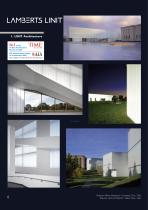
Nelson Atkins Museum / Kansas City / USA Steven Holl Architects / New York / USA
Open the catalog to page 4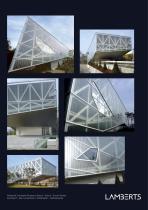
National University Museum Seoul / Seoul / South-Korea Architect: Rem Koolhaas / Rotterdam / Netherlands
Open the catalog to page 5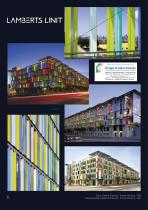
Civic Center Parking / Santa Monica / USA Moore Ruble Yudell Architects / Santa Monica / USA
Open the catalog to page 6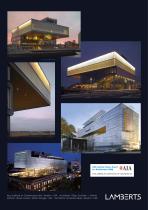
top: Institute of Contempory Arts / Boston / USA Architects: Diller, Scofidio + Renfro bottom: Shaw Center / Baton Rouge / USA Architects: Schwartz-Silver / Boston / USA
Open the catalog to page 7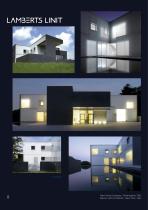
New Swiss Embassy / Washington/ USA Steven Holl Architects / New York / USA
Open the catalog to page 8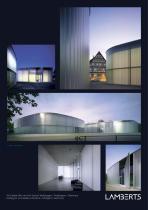
Art Gallery Stihl and Art School Waiblingen / Waiblingen / Germany Hartwig N. Schneider architects / Stuttgart / Germany
Open the catalog to page 9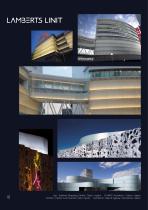
top: Kashiwa Shopping Center / Tokyo / Japan PLANTEC Architects / Tokyo / Japan bottom: Centro Commercial / Soria / Spain Architects: Vaillo & Irigaray / Pamplona / Spain
Open the catalog to page 10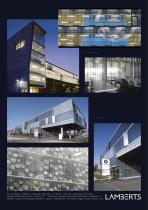
top: University Hospital / Hamburg / Germany Architect: Prof. Sill / Hamburg / Germany middle: BMW Sales Office / Munich / D Architects: Achammer-Tritthart & Partner / Innsbruck / A bottom: Traffic and Transport Museum / Luzern / Switzerland Architects: Gigon Guyer / Zurich / CH
Open the catalog to page 11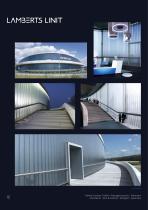
Adidas Factory Outlet / Herzogenaurach / Germany Architects: Wulf & Partner / Stuttgart / Germany
Open the catalog to page 12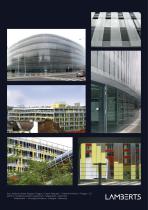
top: National Library Prague / Prague / Czech Republic Projektil Architecti / Prague / CZ bottom: Shopping Center Luisenforum / Wiesbaden / Germany Gatermann + Schossig Achitects / Cologne / Germany
Open the catalog to page 13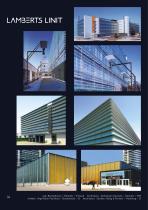
top: Biomedicum / Helsinki / Finland Architects: Gullichsen Vormala / Helsinki / FIN middle: High-Rack Facilities / Geesthacht / D Architects: Gerkan, Marg & Partner / Hamburg / D
Open the catalog to page 14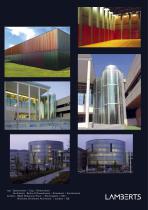
top: Sportcenter / Zug / Switzerland Architects: Bétrix & Consolascio / Erlenbach / Switzerland bottom: IMAX Millenium Point / Birmingham / GB / Nicholas Grimshaw Architects / London / GB
Open the catalog to page 15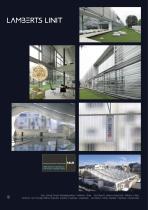
top: Living Divani Headquarters/ / Milano / Italy Architects: Lissoni Associati / Milano / Italy bottom: Ian Thorpe Ultimo Aquatic Centre / Sydney / Australia Architect: Harry Seidler / Sydney / Aaustralia
Open the catalog to page 16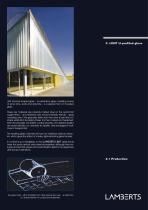
2. LINIT U-profiled glass LINIT channel shaped glass – an alkali-lime glass consisting mainly of sand, lime, soda and dolomite – is a special form of moulded glass. These raw materials are carefully melted down in the world’s first oxygen-fired – and therefore also environmentally friendly – glass moulding oven. The glass strip taken from the oven is bent into a U shape whilst still in its plastic phase. It is then cooled and hardened. After the precisely controlled cooling process, the desired lengths are automatically cut, checked for quality, and packaged in batches in transport foil. The...
Open the catalog to page 17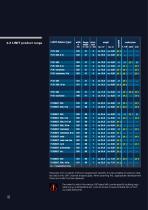
2.2 LINIT product range Obviously, from a certain minimum requirement quantity, it is also possible to add your desired decor into LINIT channel shaped glass. When planning this, appropriate development times and costs must be observed. The extent to which the various LINIT types fulfil country-specific building regulations (e.g. authorisations etc.) can be found at www.lamberts.info or from our sales personnel.
Open the catalog to page 18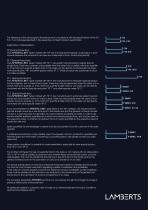
The tolerance of the above given dimensions are in compliance with the specifications of the EN 572, if not otherwise specified in the respective Lamberts’ product specification. Explanation of abbreviations: NP (Normal Production): The > types marked with “NP” are manufactured regularly, as standard, in short intervals between the production runs and are mostly kept in stock, as demand permits. SP 1 (Special Production): The > types marked with “SP 1” are usually manufactured in regular special productions. These are, however, only possible when the order is for a certain minimum quantity, or,...
Open the catalog to page 19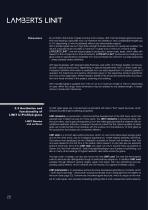
By contrast to flat panes of glass and due to its U shape, LINIT channel shaped glass has excellent load-bearing capacities and can therefore be installed in very considerable lengths (up to 7m depending on wind load/stress) without any intermediate support. LINIT U-profiled glass has such high static strength that side braces can usually be avoided. The result is a façade which provides a maximum of glass and a minimum of frame profile. > channel shaped glass is produced in seven basic types, which differ with respect to the U shape and in their dimensions. > produced according to our given...
Open the catalog to page 20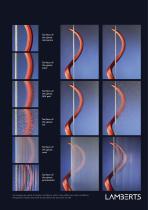
Surface of the glass: clarissimo Surface of the glass: solar Surface of the glass: 504 perl Surface of the glass: cord Surface of the glass: prismasolar All images are done at studio conditions, which may differ from site conditions. Production tolerances have to be taken into account as well. LINIT Designs Glass surfaces
Open the catalog to page 21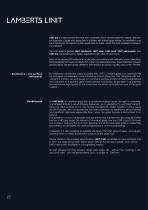
LINIT Ice is a new surface structure from Lamberts, which accentuates the natural, elemental character of glass and, especially in addition with frosted glass insides, Ice-aesthetics can be empathised. Alongside it is also applicable for fields, where the least possible transparency is desired. The LINIT special glasses LINIT clarissimo, LINIT solar, LINIT cord, LINIT prismasolar and LINIT Ice are protected by design registrations with effect in Germany. Each of the above LINIT surfaces is produced in accordance with defined product specifications (available from www.lamberts.info or from our...
Open the catalog to page 22All Glasfabrik Lamberts GmbH & Co. KG catalogs and technical brochures
 LAMBERTS Projects: Museums
25 Pages
 LAMBERTS Projects: Interior
26 Pages
 LINIT U-Glass Product range
2 Pages
 Thermolight brochure
12 Pages
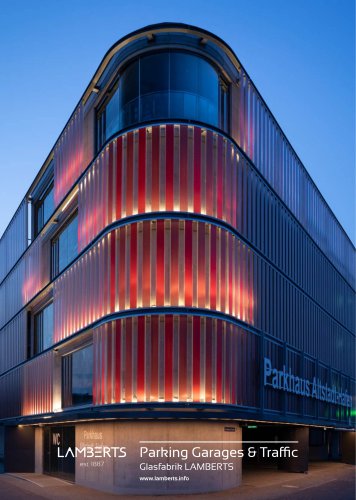
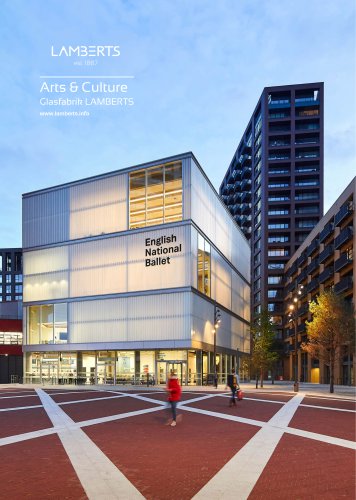
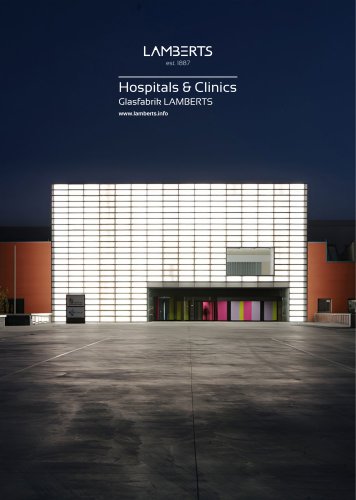
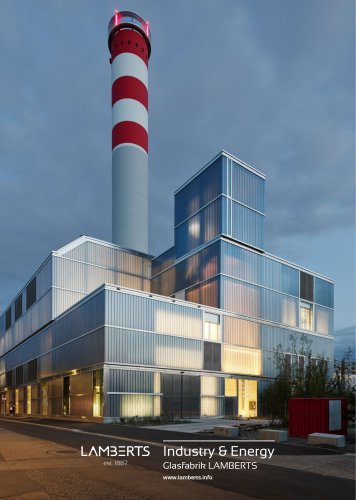
- Glasfabrik Lamberts interior glass panel
- Glasfabrik Lamberts building glass panel
- Industrial solar panel
- Glasfabrik Lamberts patterned glass panel
- Laminated glass panel
- Glasfabrik Lamberts joinery glass panel
- Glasfabrik Lamberts facade glass panel
- Safety glass panel
- Industrial photovoltaic module
- Glasfabrik Lamberts translucent glass panel
- Glasfabrik Lamberts partition wall glass panel
- Glasfabrik Lamberts flat glass panel
- Glasfabrik Lamberts door glass panel
- Glasfabrik Lamberts custom-made glass panel
- Glasfabrik Lamberts window glass panel
- Glasfabrik Lamberts colorless glass panel
- Glasfabrik Lamberts high-resistance glass panel
- Exterior fitting glass panel
- Glasfabrik Lamberts furniture glass panel