- Catalogs
- Genap
- Genap BV ? PO Box 27 ? NL 7040 AA ?s - Heerenberg ? T +31 314 661644 - [email protected] ? www.genap.nl Geomembrane structures for infrastructure ?Under water installation?

Genap BV ? PO Box 27 ? NL 7040 AA ?s - Heerenberg ? T +31 314 661644 - [email protected] ? www.genap.nl Geomembrane structures for infrastructure ?Under water installation?
Genap BV ? PO Box 27 ? NL 7040 AA ?s - Heerenberg ? T +31 314 661644 - [email protected] ? www.genap.nl Geomembrane structures for infrastructure ?Under water installation?
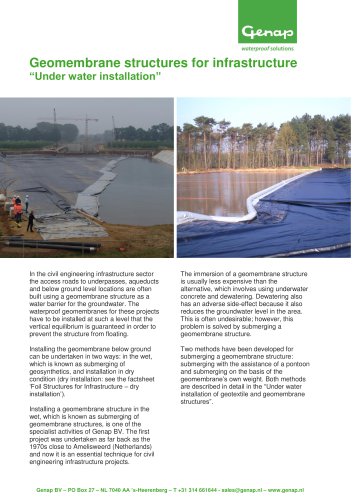
Geomembrane structures are crucial in civil engineering infrastructure, particularly for access roads to underpasses, aqueducts, and below-ground locations. These structures act as water barriers to prevent groundwater intrusion and ensure stability by preventing floating.
Installation Methods
There are two primary methods for installing geomembranes below ground:
- Wet Installation (Submerging): This involves submerging geosynthetics and is a specialty of Genap BV. It is often more cost-effective than using underwater concrete and dewatering, which can undesirably lower groundwater levels.
- Dry Installation: Details on this method are available in a separate factsheet titled 'Foil Structures for Infrastructure – dry installation'.
Submerging Techniques
Two techniques are used for submerging geomembrane structures:
- Using a Pontoon: This method involves the assistance of a pontoon to submerge the geomembrane.
- Using the Geomembrane's Own Weight: This method relies on the weight of the geomembrane itself for submersion.
Historical Context
Genap BV has been involved in underwater geomembrane installations since the 1970s, starting with a project near Amelisweerd, Netherlands. This technique has become essential in modern civil engineering projects.
Catalog excerpts

Geomembrane structures for infrastructure “Under water installation” In the civil engineering infrastructure sector the access roads to underpasses, aqueducts and below ground level locations are often built using a geomembrane structure as a water barrier for the groundwater. The waterproof geomembranes for these projects have to be installed at such a level that the vertical equilibrium is guaranteed in order to prevent the structure from floating. The immersion of a geomembrane structure is usually less expensive than the alternative, which involves using underwater concrete and dewatering. Dewatering also has an adverse side-effect because it also reduces the groundwater level in the area. This is often undesirable; however, this problem is solved by submerging a geomembrane structure. Installing the geomembrane below ground can be undertaken in two ways: in the wet, which is known as submerging of geosynthetics, and installation in dry condition (dry installation: see the factsheet ‘Foil Structures for Infrastructure – dry installation’). Two methods have been developed for submerging a geomembrane structure: submerging with the assistance of a pontoon and submerging on the basis of the geomembrane’s own weight. Both methods are described in detail in the “Under water installation of geotextile and geomembrane structures”. Installing a geomembrane structure in the wet, which is known as submerging of geomembrane structures, is one of the specialist activities of Genap BV. The first project was undertaken as far back as the 1970s close to Amelisweerd (Netherlands) and now it is an essential technique for civil engineering infrastructure projects. Genap BV – PO Box 27 – NL 7040 AA ’s-Heerenberg – T +31 314 661644 - [email protected] – www.genap.nl
Open the catalog to page 1All Genap catalogs and technical brochures
 Genatop silo cover
1 Page
 GenaSpan
1 Page