
- Catalogs
- Fritz Hansen
- REPUBLIC Brochure


REPUBLIC Brochure

REPUBLIC Brochure
This document from Republic no.15, 2014, explores the enduring design philosophy of Fritz Hansen, focusing on the revival of classic furniture and the introduction of new designs. It highlights the emotional connection and lasting quality of their furniture, intended to be cherished across generations.
The document details the reintroduction of iconic designs by Arne Jacobsen, such as the Grand Prix™ and Drop™ chairs. These pieces are praised for their aesthetic appeal and ability to enhance environments. The Drop™ chair, initially designed for the SAS House, is now available to the public, reflecting Jacobsen's human-centric design approach.
Jaime Hayón's Analog™ table is introduced as a celebration of face-to-face interaction, countering the digital age's demands. The table fosters genuine togetherness and offline engagement.
Fritz Hansen's dedication to perfectionism, craftsmanship, and detail is evident in their furniture, designed to last a lifetime. The document emphasizes the importance of physical and psychological comfort in design, as exemplified by Jacobsen's work for the Royal Hotel.
The document examines how architecture influences human interactions, focusing on the M/S Maritime Museum of Denmark and the impact of world-class architecture.
Fritz Hansen's designs, both classic and new, are positioned as timeless pieces that transcend fashion, emphasizing the intersection of ethics and aesthetics in design.
The document discusses the design and impact of Arne Jacobsen's iconic furniture pieces, particularly the Egg™, Swan™, and Drop™ chairs, originally created for the Royal Hotel. It also explores the influence of architectural design on social behavior, focusing on open spaces and stairwells in modern buildings.
Jacobsen's chairs were designed with human comfort in mind, balancing aesthetics and functionality. The Egg™ chair was upholstered in brown leather, while the Drop™ chair, initially not mass-produced, is now available in both fabric and plastic versions. The Swan™ chair was designed for panoramic views without obstructing sightlines.
The document highlights a research project by Mille Sylvest on how architectural design affects social interaction. Open stairwells and atriums enhance visibility and social interaction, though they require complementary private spaces for balance.
The document suggests that while open spaces promote interaction, they should be complemented by private areas to accommodate different needs. Transparency in design intentions and management practices is crucial for successful implementation.
Jacobsen's designs remain timeless due to their focus on human needs, and the research underscores the importance of thoughtful architectural design in enhancing social well-being.
The document discusses the challenges and solutions in designing open plan offices. It highlights the need for privacy and protection, akin to prehistoric instincts, and critiques the use of partition walls that allow sound but not sight. Solutions include arranging people in smaller groups and ensuring social spaces are not intrusive.
The trend of open plan offices has influenced home design, leading to a preference for smaller, private spaces within open areas. High-backed furniture is popular for creating intimate spaces.
Mille Sylvest's research project aims to understand how architectural design affects social behavior and well-being, a collaboration with Roskilde University and 3XN's GXN lab.
The document mentions various artistic and architectural projects, including Yasuaki Onishi's "Vertical Emptiness" installation and the Juvet landscape hotel in Norway, emphasizing a connection with nature.
The revival of the Kaiser Idell lamp series, designed by Christian Dell, is highlighted. The series is noted for its Bauhaus design and historical significance in industrial design.
Geranium, a Michelin-starred restaurant, is noted for its sensory dining experience, led by chef Rasmus Kofoed.
The Kaiser Idell lamp series, renowned for its Germanic design and precise engineering, was a symbol of exquisite material choice. Christian Dell, a pioneer in industrial and plastic design, utilized materials like Bakelite and amino plastics. Post-World War II, Dell ventured into silver goods and operated a jewelry shop in Wiesbaden until 1955.
The Analog™ table, designed by Jaime Hayón for Fritz Hansen, is a multi-functional piece that combines the warmth of wood with a modern design. The table features a unique shape that is neither square nor round, promoting social interaction by allowing everyone seated to see each other. It is available in two sizes, with options for oak, walnut veneer, or white laminate tops.
The design process involved a collaborative effort between Hayón and Fritz Hansen, focusing on creating a table with international appeal and warmth. The table's design was inspired by the idea of a communal meeting point, reminiscent of traditional family gatherings. The placement of the legs and the choice of materials were carefully considered to ensure stability and aesthetic appeal.
Jaime Hayón, a versatile designer, has created several notable products for Fritz Hansen, including the Favn™ sofa and the Ro™ chair. His work is characterized by a deep understanding of the company's design philosophy, making him a key figure in their product development.
The Grand Prix™ chair, originally designed by Arne Jacobsen, marked a significant development in industrial furniture design. Initially met with skepticism due to production costs, it gained traction after securing a large order from Novo Nordisk, showcasing its potential and leading to its eventual success.
In the 1940s, Fritz Hansen's experimentation with steam bending plywood caught the attention of architect Arne Jacobsen. Jacobsen, known for designing furniture for specific purposes, created the three-legged Ant™ chair in 1952 as an all-purpose, stackable chair. Despite initial reluctance from Fritz Hansen due to production costs, Jacobsen secured an order from Novo Nordisk, leading to the chair's production. In 1955, the Series 7™ was launched, featuring a wider seat and back with four legs for stability.
Introduced in 1957, the Grand Prix™ chair was showcased at the Danish Museum of Art & Design and later received the Grand Prix award at the Milan Triennale. The chair featured new glue technology allowing larger pieces to be joined, and had wooden legs with a more defined back shape. However, its complex and costly production, along with structural fragility, led to its initial discontinuation. Modern production methods have since improved its sturdiness.
Launched at the Salone del Mobile in Milan, the Ro™ easy chair by Jaime Hayon was designed to offer comfort and simplicity. It comes in nine colors and two textile textures, with an optional footstool for added relaxation. The chair and footstool can also be ordered with oak legs for a traditional look.
Poul Kjærholm, a Danish designer, was known for his meticulous work with steel, inspired by artists like Piet Mondrian and architects like Mies van der Rohe. His minimalist designs, such as the PK22™ lounge chair, reflect a blend of international functionalism and Danish tradition. Kjærholm's work was characterized by attention to detail, often producing only one piece per year. Fritz Hansen has been producing his designs since 1982.
Poul Kjærholm was a prominent Danish designer known for his minimalist approach and integration of international functionalism with Danish furniture traditions. His designs, such as the PK9™ chair, were often created with personal comfort in mind, as exemplified by the chair molded to his wife's form for their dining room. Kjærholm's work, including the PK22™ lounge chair and the PK55™ table, is characterized by the use of materials like satin-brushed stainless steel and leather, reflecting his minimalist aesthetic.
Fritz Hansen has been a long-time collaborator with Kjærholm, producing a wide range of his designs. Despite common misconceptions, Kjærholm preferred designing for private homes, hoping that economic growth would make his furniture accessible to the general public.
Designed by the Bjarke Ingels Group (BIG), the Danish Maritime Museum is an architectural marvel located underground around the old dry dock of Elsinore Shipyard. The museum preserves the historical dock as an open exhibition space. The project, which took seven years to complete, faced challenges such as preserving the UNESCO-listed Kronborg site. The museum features innovative architecture with interactive exhibits that engage visitors with the maritime theme.
The museum offers a modern experience with minimal text and increased interactivity. Visitors can engage with exhibits like a tattoo parlour chair or an 18th-century tea room, enhancing their understanding of maritime history. The museum aims to attract 100,000 visitors annually and has received positive reviews, including recognition from "The New York Times" and winning ArchDaily's "Building of the Year" award.
Kasper Salto designed the Little Friend™ table to support modern lifestyles, addressing ergonomic issues of using laptops in public spaces. The table features a height adjustment mechanism, developed with a specialist in Spain, allowing for flexibility and functionality. The table is available in oak and walnut veneer, adding warmth suitable for home environments. Salto's collaboration with Fritz Hansen highlights the quality and innovation in contemporary furniture design.
Kasper Salto, a renowned designer, has created the Little Friend™ table, inspired by the need for ergonomic solutions for laptop users in public spaces. This table is part of a larger project initiated by Fritz Hansen, which also included a dumb waiter and an umbrella stand.
The Little Friend™ table is crafted from dyed, compact laminate available in white and black. It comes in two versions: one with a fixed height and another with adjustable height. The height adjustment feature was a significant challenge during production, eventually solved by collaborating with a specialist in Northern Spain.
The main challenge was developing a custom height adjustment mechanism that could support the weight of a laptop. This was achieved by adjusting the pressure in the column and integrating a release mechanism as a button on the table's top.
The table is now available with a top made of oak and walnut veneer, providing a warm look suitable for home environments.
Kasper Salto trained as a carpenter and completed his design studies at the Danish Design School. He runs a design studio in Copenhagen with architect Thomas Sigsgaard. Salto gained international recognition in 2011 for designing furniture for the Finn Juhl room in the UN Building, New York.
Fritz Hansen offers a 20-year limited warranty on registered furniture. Customers can join the Republic of Fritz Hansen for exclusive offers and updates.
Catalog excerpts

The Drop™ - Rebirth of a classic Analog™ the new table by Jaime Hayón + Focus on architecture and relations Poul Kjærholm Perfectionist The return of Grand Prix™ Kasper Salto updates Little Friend™ M/S Maritime Museum of Denmark PHOTO Ditte Isager STYLING Christine Rudolph
Open the catalog to page 1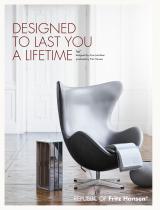
Designed to last you a lifetime Egg™ designed by Arne Jacobsen produced by Fritz Hansen
Open the catalog to page 2
Republic of Fritz Hansen Unplugged relations PHOTO Egon Gade We all know the feeling of attachment to a favorite object. Not because what it is, but what it does. The memories it carries and the stories it tells. That is true for our furniture. Thanks to the design and the quality that we put into the development, they last through generations and people relate to them as more than just mere chairs and tables. The first scratch or dent may hurt a bit, but gradually the sign of wear and usage adds to the sense of “something special”. If you own a piece of Fritz Hansen furniture there is a good...
Open the catalog to page 3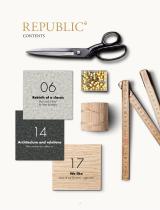
REPUBLIC CONTENTS Rebirth of a classic The iconic Drop™ by Arne Jacobsen. Architecture and relations How architecture affect us. Some of our favorites – right now.
Open the catalog to page 4
New light from KAISER idell™ Analog™ by Jaime Hayón New tables from the Spanish design star. Mini portrait of Jaime Hayón. The return of the Grand Prix™ More Kjærholm The original Arne Jacobsen chair. New addition to the successful chair. The whole collection from Fritz Hansen. World class architecture in the dock New maritime museum in Helsinore. Little Friend™ New expressions for Kasper Salto’s table.
Open the catalog to page 5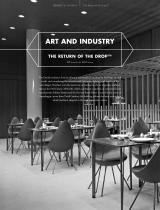
Art and Industry The Return of The Drop™ TEXT Michael Sheridan PHOTO Strüwing The Danish architect Arne Jacobsen is renowned for treating his buildings as total works and completing the interiors with furniture, lighting and textiles of his own design. Nowhere was this more true or Jacobsen’s talents in greater evidence than at the SAS House (1956-60), which combined a satellite air terminal for the Scandinavian Airlines System and the five-star Royal Hotel. Located in the center of Copenhagen, across from Tivoli Gardens, the building utilized the latest technology, which Jacobsen adapted to...
Open the catalog to page 6
The 22-story tower of the hotel would alter the Copenhagen skyline and Jacobsen was anxious that his building might overwhelm the area around Tivoli. Working through a long series of color studies and his own watercolor paintings, Jacobsen arrived at a delicate curtain wall of closely spaced aluminum mullions and grey-green spandrel glass. The result is a luminous shell that registers even the most nuanced shifts in the atmosphere, so that the building has a constantly changing appearance and becomes part of the setting. While the building is a model of rational, rectilinear construction with...
Open the catalog to page 7
The Egg™ chair was created for the lobby of the Royal Hotel, where it was upholstered in brown leather and positioned on blue, rya rugs that complimented the grey Porsgruun marble floor. At the far end of the lobby, the wintergarden glowed like a lantern and served as the centerpiece of the public areas. find their own level of comfort. Solitary travelers could turn away from the crowd, while groups of travelers could rotate and form an intimate circle. The spectacular centerpiece of the hotel was a doubleheight winter garden encased in hanging walls of orchids and furnished with the Pot™, a...
Open the catalog to page 8
the seat, so that the occupant seems to float in mid-air. The most flamboyant of Jacobsen’s voluptuous quartet was the SwanTM, a low-backed armchair that he designed for the Panorama Room, a lounge on the 21st-floor of the hotel that offered views over the city on three sides. The restricted height of the chair kept it from interfering with the views through the panoramic windows, but also encouraged an informal, convivial atmosphere appropriate to the festive setting. At the same time, the swiveling base allowed patrons to turn and enjoy the views of the city, and each other. Today, the interiors...
Open the catalog to page 9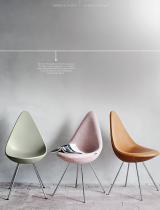
More than 50 years after its birth, the design icon The Drop™ is now in production, in its original version with upholstery of fabric or leather, and in a new plastic version in colours matching the modern Nordic lifestyle.
Open the catalog to page 10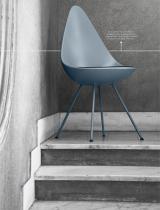
In the plastic version The Drop™ is available in colours matching the iconic design and with a choice of legs in chrome or painted in the colour of the chair.
Open the catalog to page 11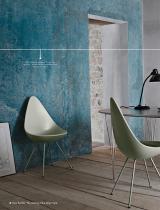
With a design as unique as 50 years ago, the Drop™ remains exclusive regardless which material you choose. View the film ”The making of the Drop” here.
Open the catalog to page 12
an original to match an original
Open the catalog to page 13
How does architecture affect us as people? TEXT Katrine Martensen Larsen PHOTO Adam Mørk, 3XN Do people really behave the way architects imagine them to? Do they hang out together in waiting areas, meet on the stairs, eat lunch together in the canteen, and generally thrive in the large, open office land scape? We talked with a researcher who specialises in architectural psychology. At architecture studio 3XN, Mille Sylvest is in the middle of a large-scale research project that attempts to map how architectural design affects people's social behaviour and well-being. As far as 3XN is concerned,...
Open the catalog to page 14
The staircase at Ørestads Gymnasium has been rather eloquently dubbed 'The Catwalk' by students, as you can't avoid being seen as you walk down it. According to architect studio 3XN, it is the backbone of the building.
Open the catalog to page 15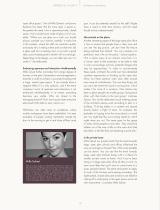
open office space." One of Mille Sylvest's conclusions therefore has been that the more open a space is, the greater the need is for a separate private, closed space. And a closed room made of glass is of no use, either: "When you use glass as a wall, you should always consider your motives carefully. It works fine in the canteen, where the staff can ascertain quickly and easily who is eating where and at what time. But a glass wall into a meeting room is not such a good idea, and a frosted panel to shield it off is not enough. Depending on the design, you can often see over it or under it,"...
Open the catalog to page 16Archived catalogs
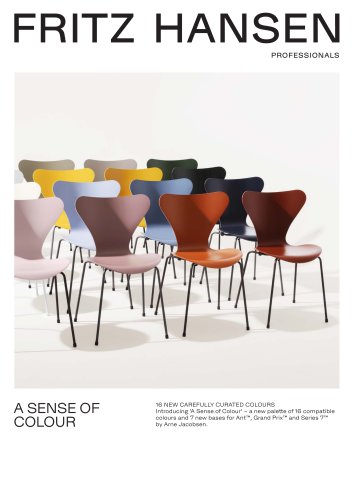 A SENSE OF COLOUR
32 Pages
 LIGHTING COLLECTION
64 Pages
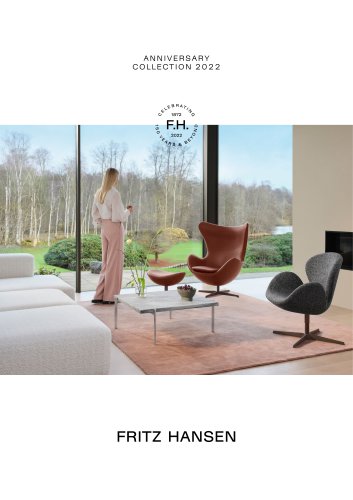 ANNIVERSARY COLLECTION 2022
24 Pages
 PROFESSIONALS
144 Pages
 DESIGN COLLECTION catalogue 2022
64 Pages
 Catalogue 2020
65 Pages
 ANT™ DECO SILHOUETTE
2 Pages
 WALL MIRROR
1 Page
 FRI™ NEW TEXTILES
3 Pages
 CALABASH™ NEW COLOURS
3 Pages
 HIGH DOT™
1 Page
 SERIES 7™ JUNIOR
1 Page
 DROP ™
4 Pages
 ANT ™
ANT ™3 Pages
 VIA57 ™
4 Pages
 EGG™
EGG™4 Pages
 The Poul Kjærholm collection
15 Pages
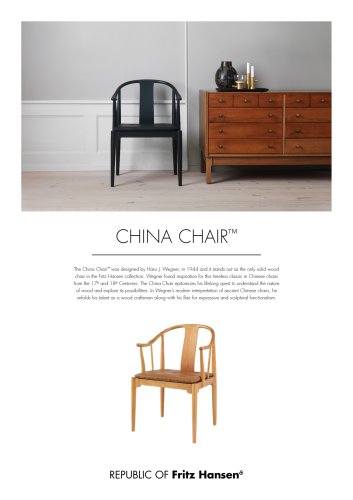 CHINA CHAIR™
2 Pages
 The collection
19 Pages
 PK25
PK254 Pages
 ANALOG™
4 Pages
 RO ™
RO ™2 Pages
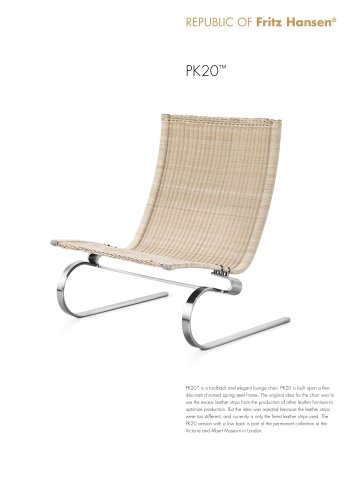 PK20
PK204 Pages
 Little Friend
4 Pages
 The Series 7™
27 Pages
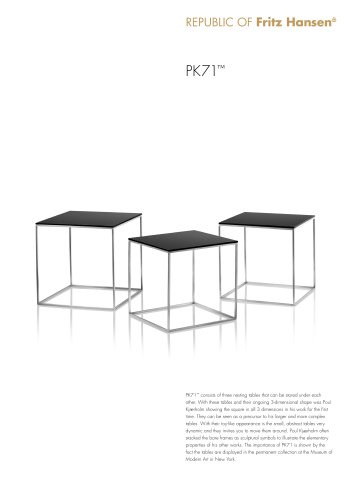 PK71
PK714 Pages
 PK63
PK634 Pages
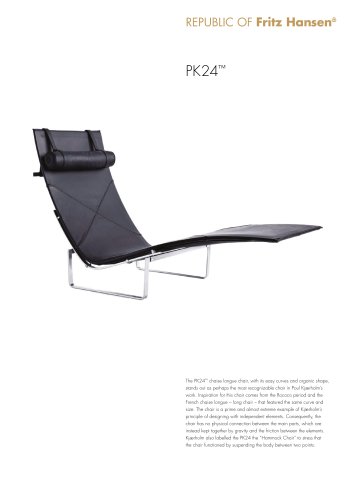 PK24
PK244 Pages
 PK61
PK614 Pages
 Space
Space5 Pages
 PK55
PK554 Pages
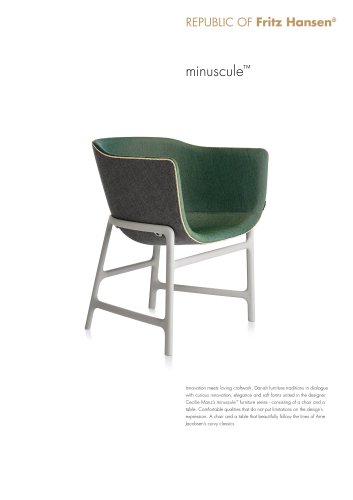 minuscule
5 Pages
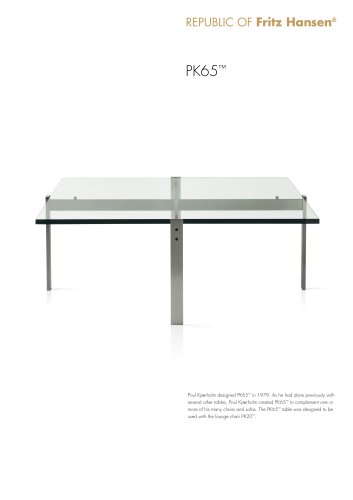 PK65
PK654 Pages
 Plano
Plano5 Pages
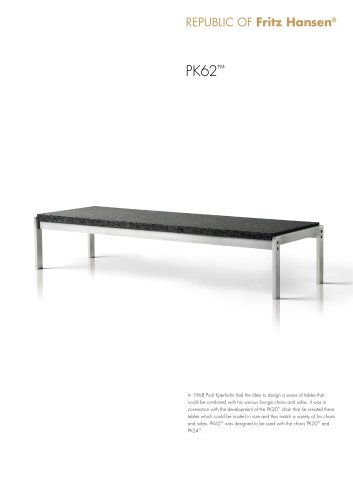 PK62
PK624 Pages
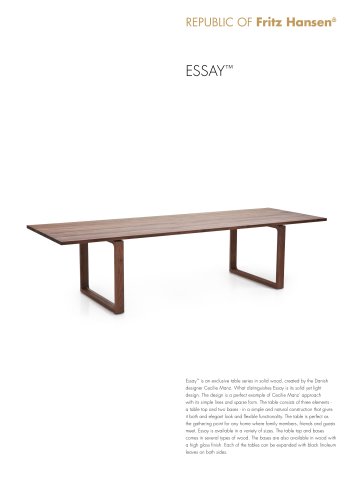 Essay
Essay4 Pages
 PK58
PK584 Pages
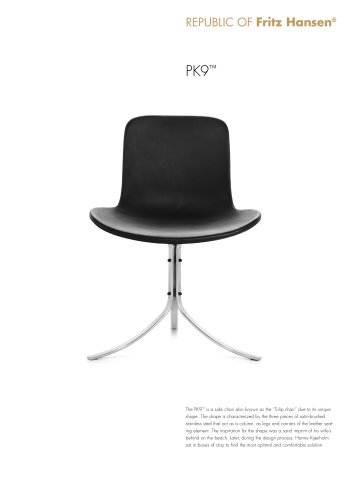 PK9
PK94 Pages
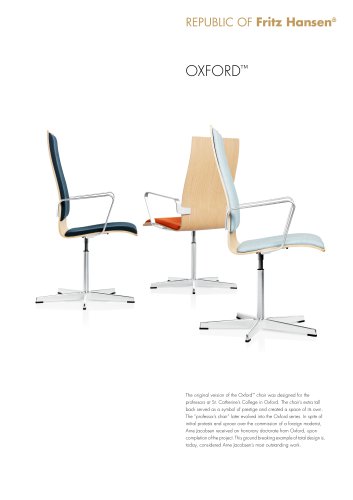 Oxford
5 Pages
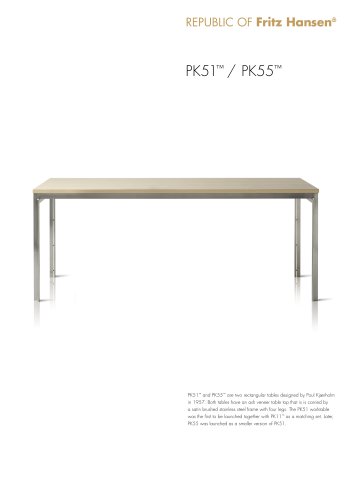 PK51, Rectangular
4 Pages
 RIN
RIN4 Pages
 T-NO. 1
6 Pages
 Dot
Dot4 Pages
 Lily
Lily6 Pages
 PK11
PK114 Pages
 PK8
PK84 Pages
 Series 3300
4 Pages
 Lissoni Sofa
4 Pages
 NAP
NAP6 Pages
 PK91
PK914 Pages
 PK33
PK334 Pages
 Grand Prix
5 Pages
 Coat Tree
4 Pages
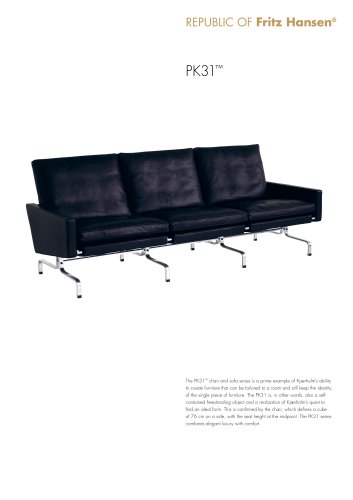 PK31
PK314 Pages
 Alphabet sofa
5 Pages
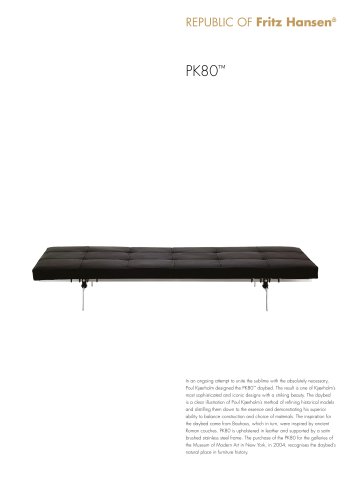 PK80
PK804 Pages
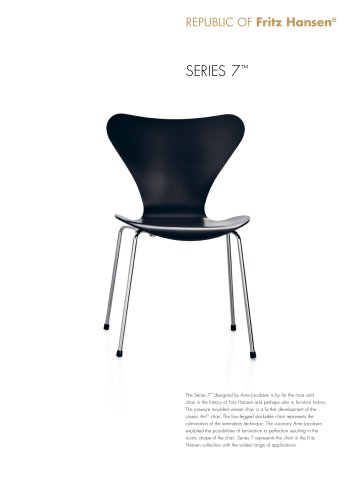 Serie S 7
7 Pages
 Kaiser Idell
4 Pages
 ICE
ICE5 Pages
 Table Series shaker base
7 Pages
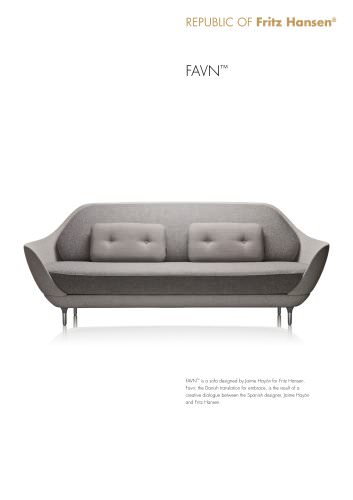 FAVN series
5 Pages
 Swan series
4 Pages
 Swan Sofa
4 Pages
 EGG series
5 Pages
 Drop
Drop5 Pages
 China Stuhl
4 Pages
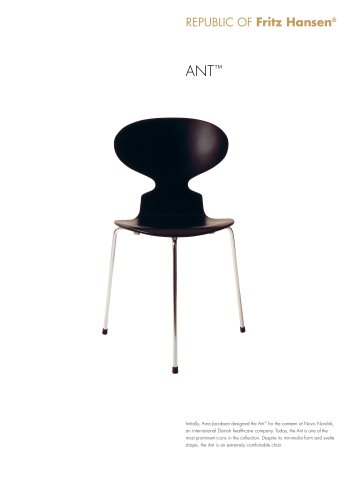 ANT? Series
5 Pages
 Analog
4 Pages
 Fritz Hansen Catalogue
198 Pages
- Fritz Hansen indoor lamp
- Fritz Hansen contemporary lamp
- Fritz Hansen home lamp
- Fritz Hansen corded lamp
- Fritz Hansen metal lamp
- LED lamp
- Fabric sofa
- Fritz Hansen single lamp
- Hanging lamp
- Fritz Hansen white lamp
- Wall-mounted light
- Fritz Hansen contemporary chair
- Fritz Hansen indoor chair
- Fritz Hansen home chair
- Fritz Hansen straight lamp
- Fritz Hansen contemporary armchair