- Catalogs
- Forbo Flooring Systems
- Marmoleum Meets Mendini


- Company
- Products
- Catalogs
- News & Trends
- Exhibitions
Marmoleum Meets Mendini

Marmoleum Meets Mendini
Forbo, a leader in linoleum flooring, collaborates with Italian architect Alessandro Mendini to create innovative floor designs under the Marmoleum brand. These designs emphasize sustainability and artistic expression, using natural materials and advanced aquajet technology.
Design Collections
Plato: This design features vibrant and soft shades, reflecting pointillism principles with abstract square shapes. Each order includes Mendini's signature on a Marmoleum strip.
Harlekino: Central to the collection, it offers bright and classical versions inspired by a harlequin's suit, composed of seven colors.
Proust: Inspired by Mendini's earlier works, this design magnifies brush-strokes and can be used as a wall-to-wall design or as a rug accent.
Design Philosophy
Mendini's work integrates art with industrial production, challenging traditional distinctions between high art and functional design. His "Design pittorico" approach applies pictorial criteria systematically across various forms.
Historical Context
The collaboration reflects a historical trend of integrating art into industrial production, similar to Josiah Wedgwood's 18th-century initiatives. Forbo continues this tradition by making high-quality, aesthetically pleasing materials accessible to a broader audience.
Global Presence
Forbo operates internationally, providing contact information for various countries to ensure global availability of their innovative flooring solutions.
Catalog excerpts

MARMOLEUM meets .
Open the catalog to page 2
With its main brand Marmoleum, Forbo is the world leader in linoleum. Our floor coverings set the trend in design, quality, innovation and service in both the commercial and private sector. Close cooperation with the Italian architect Alessandro Mendini has Marmoleum is manufactured solely produced six innovative floor from natural materials. Linseed oil designs, each available in from Canada – extracted from the seeds of the flax plant – is one of the most important ingredients. Pine rosins come from Indonesia and China, cork from Portugal, wood flour and pigments from a number of European countries,...
Open the catalog to page 3
Mendini has made for Forbo be
Open the catalog to page 4
Platonic relationship Plato is available in a brightly coloured version (in eight Marmoleum colours) and one based on softer shades. The design reflects the principles of pointillism, in which the brush-strokes are abstracted into square shapes overlaid in a variety of ways. With each order Mendini’s signature is delivered on a strip of Marmoleum, ready to be incorporated in the overall design (see an example of how this can be done on page 9).
Open the catalog to page 6
Plato forte
Open the catalog to page 7
Plato sotto
Open the catalog to page 8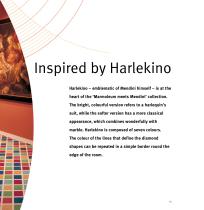
Inspired by Harlekino Harlekino – emblematic of Mendini himself – is at the heart of the ‘Marmoleum meets Mendini’ collection. The bright, colourful version refers to a harlequin’s suit, while the softer version has a more classical appearance, which combines wonderfully with marble. Harlekino is composed of seven colours. The colour of the lines that define the diamond shapes can be repeated in a simple border round the edge of the room.
Open the catalog to page 12
Harlekino forte
Open the catalog to page 13
Harlekino sotto
Open the catalog to page 14
Harlekino sotto Harlekino sotto Harlekino sotto Harlekino sotto
Open the catalog to page 15
Memories of Proust This comes closest to designs made earlier by Mendini such as the Poltrona di Proust. The brushstrokes are clearly visible in this floor, powerfully magnified to a size of about 50 cm. Proust contains seven colours. As with all Mendini floors, the panels can be connected to create a wall-to-wall design. It’s also possible to lay a panel as if it were a rug, creating a strong accent within a larger uniform area of Marmoleum.
Open the catalog to page 17
Proust forte
Open the catalog to page 19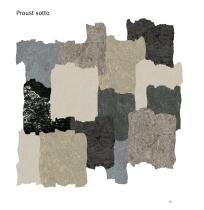
Proust sotto
Open the catalog to page 20
Harlekino forte Forte consists of eight Sotto consists of eight Forte consists of seven colours from the Real colours from the Fresco colours from the Real Example of how to convert the irregular Plato panels into squares Example of how to covert the irregular Harlekino panels into squares
Open the catalog to page 23
Harlekino sotto Sotto consists of seven Forte consists of seven Sotto also consists of colours from the Real colours from the Real seven colours from the Real Example of how to convert the irregular Proust panels into squares
Open the catalog to page 24
Australia Forbo Floorcoverings Pty Ltd. 23 Ormsby Place, Wetherill Park NSW 2164 Tel: +61 2 9828 0200 [email protected] www.forbo-flooring.com.au Germany Forbo Flooring GmbH Steubenstraße 27 D-33100 Paderborn Tel: +49-(0)52 51 - 1803-0 [email protected] www.forbo-flooring.de Austria Forbo Flooring Austria GmbH Oswald-Redlich-Straße 1 A-1210 Wien Tel: +43-(0)1- 3309204 [email protected] www.forbo-flooring.at Ireland Forbo Ireland Ltd. 2 Deansgrange Business Park Blackrock, Co Dublin Tel: 00353 1 2898 898 [email protected] www.forbo-flooring.ie Belgium Forbo Flooring ‘t Hofveld 4...
Open the catalog to page 25
MARMOLEUM meets
Open the catalog to page 26
MARMOLEUM meets .
Open the catalog to page 27
Marmoleum meets Mendini is like a marriage that has created six children. Two can be seen as paintings, two can be seen as selfportraits by the artist, and two are ‘normal’ floors. Such cooperation between industry and art has a long and interesting history. In this booklet Frans Haks tells the story behind the close collaboration between Mendini and Forbo.
Open the catalog to page 28
On the way to the art factory features a number of remarkable examples from the history of the industrial revolution, prefiguring the output of Marmoleum meets Mendini. Design pittorico tells about Mendini’s ideology and methods. Rammendini is an interview in which Mendini explains why he views the cooperation with Forbo as a marriage, and how the results can be interpreted and applied.
Open the catalog to page 29
On the way to the art factory Ever since the emergence of industrial technologies, manufacturers have sought to enhance and expand the scope of production by involving artists in their work. One of the first and most remarkable personalities to take such an initiative was Josiah Wedgwood (1730-1793). In a catalogue published in 1779, he wrote that it was the duty of Alessandro Mendini every manufacturer to promote good taste. The best and most effective way to achieve this, he claimed, is by using new techniques and materials to produce existing works of art in such large numbers that a much...
Open the catalog to page 30
Design pittorico Mendini’s architecture can be seen all over the world. A brief compendium of his work during the past decade includes several hundred shops for the Swatch and Alessi chains in Europe, Asia and the United States; the new underground stations in Naples; casinos in Switzerland; a cultural centre in Omegna; and a museum at Groningen in the Netherlands. This enormous output is the work of Atelier Mendini, presided over by the Mendini brothers. Francesco deals with the technical aspects, the financial administration and the day-to-day management. The artistic direction is in the hands...
Open the catalog to page 31
their advantages in his catalogue shows. Black porcelain is acidresistant and can be just as easily cleaned and polished as copper, silver and gold. It is even possible to put it in an oven without damaging it. He drew his reader’s special attention to ‘Bisquit ware’. While this looks like marble, it is much cheaper and lighter, and therefore extremely suitable not only for copying portraits and busts from antiquity, but also for producing household goods such as vases and bowls. And while Wedgwood didn’t make this explicit, he clearly intended his mass-produced work to achieve more than commercial...
Open the catalog to page 32
To achieve this, he developed his own method, whereby the principles of one branch of art were transferred to another. One of the terms he used to describe this process was Design pittorico – literally: pictorial design. Design based on pictorial criteria became the hallmark of his work. He felt that decoration should be applied not so much intuitively, but rather systematically to a wide variety of forms in all shapes and sizes. The most highly developed of these systems – the one that has been used most frequently and therefore occupies an important place in Mendini’s oeuvre – is known as Proust....
Open the catalog to page 33All Forbo Flooring Systems catalogs and technical brochures
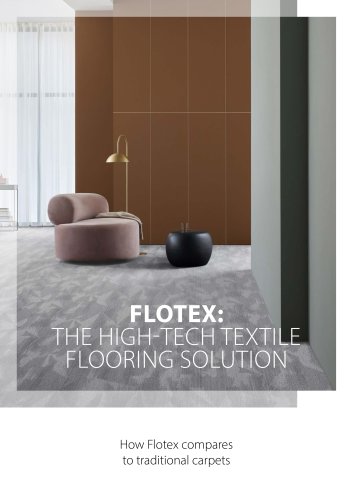 FLOTEX
12 Pages
 Bulletin Board
11 Pages
 Marmoleum Click
9 Pages
Archived catalogs
 FORBO MARMOLEUM MAGAZINE
37 Pages
 COLOREX BROCHURE
26 Pages
 Showtime®
40 Pages
 Decorative Linoleum Flooring
24 Pages
 Westbond
8 Pages
 Bus & Coach Brochure
20 Pages
 Allura LVT brochure
14 Pages
 Sarlon Modul'Up brochure
20 Pages
 Rail Brochure
15 Pages
 Marine Brochure
8 Pages
 CHO brochure
9 Pages
 Coral entrance flooring
15 Pages
 Step safety vinyl
24 Pages
 Flotex brochure
32 Pages
 MARMOLEUM AQUAJET
24 Pages
 THE NEXT GENERATION OF MARMOLEUM
37 Pages
 Sphera® homogeneous vinyl
16 Pages
 TRUE TO NATURE allura magazine
31 Pages
 Furniture linoleum
13 Pages
 SARLON ACOUSTIC VINYL BROCHURE
20 Pages
 FLOTEX BY TIBOR
24 Pages
 FORBO LIFE SCIENCES
5 Pages
 EPD MARMOLEUM 2.0 AND 2.5MM
53 Pages
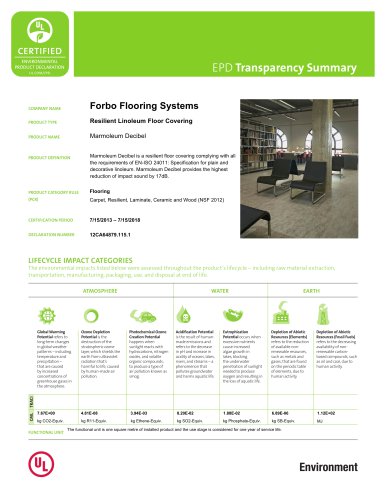
 EPD MARMOLEUM DECIBEL
44 Pages
 EPD MARMOLEUM TILE 2.0 AND 2.5MM
51 Pages
 EPD ACOUSTIC VINYL
40 Pages
 EPD SMARAGD
42 Pages
 TRANSPARENCY SUMMARY ETERNAL
2 Pages
 TRANSPARENCY SUMMARY SMARAGD
2 Pages
 TOPSHIELD2
4 Pages
 showtime
25 Pages
 Modul’up 19dB / Modul’up compact
16 Pages
 Colorex automotive
5 Pages
 Colorex ELECTRONICS
5 Pages
 Colorex Life sciences
5 Pages
 ACOUSTIC
16 Pages
 MARMOLEUM SPORT
11 Pages
 MARMOLEUM MODULAR TEXTURA
2 Pages
 MARMOLEUM MODULAR
19 Pages
 Needlefelt
20 Pages