- Catalogs
- Forbo Flooring Systems
- EPD MARMOLEUM 2.0 AND 2.5MM


- Company
- Products
- Catalogs
- News & Trends
- Exhibitions
EPD MARMOLEUM 2.0 AND 2.5MM

EPD MARMOLEUM 2.0 AND 2.5MM
Marmoleum, a linoleum brand by Forbo, is renowned for its low environmental impact, using natural renewable materials and high recycled content. Forbo leads in environmental transparency, offering Environmental Product Declarations (EPD) and Life Cycle Assessment (LCA) reports for its products.
Marmoleum is a resilient floor covering available in 2.0 and 2.5 mm thicknesses, made from natural materials like linseed oil and jute. It is biodegradable and complies with EN-ISO 24011 standards.
Marmoleum meets ASTM F 2034 and EN-ISO 24011 standards, with a fire classification of Cfl - s1, slip resistance of DS: ≥ 0.30, and thermal conductivity of 0.17 W/mK. It complies with CHPS 01350 for VOC emissions.
The production involves oxidizing linseed oil to form linoleum cement, mixed with other materials, calendared on jute, and cured. The process adheres to ISO 14001 and OHSAS 18001 standards.
Globally distributed by truck and ship, Marmoleum installation waste is about 6%, with recyclable packaging. Low-emission adhesives are recommended.
The product's reference service lifetime is one year, with maintenance involving vacuuming and damp mopping. Entrance mats can reduce cleaning frequency.
Marmoleum is deconstructed mechanically, with energy recovery through incineration due to its high calorific value, avoiding landfilling.
The LCA covers production, transport, installation, use, and end-of-life stages, focusing on energy usage and environmental impacts.
The document provides a comprehensive LCA of Marmoleum, adhering to ISO 14025 and EN 15804 standards, detailing energy usage and environmental impacts across the product lifecycle.
All production data, including raw materials and waste, are considered, with a 1% cut-off for energy usage and mass.
No co-product allocation occurs; multi-input processes are allocated based on mass or calorific values.
Using GaBi 5 Software, the LCA data meets PCR specifications, covering all lifecycle stages.
Renewable energy comes from raw materials, while non-renewable energy is used in production and installation.
Minimal non-hazardous and radioactive waste, with significant non-renewable resource usage during production.
The production stage significantly impacts environmental categories, with raw material supply being a major factor.
The production stage is the main contributor to environmental impacts, with transport also having a notable impact.
Includes explanations of terms like ADP, GWP, and EPD.
The LCA report for Marmoleum follows EN15804 and ISO 14025 standards, verified on 10/17/12.
The LCA covers all lifecycle stages, intended for business-to-business and consumer communication.
Marmoleum is biodegradable, complying with EN-ISO 24011, suitable for various uses.
Complies with ASTM F 2034 and CHPS 01350, among others.
Involves oxidation of linseed oil, mixing, calendaring, curing, and recycling of waste.
Global distribution with recyclable packaging and low-emission adhesives recommended.
One-year service life with specific cleaning recommendations.
Adheres to ISO 14001 and OHSAS 18001 standards, with protective measures recommended.
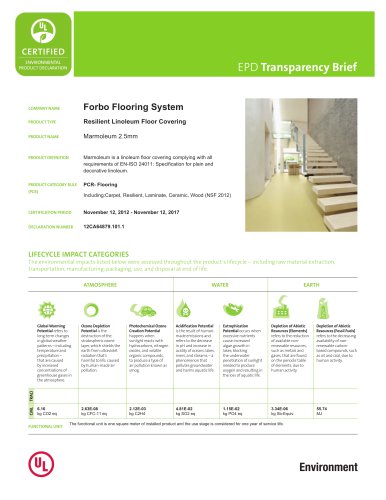
Detailed tables show impacts on global warming, ozone depletion, and other categories.
Uses GaBi 5 Software for modeling, with high data quality.
End-of-life stage contributes to global warming potential, with production and transport also having notable impacts.
Suggests optimizing energy use and waste management to reduce impacts.
Emphasizes understanding environmental impacts across the lifecycle, focusing on energy consumption and emissions.
Catalog excerpts

Environmental Product Declaration Marmoleum 2.0 and 2.5MM FORBO FLOORING SYSTEMS RESILIENT LINOLEUM FLOOR COVERING Color 3566 "Silent Sulphur" ffedbo FLOORING SYSTEMS Marmoleum the most globally used brand of linoleum has been manufactured by Forbo for more than 150 years. Marmoleum is produced having low environmental impacts as a result of the combination of natural renewable materials and high recycle content. Forbo was the first flooring manufacturer to publish a complete Life Cycle Assessment (LCA) report verified by CML in 2000.In addition Forbo is now to publish Environmental Product Declarations (EPD) for all products including full LCA reports. This EPD is using all recognized flooring Product Category Rules and is including additional information to show the impacts on human health and eco-toxicity. By offering the complete story we hope that our stakeholders will be able to use this document as a tool that will translate the environmental performance of Marmoleum into the true value and benefits to all our customers and stakeholders alike. For more information visit: www.forbo-flooring.com
Open the catalog to page 1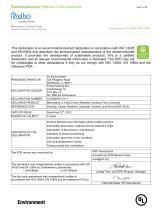
Environmental Product Declaration FLOORING SYSTEMS Marmoleum 2.0 and 2.5 mm Resilient Linoleum Floor Covering This declaration is an environmental product declaration in accordance with ISO 14025 and EN15804 that describes the environmental characteristics of the aforementioned product. It promotes the development of sustainable products. This is a certified declaration and all relevant environmental information is disclosed. This EPD may not be comparable to other declarations if they do not comply with ISO 14025, EN 15804 and the reference PCR.
Open the catalog to page 2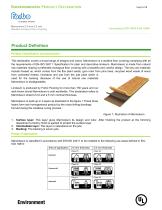
Marmoleum 2.0 and 2.5 mm Resilient Linoleum Floor Covering Product Definition Product Classification and description This declaration covers a broad range of designs and colors. Marmoleum is a resilient floor covering complying with all the requirements of EN-ISO 24011: Specification for plain and decorative linoleum. Marmoleum is made from natural raw materials making it preferable ecological floor covering with a beautiful and colorful design. The key raw materials include linseed oil, which comes from the flax plant seeds, gum rosin from pine trees, recycled wood waste of wood from controlled...
Open the catalog to page 3
Environmental Product Declaration (fodbo FLOORING SYSTEMS Marmoleum 2.0 and 2.5 mm Resilient Linoleum Floor Covering According to ISO 14025 & EN 15804 Product Standard The products considered in this EPD have the following technical specifications: o Meets or exceeds all technical requirements in ASTM F 2034 Standard Specification for Linoleum Sheet Flooring. o Meets or exceeds all technical requirements in EN-ISO 24011 Specification for plain and decorative Linoleum. Marmoleum meets the requirements of EN 14041 EN 13501-1 Reaction to fire Cfl - s1 Fire Testing: o Class 1 when tested...
Open the catalog to page 4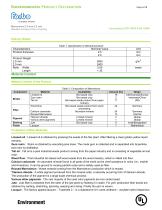
Environmental Product Declaration (fodbo FLOORING SYSTEMS Marmoleum 2.0 and 2.5 mm Resilient Linoleum Floor Covering According to ISO 14025 & EN 15804 Delivery Status Table 1: Specification of delivered product Production of Main Materials Linseed oil : Linseed oil is obtained by pressing the seeds of the flax plant. After filtering a clear golden yellow liquid remains. Gum rosin : Rosin is obtained by wounding pine trees. The crude gum is collected and is separated into turpentine and rosin by distillation. Tall oil : Tall oil is a post industrial waste product coming from the paper industry...
Open the catalog to page 5
Marmoleum 2.0 and 2.5 mm Resilient Linoleum Floor Covering Production of the Floor Covering Figure 2: Illustration of the Production process Marmoleum is produced in several stages starting with the oxidation of linseed oil mixed with tall oil and rosin. With the influence of oxygen from the atmosphere a tough sticky material is obtained called linoleum cement. The linoleum cement is stored in containers for a few days for further reaction and after this it is mixed with wood flour, calcium carbonate, reused waste (if applicable), titanium dioxide and pigments. This mixture is calendared on a...
Open the catalog to page 6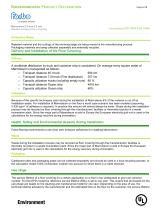
Environmental Product Declaration (fodbo FLOORING SYSTEMS Marmoleum 2.0 and 2.5 mm Resilient Linoleum Floor Covering According to ISO 14025 & EN 15804 Rejected material and the cuttings of the trimming stage are being reused in the manufacturing process. Packaging materials are being collected separately and externally recycled. Delivery and Installation of the Floor Covering A worldwide distribution by truck and container ship is considered. On average every square meter of Marmoleum is transported as follows: o T ransport distance 40 t truck 694 km o Transport distance 7.5t truck...
Open the catalog to page 7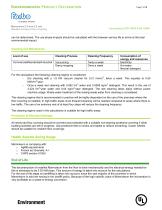
Environmental Product Declaration (fodbo FLOORING SYSTEMS Marmoleum 2.0 and 2.5 mm Resilient Linoleum Floor Covering According to ISO 14025 & EN 15804 can be determined. The use phase impacts should be calculated with the foreseen service life to arrive at the total environmental impact. For the calculations the following cleaning regime is considered: 2 - Dry cleaning with a 1.5 kW vacuum cleaner for 0.21 min/m , twice a week. This equates to 0.55 kWh/m2*year. - Once a week wet cleaning with 0.062 l/m2 water and 0.0008 kg/m2 detergent. This result in the use of 3.224 l/m2*year water and 0.04...
Open the catalog to page 8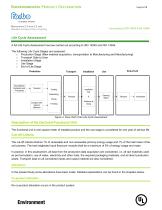
Marmoleum 2.0 and 2.5 mm Resilient Linoleum Floor Covering Life Cycle Assessment A full Life Cycle Assessment has bee carried out according to ISO 14040 and ISO 14044. The following Life Cycle Stages are assessed : o Production Stage (Raw material acquisition, transportation to Manufacturing and Manufacturing) o Transport Gate to User o Installation Stage o Use Stage o End of Life Stage Production Raw Material Extraction and Processing Installation loss Coating, Calendaring, Transport Drying, Energies with regional reference End-of Life Cleaning regime Figure 3: Flow chart of the Life Cycle Assessment...
Open the catalog to page 9
Marmoleum 2.0 and 2.5 mm Resilient Linoleum Floor Covering Allocation of multi-input processes The Production and End of Life stage include incineration plants. In these processes different products are treated together within a process. The allocation procedures followed in these cases are based on a physical classification of the mass flows or calorific values. Credits from energy substitution are allocated to the production stage, because the gained energy from energy substitution is lower than the energy input in this stage. The same quality of energy is considered. Allocation procedure of...
Open the catalog to page 10All Forbo Flooring Systems catalogs and technical brochures
 FLOTEX
12 Pages
 Bulletin Board
11 Pages
 Marmoleum Click
9 Pages
Archived catalogs
 FORBO MARMOLEUM MAGAZINE
37 Pages
 COLOREX BROCHURE
26 Pages
 Showtime®
40 Pages
 Decorative Linoleum Flooring
24 Pages
 Westbond
8 Pages
 Marmoleum Meets Mendini
46 Pages
 Bus & Coach Brochure
20 Pages
 Allura LVT brochure
14 Pages
 Sarlon Modul'Up brochure
20 Pages
 Rail Brochure
15 Pages
 Marine Brochure
8 Pages
 CHO brochure
9 Pages
 Coral entrance flooring
15 Pages
 Step safety vinyl
24 Pages
 Flotex brochure
32 Pages
 MARMOLEUM AQUAJET
24 Pages
 THE NEXT GENERATION OF MARMOLEUM
37 Pages
 Sphera® homogeneous vinyl
16 Pages
 TRUE TO NATURE allura magazine
31 Pages
 Furniture linoleum
13 Pages
 SARLON ACOUSTIC VINYL BROCHURE
20 Pages
 FLOTEX BY TIBOR
24 Pages
 FORBO LIFE SCIENCES
5 Pages
 EPD MARMOLEUM DECIBEL
44 Pages
 EPD MARMOLEUM TILE 2.0 AND 2.5MM
51 Pages
 EPD ACOUSTIC VINYL
40 Pages
 EPD SMARAGD
42 Pages
 TRANSPARENCY SUMMARY ETERNAL
2 Pages
 TRANSPARENCY SUMMARY SMARAGD
2 Pages
 TOPSHIELD2
4 Pages
 showtime
25 Pages
 Modul’up 19dB / Modul’up compact
16 Pages
 Colorex automotive
5 Pages
 Colorex ELECTRONICS
5 Pages
 Colorex Life sciences
5 Pages
 ACOUSTIC
16 Pages
 MARMOLEUM SPORT
11 Pages
 MARMOLEUM MODULAR TEXTURA
2 Pages
 MARMOLEUM MODULAR
19 Pages
 Needlefelt
20 Pages