


Antibacterial properties
Antibacterial properties
Catalog excerpts

Antibacterial properties of our decorative surfaces
Open the catalog to page 1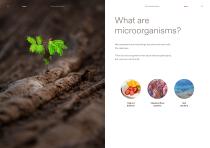
Finsa Antimicrobial solutions Antimicrobial solutions Finsa 3 Finsa Antimicrobial solutions Antimicrobial solutions Finsa 3 What are microorganisms? Microorganisms are living things that cannot be seen with the naked eye. There are microorganisms that cause disease (pathogens), but many are not harmful: Intestinal flora bacteria
Open the catalog to page 2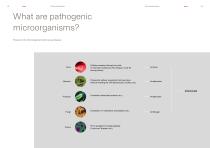
Antimicrobial solutions Antimicrobial solutions What are pathogenic microorganisms? These are the microorganisms that cause disease. Cellular parasites that get into cells to reproduce (influenza, HIV, dengue, covid-19, among others) Prokaryotic cellular organisms that reproduce without invading the cell (tuberculosis, cholera, etc.) Antimicrobial Protozoa Unicellular eukaryotes (malaria, etc.) Unicellular or multicellular (candidiasis, etc.) Prion spongiform encephalopathy ("mad cow" disease, etc.)
Open the catalog to page 3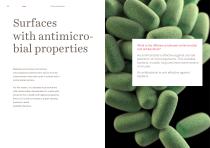
Antimicrobial solutions Surfaces with antimicrobial properties Materials and surfaces can harbour microorganisms and thus be a source of crosscontamination when they come in contact with a contaminated surface. For this reason, it is advisable to provide them with antimicrobial characteristics to create safer products from a health and hygiene perspective. Even so, it is vital to maintain a proper cleaning protocol to avoid possible infections. Antimicrobial solutions What is the difference between antimicrobial and antibacterial? An antimicrobial is effective against a broad spectrum of microorganisms....
Open the catalog to page 4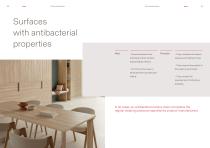
8 Finsa Antimicrobial solutions Antimicrobial solutions Finsa 9 with antibacterial - They contribute to cleaner spaces and healthier living. - They improve the quality of the indoor environment. - They prevent the development of infectious diseases. Must _ Prevent bacteria from Therefore attaching to their surface (bacteriostatic effect); - Or, if this is the case, to eliminate them (bactericidal effect).
Open the catalog to page 5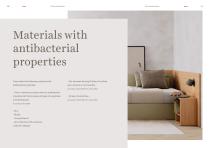
10 Finsa Antimicrobial solutions Antimicrobial solutions Finsa 11 10 Finsa Antimicrobial solutions Antimicrobial solutions Finsa 11 Finsa offers the following materials with antibacterial properties: - All our melamine surfaces have an antibacterial characteristic that includes all types of substrates and thicknesses: Materials with antibacterialproperties - Our laminate flooring (Finfloor, Purefloor and customers' own brands). - Fintop+ Countertops ■ Any melamine with exclusive customer designs
Open the catalog to page 6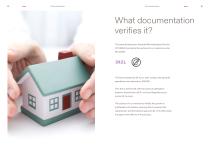
12 Finsa Antimicrobial solutions Antimicrobial solutions Finsa 13 12 Finsa Antimicrobial solutions Antimicrobial solutions Finsa 13 What documentation verifies it? The external laboratory Industrial Microbiological Service LTD (IMLS) has tested the surface of our melamine under ISO 22196. The test showed that 24 hours after contact, the bacterial population was reduced by >99.99%. This test is performed with two types of pathogenic bacteria: Escherichia coli (E. coli) and Staphylococcus aureus (S. Aureus). The surface of our melamines inhibits the growth or proliferation of bacteria, meaning...
Open the catalog to page 7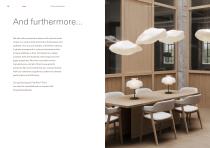
14 Finsa Antimicrobial solutions icrobial solutions Finsa We also offer veneered surfaces with natural wood veneer in a wide variety of formats, thicknesses and qualities. As it is a pre-sanded, unfinished material, it admits transparent or coloured treatments that include additives in their formulations to obtain surfaces with anti-bacterial, anti-fungal and antialgae properties. We have consulted varnish manufacturers and all of them have specific products. We recommend that you consult directly with your reference suppliers to obtain the desired performance and efficiency. Our painted board,...
Open the catalog to page 8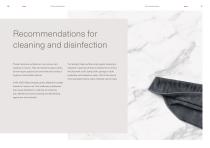
16 Finsa Antimicrobial solutions Antimicrobial solutions Finsa 17 These melamine surfaces are non-porous and resistant in nature. They are therefore easy to clean, do not require special care and make this surface a hygienic and durable material. In EN 14323 (Wood-based panels. Melamine-coated boards for interior use. Test methods), substances that cause alterations or staining of melamine are collected and some cleaning and disinfecting agents are also included. To maintain these surfaces only regular cleaning is required. In general, all that is required is to remove the dust with a soft, damp...
Open the catalog to page 9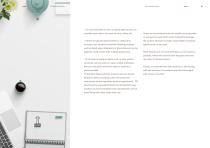
Antimicrobial solutions Antimicrobial solutions - It is recommended to clean up liquid spills as soon as possible, especially in the case of wine, coffee, etc. Under no circumstances should metallic scouring pads or sponges be used which could irreversibly damage - If there are grease stains present or visibly dirty the surface. Abrasive or highly acidic/alkaline cleaning surfaces, non-abrasive household cleaning products agents must not be used. such as liquid soap, detergents or glass cleaners can be applied to help restore their original appearance. Paint thinners are not recommended, nor...
Open the catalog to page 10All FINSA catalogs and technical brochures
 Colour chart 2025 - 2029
24 Pages
 FINFLOOR CATALOGUE 2022
86 Pages
 catalogo purefloor 2024
23 Pages
Archived catalogs
 Workplace
42 Pages
 Residencial 2022
35 Pages
 INSPIRATIONAL CATALOGUE 2022
77 Pages
 Solutions for facades
114 Pages
 CONSTRUCTION SOLUTIONS
210 Pages
 FIBRACOLOUR & TEXTURES
28 Pages
 FINSA INFINITE TRICOYA
36 Pages
 STUDIO NATUR
41 Pages
 HOSPITALITY FINSA PORTFOLIO
45 Pages
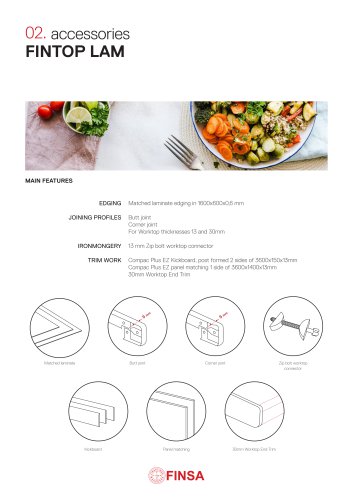 FINTOP LAM
1 Page
 SuperPan FD30
2 Pages
 THERMOPINE
24 Pages
 SuperPan
34 Pages
 FIBRACOLOUR Design
15 Pages
 FIBRACOLOUR Technical
15 Pages
 high gloss
2 Pages
 States of mind and matter
122 Pages
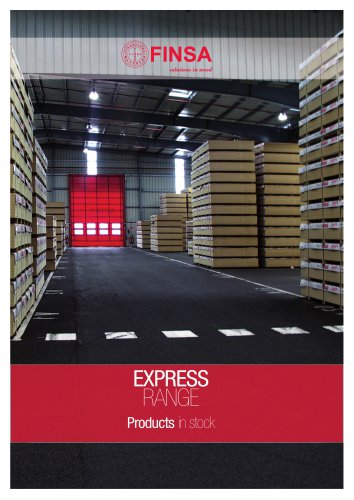 EXPRESS RANGE
2 Pages
 Finfloor LVT
17 Pages
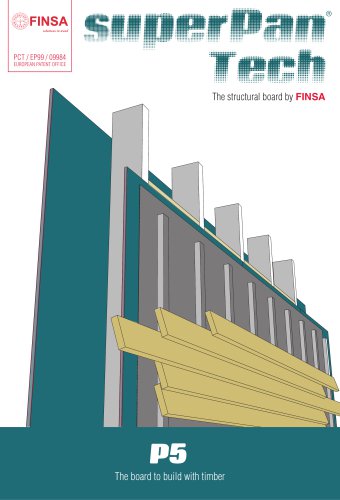 Superpan Tech P5
20 Pages
 Gama Studio
44 Pages
 SuperpanTech Encoform
12 Pages
 SuperpanTech P4-P6
12 Pages
 Light solutions in wood
20 Pages
 COMPACMEL PLUS
52 Pages
 Presentation
36 Pages
 Supreme
2 Pages
 FINfloor
89 Pages
 Purefloor 2018
8 Pages
 gama duo
16 Pages
 2020 Gama duo
100 Pages

- Kitchen work surface
- Interior panel
- Commercial panel
- Cover panel
- Home panel
- Wood look laminate flooring
- Home laminate flooring
- Other materials laminate flooring
- Stain-proof countertop
- Decorative panel
- Heat-resistant countertop
- Sustainable panel
- Smooth panel
- Commercial laminate flooring
- HDF laminate flooring
- Antibacterial kitchen worktop
- Building panel
- Home decorative panel