


HOUSE OF FINN JUHL CATALOGUE

HOUSE OF FINN JUHL CATALOGUE
Finn Juhl was a pioneering Danish furniture designer born in 1912 in Copenhagen. Known for his sculptural and functional designs, Juhl was a key figure in the Danish Modern movement. Despite not completing formal education, he became a self-taught designer celebrated worldwide for works like the UN Trusteeship Council Chamber interior.
Juhl's designs were inspired by modern art and functionalism, focusing on creating furniture that is both aesthetically pleasing and practical. His pieces, such as the 57 Sofa, are designed to support the human body comfortably, emphasizing living in the furniture rather than just with it.
The relaunch of Juhl's furniture began in 1998, aiming to preserve his legacy while adapting to modern production techniques. The furniture is primarily manufactured in Denmark, focusing on quality and durability.
- Pelican Chair (1940): Known for its surrealist influence and unique shape, offering multiple seating positions.
- Pelican Table (1940): Relaunched in 2014, available in several wood types.
- Poet Sofa (1941): A compact two-seater designed for smaller spaces, emphasizing the connection between furniture and sculpture.
Finn Juhl's furniture remains a testament to his innovative spirit and artistic vision, blending form and function in a way that is still relevant and admired today.
The document provides detailed descriptions and specifications of various furniture pieces designed by Finn Juhl, highlighting their historical context, design philosophy, and material composition. Each piece is a testament to Juhl's innovative approach to furniture design, blending functionality with artistic expression.
- 46 Sofa (1946): Known for its organic shape and craftsmanship.
- Eye Table (1948): Characterized by its organic eye shape and three-legged design.
- Glove Cabinet (1961): Features a cherrywood and brass exterior with a colorful interior.
- Baker Sofa (1951): Known for its sculptural design with a two-piece backrest.
- Cocktail Table (1951): Reflects the American extravagance of the 1950s.
- 57 Sofa (1957): Features handsewn upholstery and a choice of stainless or burnished steel legs.
- Ross Coffee Table (1948): Features a delicate steel frame and a kidney-shaped top with a built-in vase.
- Wall Sofa (1950): Known for its surrealistic design with an asymmetrical backrest.
- Kaufmann Table (1945): Combines a walnut tabletop with an oak frame.
- France Chair (1956): Initially delivered as flat-pack furniture.
- Japan Series (1953): Inspired by Japanese architecture, emphasizing simplicity.
- 500 Table (1958): Typical of Scandinavian mid-century design.
- 45 Chair (1945): Known as "the mother of all modern chairs."
- 46 Chair (1946): Emphasizes lightness and is available with or without armrests.
- Chieftain Chair (1949): Celebrated for its organic shapes.
- Chieftain Sofa (1949): A rare piece, handcrafted in teak or walnut.
- Butterfly Table (1949): Features an organic design typical of Finn Juhl.
- Egyptian Chair (1949): A blend of traditional and modern elements.
- Silver Table (1948): Known for its Sterling silver inlays.
- Sideboard (1955): Combines exclusive wood materials with colors from Goethe’s color wheel.
- Table Bench (1953): Can be used as both a table and a bench.
- Reading Chair (1953): Suitable for dining or reading.
- Nyhavn Dining Table (1953): Features a drop leaf design.
- Nyhavn Desk (1945): Known for its floating lightness.
- 53 Sofa (1953): Part of a streamlined series.
- Tray Table (1965): Features a reversible tray available in teak or walnut.
- Circle Rug (1963): Features a circular pattern reminiscent of the 1960s.
- Panel System (1953): A wall-mounted storage solution.
- 44 Chair (1944): Known for its organic shape.
- FJ 64 Chair (1964): A stackable chair suitable for various settings.
- Modern Art Chair (1948): Suitable for indoor and outdoor use.
Catalog excerpts

HOUSEOF FINN JUHL
Open the catalog to page 1
"One cannot create happiness with beautiful objects, but one can spoil quite a lot of happiness with bad ones" Finn Juhl
Open the catalog to page 3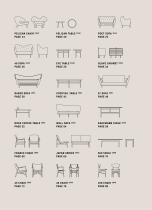
PELICAN CHAIR 1940 PAGE 14 PELICAN TABLE 1940 PAGE 20 POET SOFA 1941 PAGE 22 BAKER SOFA 1951 PAGE 38 COCKTAIL TABLE 1951 PAGE 42 WALL SOFA 1950 PAGE 54 ROSS COFFEE TABLE 1948 PAGE 52 KAUFMANN TABLE 1945 PAGE 56 FRANCE CHAIR 1956 PAGE 60 JAPAN SERIES 1953 PAGE 66
Open the catalog to page 4
CHIEFTAIN CHAIR 1949 PAGE 90 CHIEFTAIN SOFA 1949 PAGE 96 BUTTERFLY TABLE 1949 PAGE 100 EGYPTIAN CHAIR 1949 PAGE 102 SILVER TABLE 1948 PAGE 106 TABLE BENCH 1953 PAGE 114 READING CHAIR 1953 PAGE 118 NYHAVN DINING TABLE 1953 PAGE 122 NYHAVN DESK 1945 53 SOFA 1953 TRAY TABLE 1965 PAGE 132 PANEL SYSTEM 1953 PAGE 142 FJ 64 CHAIR 1964 MODERN ART CHAIR 1948
Open the catalog to page 5
FINN JUHL IN SHORT Finn Juhl was born on January 30, 1912 in Copenhagen. He wished to study art history, however, his father would not allow it. Instead, Finn Juhl began studying architecture at the Royal Academy of Arts in Copenhagen. Here, he studied under some of the most influential functionalists of his time. Among these was the great architect Vilhelm Lauritzen who hired Finn Juhl at his own studio in 1934 before Finn Juhl had even graduated. Eventually, the work took up all of his time and Finn Juhl never finished his studies. Later in life he always described himself as a self-taught...
Open the catalog to page 6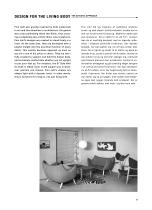
DESIGN FOR THE LIVING BODY Finn Juhl was greatly inspired by both modernism in art and functionalism in architecture. His genius was cross-pollinating these two fields, thus creating a completely new artistic idiom. Like sculptures, Finn Juhl’s designs are created to stand freely in a room. At the same time, they are developed with a playful insight into the practical function of every detail. This quickly becomes apparent as soon as you sit in one of his sofas or chairs. They are carefully created to support and hold the human body, and extremely comfortable whether you sit upright or put your...
Open the catalog to page 9
A JOYFUL UNIVERSE Venturing into Finn Juhl’s universe of furniture is like embarking on a joyful journey. There are constantly new surprises waiting around the corner, both in terms of overall shapes and aesthetics as well as daring design details. For us, the journey began in 1998, when Finn Juhl’s widow, Hanne Wilhelm Hansen, contacted us with a wish to have a single 57 Sofa produced. This was the beginning of a friendly partnership, which culminated in 2001 when she trusted us with the worldwide production rights of Finn Juhl’s furniture. Exploring Finn Juhl’s furniture universe is a constant...
Open the catalog to page 10
RELAUNCHING FINN JUHL’S FURNITURE Our passion is to relaunch Finn Juhl’s furniture, in respect of his legacy, but in a modern reality. The details must be as fine and pure as if they came from the original cabinetmakers’ workshop but our understanding of quality also includes durability. Our furniture has to be so durable that they can be enjoyed by users today and by generations to come. Vores passion er at relancere Finn Juhls møbler, med respekt for arven og traditionen, men i en moderne virkelighed. De skal i detaljer være lige så fine og lige så originale som dem, de gamle snedkermestre...
Open the catalog to page 13
PELICAN CHAIR In no other design of his is Finn Juhl’s fascination for surrealism more apparent than in the Pelican Chair. Out of all of his many designs, the Pelican Chair was probably the one furthest ahead of its time. When it was presented at the Copenhagen Cabinetmakers’ Guild Exhibition in 1940, it stood out with its unusual shape and sturdy legs. Finn Juhl normally named his furniture numbers after the year in which they were designed, but over time the nickname "Pelican" stuck to the chair. Very few were manufactured and the chair was almost forgotten until we rediscovered and relaunched...
Open the catalog to page 14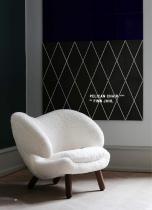
PELICAN CHAIR BY FINN JUHL
Open the catalog to page 16
“Presumably, the creative capabilities of a craftsman are the same as those of a sculptor. A chair is not just an industrial product in a space. It becomes form and space itself” Finn Juhl
Open the catalog to page 17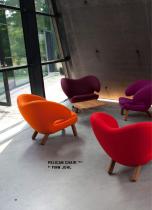
PELICAN CHAIR BY FINN JUHL
Open the catalog to page 18
PELICAN TABLE The only known version of this table was displayed with two Pelican Chairs at the Copenhagen Cabinetmakers’ Guild Exhibition in 1940. As far as we know, it was never produced again. Both the Pelican Chair and the Pelican Table are exceptional examples of Finn Juhl’s spiritual kinship with modern art. He handpicked particular artifacts, which were exhibited together with his furniture at the exhibition. Den eneste kendte udgave af dette bord blev fremvist sammen med to Pelikanstole på Snedkerlaugets udstilling i besættelsesåret 1940 og blev, så vidt vi ved, aldrig senere sat i produktion....
Open the catalog to page 20
POET SOFA This small two-seater sofa first saw the light of day at the Copenhagen Cabinetmakers’ Guild Exhibition in 1941. It should be seen as a natural progression from the Pelican Chair that was displayed the previous year. The upholstery is very slim compared to the norm at the time and it was the result of Finn Juhl’s ambition to create functional furniture for smaller apartments. The Poet Sofa is also one of Finn Juhl’s experiments for his own home. At the Guild Exhibition, the sofa was shown together with a couple of plaster reliefs by artist Sigurjón Ólafsson. In this way, he indicated...
Open the catalog to page 22
POET SOFA 1941 BY FINN JUHL
Open the catalog to page 25
As the name suggests, this sofa was designed in 1946. The sofa was manufactured by the upholsterer Carl Brørup in his workshop in Copenhagen. 46-sofaen er, som navnet angiver, tegnet i 1946. Sofaen blev produceret af polstermester Carl Brørup i Blågårdsgade på Nørrebro i København. As a young man, Finn Juhl had a dream of becoming an art historian. During the 1930s and 1940s he had been strongly influenced by modern art, which was the main reason his designs took on such organic shapes with almost human-like features. He worked from the core and outwards in similar fashion to that of a surrealist...
Open the catalog to page 26All Finn Juhl catalogs and technical brochures
 46 SOFA
2 Pages
 TABLE BENCH
2 Pages
 PELICAN CHAIR 1940
2 Pages
 COCKTAIL BENCH 1951
2 Pages
 CHIEFTAIN CHAIR
2 Pages
 FINN JUHL BY ONECOLLECTION
103 Pages
 THE PELICAN
13 Pages
