
- Catalogs
- Fassa Bortolo
- Masonry Restoration System - Dehumidifying System


Masonry Restoration System - Dehumidifying System
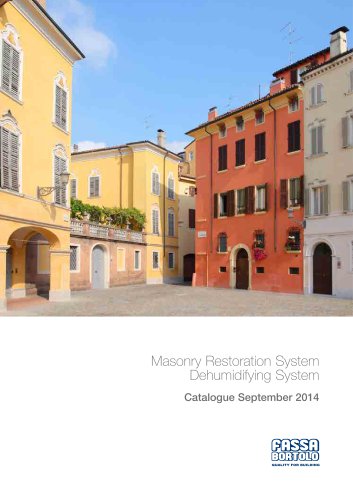
Masonry Restoration System - Dehumidifying System
The document is a catalogue from September 2014 detailing the Masonry Restoration and Dehumidifying Systems by Fassa Bortolo. It highlights the company's history, innovation, and commitment to sustainability in the building sector.
Fassa Bortolo is a leader in the building industry, known for innovations like premixed lime and cement plasters. The company emphasizes quality, sustainability, and environmental respect, offering a comprehensive range of systems and services.
Fassa focuses on sustainable building solutions, energy saving, and environmental protection. The Integrated System combines various products and services to meet market demands efficiently.
Dampness in masonry can cause significant damage, often due to poor construction or maintenance. Rising damp is particularly problematic in older buildings, leading to physical, chemical, and biological deterioration.
Several restoration techniques are outlined, including moisture removal systems, damp proof courses, electro osmotic damp proofing, and porous renovating plasters. These solutions aim to manage moisture and salt effects rather than eliminate the causes.
Porous renovating plasters are crucial for managing rising damp, enhancing evaporation, and resisting salt damage. However, they are part of a broader renovation strategy that includes preventing new moisture sources.
The document mentions the importance of certification and adherence to standards, ensuring the effectiveness and reliability of the restoration systems.
Fassa Bortolo's systems are designed to address the challenges of masonry restoration and dehumidification, focusing on sustainability, efficiency, and long-term performance.
- Application by machine reduces working time and ensures consistent quality.
- High porosity and excellent breathability facilitate rapid evaporation of excess water.
- High resistance to salt attack due to sulphate-resistant binders.
- The system passes the Le Chatelier-Anstett test, demonstrating effective protection against dampness and saline substances.
- Products conform to EU directives and CE Marking requirements, specifically EN 998-1 and EN 459-1 standards.
- Additional certifications include compliance with WTA standards and ANAB ICEA requirements for bio-ecological products.
- Products contribute to LEED® credits for construction waste management, regional materials, low-emitting materials, and innovation in design.
- Detailed steps for masonry restoration include making holes, inserting plastic tubes, mixing grout, and injecting it at low pressure.
- Specific products like L 512 and Legante Per Iniezioni 790 are used for consolidation and reinforcement of masonry structures.
- Products exhibit excellent sulphate resistance, fluidity, and workability.
- Compressive strength and modulus of elasticity are specified for different products.
The document outlines the use of various types of bio mortars and plasters for masonry restoration, focusing on products certified for bio-architecture and historic preservation. These products are designed for the renovation of damp masonry and the construction of brick and stone walls.
- MB 60 Bio Facing Brick Mortar: Dehumidifying, breathable, sulphate-resistant, and water-repellent, conforming to EN 998-2 (M10) standards.
- Malta di Allettamento 770: Suitable for historic preservation, dehumidifying, breathable, sulphate-resistant, and eco-compatible, conforming to EN 998-2 (M5) standards.
- Malta Faccia a Vista 767: Ideal for facing brick walls and historic preservation, natural, water-repellent, dehumidifying, and sulphate-resistant, conforming to EN 998-2 (M10) standards.
- Malta Strutturale NHL 712: Used for structural reinforcement and earthquake adaptation, fibre-reinforced, dehumidifying, and breathable, conforming to EN 998-1 (GP-CSIV) and EN 998-2 (M15) standards.
- FASSANET ARG 40 Reinforcing Mesh: Alkali-resistant fibreglass mesh for reinforced plaster, ideal for seismic reinforcement and resistant to aggressive agents.
- Dehumidifying System with Pure Hydrated Lime: Includes products like S 650 Bio Dehumidifying Undercoat, S 639 Bio Dehumidifying Plaster, and S 605 Bio Dehumidifying Finish, designed for bio-architecture and renovation of damp masonry, conforming to EN 998-1 standards.
All products should be stored in a dry place and applied at temperatures between +5°C and +30°C. The document provides detailed specifications for consumption, packaging, and technical characteristics of each product.
The document provides detailed specifications and applications for various construction materials, primarily focusing on dehumidifying systems using natural hydraulic lime (NHL) and sulphate-resistant hydraulic binders. These products are designed for historic preservation and renovation of damp masonry.
- Surfaces must be clean and free from salt efflorescence.
- Old plaster should be removed to at least one meter above visible dampness.
- Apply undercoats and plasters using specified methods, ensuring proper thickness and coverage.
- Water vapour diffusion resistance factor (μ) and water absorption coefficients are specified for each product.
- Products are compliant with EN standards for construction materials.
- Dehumidifying and breathable properties.
- Sulphate resistance and water repellency.
- Suitable for both hand and machine application.
- Refer to datasheets for detailed application instructions.
- Store products in a dry place and apply within specified temperature ranges.
The document provides detailed specifications and application procedures for dehumidifying systems using sulphate-resistant hydraulic binders. It focuses on products designed for renovating damp masonry, including plasters and finishes suitable for both interior and exterior applications.
- Water Absorption: Capillary water absorption test results show penetration ≤ 5 mm.
- Thermal Conductivity: Coefficient λ = 0.49 W/m·K for Classic 51 and λ = 0.53 W/m·K for Classic 52.
- Compliance: Products comply with EN 998-1 (R-CSII).
- Porosity: Porosity on hardened plaster > 40% (mercury porosimetry).
- Surfaces must be clean, free from salt efflorescence, and old plaster removed to at least one meter above visible dampness.
- Plaster application requires a clean, level surface, free from loose parts.
- Use of Fassa S.r.l. products like S 641 undercoat and S 612 plaster is recommended for renovation.
- S 612 Classic Dehumidifying Plaster: Designed for damp masonry, applied by hand, with a consumption of approx. 11.5 kg/m² for 10 mm thickness.
- S 605 Bio Dehumidifying Finish: Used for bio-architecture, providing a breathable finish with a marmorino effect.
- RisanaFacile: A two-in-one product for undercoat and plaster, suitable for bio-architecture, with high breathability and sulphate resistance.
- Substrate Preparation: Remove damaged plaster, clean with water, and allow salts to crystallize before removal.
- Undercoat Application: Apply renovating undercoats by hand or sprayer, ensuring coverage of 50% of the substrate.
- Porous Plaster Application: Apply in thicknesses of at least 20 mm, incorporating air for dehumidifying effect.
- Finish Application: Use float or smooth finishes, with options for breathable paints and decorative coatings.
- Products are dehumidifying, breathable, and sulphate-resistant.
- They offer optimum adhesion and are suitable for sustainable building practices.
Catalog excerpts

Masonry Restoration System Dehumidifying System Catalogue September 2014
Open the catalog to page 1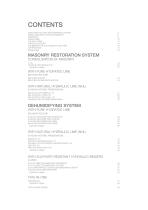
FASSA BORTOLO AND THE iNTEGRATED SYSTEM 3 FASSA: iNNOVATiON FOR SUSTAiNABiLiTY 6 THE BENEFITS OF A SuCCESSFuL SOLuTiON 15 MASONRY RESTORATION SYSTEM CONSOLIDATION OF Masonry L 512 19 with pure hydrated lime bio-architecture MB 49 BIO MORTAR 23 MB 60 BIO FACING BRICK MORTAR 24 with natural hydraulic LIME (NHL) EX NOvO HISTORIC PRESERvATION MALTA Di ALLETTAMENTO 770 27 MALTA FACCIA A viSTA 767 28 FASSANET ARG 40 REINFORCING MESH 30 DEHUMIDIFYING SYSTEM with pure hydrated lime bio-architecture S 650 BIO DEHuMIDIFYING uNDERCOAT 33 with natural hydraulic LIME (NHL) EX...
Open the catalog to page 3
300 years of history 15 systems
Open the catalog to page 4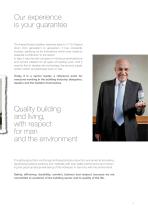
Our experience is your guarantee The Fassa Bortolo tradition stretches back to 1710. Passed down from generation to generation, it has constantly evolved, standing out for innovations which have made an essential contribution to the sector. In Italy, it was the first company to introduce premixed lime and cement plasters for all types of building work. And it was the first to develop silo technology, the product supply system which revolutionised work on site. Today it is a sector leader, a reference point for everyone working in the building industry: designers, dealers and the builders themselves....
Open the catalog to page 5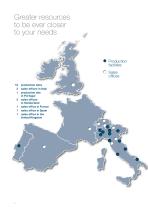
Greater resources to be ever closer to your needs 12 production sites 3 sales offices in Italy 1 production site in Portugal 3 sales offices in Switzerland 1 sales office in France 1 sales office in Spain 1 sales office in the United Kingdom • Production facilities
Open the catalog to page 6
Integrated System Intelligent synergy The Fassa Bortolo Integrated System focuses resources on one single objective, backed by the completeness of its range of systems and its exceptional organisation and professionalism. Just one partner is thus able to meet all customer needs, guaranteeing global service that spans supply, support, training and assistance. Fassa Bortolo Integrated System 15 coherently integrated systems MASONRY SYSTEM PLASTER SYSTEM BIO-ARCHITECTURE SYSTEM RENOVATION SYSTEM EQUIPMENT SYSTEM CONCRETE Restoration SYSTEM CONSOLIDATION AND STRUCTURAL REINFORCEMENT SYSTEM LIME SYSTEM...
Open the catalog to page 7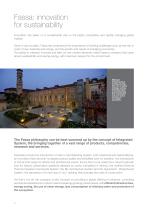
Fassa: innovation for sustainability Innovation has taken on a fundamental role on the highly competitive and rapidly changing global market. Since it was founded, Fassa has understood the importance of tackling challenges such as the rise in costs of raw materials and energy, and the growth and needs of emerging economies. The ability to interpret, innovate and take on new market demands make Fassa a company that cares about sustainability and saving energy, with maximum respect for the environment. Efficient infrastructure, energy saving, the use of clean energy, saving drinking water and protecting...
Open the catalog to page 8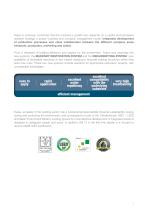
Fassa is moreover convinced that the company's growth also depends on a careful and perceptive research strategy, a proper business and company management model, integrated development of production processes and close collaboration between the different company areas (research, production, marketing and sales). From a viewpoint of building efficiency and respect for the environment, Fassa now proposes two new systems: the MASONRY Restoration SYSTEM and the DEHUMIDIFYING SYSTEM. Less availability of renewable resources in fact means needing to renovate existing structures rather than build new...
Open the catalog to page 9
Fassa research centre: skill and passion serving the customer Since the beginning, every one of the company’s solutions has been made from top quality raw materials: calcium carbonate and gypsum, obtained from the group’s quarries, selected and processed using pioneering techniques with respect for the surrounding area and the environment. Since the beginning, every product has been the fruit of ongoing investment in R&D, with specific tests and rigorous experiments today performed in our Research Centre’s ultra-modern laboratories. Ongoing development of high-tech products and the constant pursuit...
Open the catalog to page 10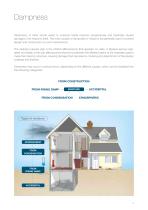
Dampness Dampness, in other words water or moisture inside masonry progressively and inevitably causes damage to the masonry itself. The main causes of dampness in masonry are generally due to incorrect design and construction or poor maintenance. The clearest outward sign is the whitish efflorescence that appears on walls. A likewise serious sign, albeit not visible, is the sub-efflorescence that forms between the different layers of the materials used to make the masonry structure, causing damage that may lead to cracking and detachment of the plaster, coatings and finishes. Dampness may occur...
Open the catalog to page 11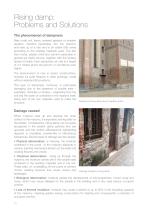
Rising damp: Problems and Solutions The phenomenon of dampness Near moist soil, lawns, watered gardens or artesian aquifers, moisture penetrates into the masonry and rises up at a rate and to an extent that varies according to the building materials used. The fact that mortar, plaster, brick and cement substrates in general are highly porous, together with the surface tension of water, mean dampness can rise to a height of 2-3 metres above the ground, or sometimes even higher. The phenomenon is rare in recent constructions, however it’s quite frequent in older buildings, made without waterproofing...
Open the catalog to page 12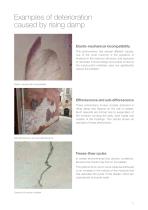
Examples of deterioration caused by rising damp Elastic-mechanical incompatibility This phenomenon has several different causes: one of the most common is the presence of moisture in the masonry structure, and exposure to rainwater. Correct design and proper choice of the construction materials used can significantly reduce the problem. Elastic-mechanical incompatibility Efflorescence and sub-efflorescence These phenomena involve crystals dissolved in rising damp that deposit on the wall or plaster. Such deposits are formed due to evaporation of the moisture carrying the salts, both inside and...
Open the catalog to page 13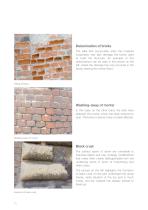
Delamination of bricks The salts that accumulate when the moisture evaporates may also damage the bricks used to build the structure. An example of this phenomenon can be seen in the picture on the left, where the damage has only occurred in the bricks, leaving the mortar intact. Washing-away of mortar In this case, on the other hand, the salts have attacked the mortar, which has been reduced to dust. The bricks, however, have not been affected. Black crust The surface layers of stone are vulnerable to chemical attack and may undergo modifications that make them clearly distinguishable from the...
Open the catalog to page 14All Fassa Bortolo catalogs and technical brochures
 FASSACOUCHE
8 Pages
 Seal your style
8 Pages
 Restoration Line EX NOVO
20 Pages
 External thermal insulation
48 Pages


- Industrial insulation
- Indoor paint
- Wall paint
- Decorative paint
- Building coating
- Panel insulation
- Outdoor paint
- Indoor coating
- Wall coating
- Thermal insulation
- Matte paint
- Industrial acrylic paint
- Outdoor coating
- Synthetic insulation
- Protective paint
- Decorative coating
- Finish paint
- Thermal-acoustic insulation
- Mineral insulation