


RESIST-SA” and “TAG10-SA

RESIST-SA” and “TAG10-SA
RESIST-SA and TAG10-SA are standalone access control devices that store codes or cards independently, without needing an online PC. The system includes a CPU board and a Keyboard board, with the CPU board capable of functioning independently with a passive reader.
- RESIST-TPS-SA: Keyboard + passive reader
- RESIST-T-SA: Keyboard only
- RESIST-PS-SA: Passive reader only
- TAG-10-SA: Passive reader only
Devices with the "SA" designation have an internal decision-making board for system configuration. It is recommended to install the decision-making unit inside the gateway and the reader outside for security.
The manual provides detailed instructions for connections, emphasizing not to connect GND with the incoming power supply's negative terminal.
- Stores one "Master-Code" and up to 500 "User Codes".
- Codes can be entered via keyboard or passive card.
- Relay activation is programmable with various modes.
The "Master-Code" is crucial for programming and can be set using a code or passive card, allowing access to special commands.
Multiple programming options are available, including user code management and technological settings, requiring a specific sequence using the "Master-Code".
The archive stores user codes with settings for relay activation and antipassback status, allowing validation on different readers.
Programming involves specific modes with LED and buzzer feedback. Exiting programming requires holding the "X" key or reading the "Master-card."
Outlines specifications for card readers and door management systems, including Wiegand formats and code length requirements.
Recommends a 'Card B ignore time' for magnetic readers and describes code typing and card reading processes.
Monitors door status and generates alarms for unauthorized access, supporting single and double gateway configurations.
Requires alternating entry and exit readings to prevent unauthorized access, with flexible settings.
Triggered by tamper inputs or door status sensors, with programmable activation time.
Operates on 12-24 Vdc or 12-21 Vac, with specific consumption rates and detailed component specifications.
Catalog excerpts

Independent readers “RESIST-SA” and “TAG10-SA” PRODUCT RESIST-SA (or TAG10-SA) is an access control device able to archive Codes or Cards. The unit operates in a completely independent manner (in fact, the letters “-SA-” of the product codes mean “StandAlone”) as regards both memory storing of Codes and the validation decisions. No on-line PC or other unit is therefore necessary. The electronics consist of two inter-connected boards: • the CPU board (the smaller one, with terminals, buzzer, relay and Passive reader piloting) • the Keyboard board (the larger one, with keys, LEDs, and antenna for passive reader if supplied) The CPU board can also be used on its own, without the Keyboard. In this case, only a passive type reader is used (e.g.: TAG10-SA). The product is available in the following versions: RESIST-TPS-SA Keyboard + passive reader RESIST-T-SA Keyboard only RESIST-PS-SA Passive reader only TAG-10-SA Passive reader only The following is an example of an application with an external reader: Reader B has no archives, no CPU for decisions, no Relay and no power unit; it sends codes in Magnetic-Stripe format to reader A for validations. Connection is on terminal M2. RESIST-SA-TPS Keyboard + passive reader "decision making" Unit 5 poles + screen + possible Aux cable (for Relay and Inputs) RESIST-TPS Only "Keyboard + passive reader" It depends o
Open the catalog to page 1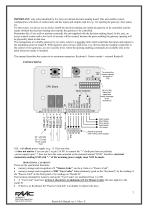
IMPORTANT: only units identified by SA, have an internal decision-making board. This unit enables system configuration, activation of codes/cards, and has inputs and outputs used for e.g.: for opening the gateway, door status, etc. For this reason, we advise you to always install the decision-making unit inside the gateway to be controlled, and the reader (without the decision-making unit) outside the gateway to be controlled. Remember this, if you wish to position externally the unit supplied with the decision-making board. In this case, an access control system with a low level of security...
Open the catalog to page 2
• You obtain validation by typing in the "User Code" or having the passive Card read by the front reader. • a "User Code" is a sequence of a minimum of 4 numbers and a maximum of 14 numbers to be typed on the keyboard (+ key "E"). • the reading of a "passive Card" produces a unique code of 14 numbers. • a "valid Code" energises the associated combination of Relays (usually Relay 1 + Relay 2); the "Master-Code" can behave like a normal user (i.e. it activates the Relays): but make sure that you do not type in the command before the code. • the times of Relay 1 and Relay 2 and the Alarm...
Open the catalog to page 3
TYPES OF PROGRAMMING The following schemes illustrate the programming items. If you are not using a "Master-Code" (i.e. a typed in code) but a "Master-card" (i.e. passive card), it is sufficient to type in the identifier key + reading "Master-card" without typing the "X" separator key. N.B.: in the following examples, it is assumed that the Master-Code is "123456" "Access Control" mode For Access Control 1) - Insert User Codes 2) - Cancel User Codes 3) - Modify User Codes 1. If "Master-Code" preceded by "Nx": - you enter programming (if N is from 1 to 8) E.g.: 6×123456 2. If "Master-Code" preceded...
Open the catalog to page 4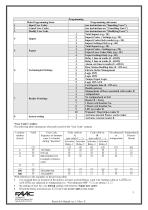
"User Codes” archive The following table summarises what each record of the "User Code" contains. Location number (fixed) With reference to the examples on the previous table: • it is assumed that, on insertion in the archive, all users activate Relays 1 and 2 for readings valid on A (00), id. on B (00); are subjected to Antipassback (i.e. “Not subjected APB” =□ ); are absent, i.e. O • the settings of user No.1 are default settings with function "Input user codes" • If both the Relay activations are (□□) the Code is not valid on that reader via Benini ii:’l 40069 Sola Predosa (Bo) Resist-SA Manual...
Open the catalog to page 5
• If the code which was read has the following activations: 00 on A or 00 on B, it will not be valid on the corresponding reader if the management control unit is set to: "Double Gateway" and "Reader B" is active. In this state, if the Relay is not activated, the code cannot be validated • an "Insert users codes" forces the Code to "Valid" (0) (see column 7) • a "Cancel users codes" forces the Code to "Non Valid" (□) (see column 7) • the settings of columns (1), (2), (3), (4) and (5) can be changed only with the function "Modify users codes" • the Absent/Present setting (column...
Open the catalog to page 6
Input from reader B; type the "location No." + "read card on B" on the reader A keyboard. NB: if the input was successfully performed, the control unit signals this activity with a rapid series of green LED light ups and buzzer soundings. If the input failed, the unit turns the yellow LED rapidly ON and OFF and he buzzer emits a particular sound. Users cancellation procedure • from the "Access Control" mode, select "2- Cancel users codes" (e.g.: type in “2x123456”) • type in the location number of the code to be cancelled. (e.g.: type "27" + E to cancel 27). If you have the passive card to be...
Open the catalog to page 7
In particular, pay attention to the "Master-Code", because, after Total import, that of "MEM-EXP" will apply. If you are not sure whether you know it, we advise you to execute function 2) import Codes + Settings - which copies the Code table, and the table with the Technological and System settings. Data export operation procedure • from the "Access Control" mode, select "5-Export" (e.g.: type in “5x123456”) • just type the number for the type of Export to execute. These are the options:
Open the catalog to page 8Archived catalogs
 XTR B TAG Reader
4 Pages
 AIRSLIDE SLIDING DOOR
8 Pages
 ITEM OF SPECIFICATIONS A1000
2 Pages
 B614
B6144 Pages
 868 SLH SYSTEM
3 Pages
 TAG - 10
2 Pages
 Resist T-PS-TPS
1 Page
 S800 ENC
4 Pages
 S800H ENC
4 Pages
 620
6202 Pages
 TK20
TK206 Pages
 S450H
S450H2 Pages
 C720
C7202 Pages
 swing-leaf gates operators
2 Pages
 844 sliding gate operator
2 Pages
 D1000 garage door operator
2 Pages
 A1400 AIR
8 Pages
 750 operator
2 Pages
 640
6402 Pages
 415 swing gate operator
2 Pages
 402 swing gate operator
2 Pages
 746
7462 Pages
 S418
S4184 Pages
 VIPER 400
6 Pages
 J200 Series bollard
13 Pages
 391 24V swing gate operator
2 Pages
 BOLLARDS
8 Pages
 S700 operator
9 Pages
 C721 Sliding gate operator
2 Pages
 S418 swinging gate operator
2 Pages
 J Series Bollards
32 Pages
 REVOLVING DOORS
9 Pages
 740 - 741
2 Pages
 615 BPR automatic barrier
2 Pages
 413 swing gate operator
2 Pages
 422 PED swing gate operator
2 Pages
 760 operator - Discontinued
2 Pages
 412 swing gate operator
2 Pages
 390 24V swing gate operator
2 Pages
 560 bi-folding door operator
2 Pages
 770N 24V operator
2 Pages
 XT 868 (new)
2 Pages
 B680 Hydraulic Barrier
8 Pages
 A140 Sliding Door Operator
8 Pages
 C720 sliding gates operator
2 Pages
 400 swing gate operator
2 Pages
 PARAGON Parking System
6 Pages
 PARKLITE Parking System
6 Pages
 Automatic doors 940
8 Pages
 FAAC CITY - Traffic bollards
16 Pages
 Automatic door 930 NSF
6 Pages
 Automatic door A100
6 Pages
 Gearmotor C720 24V
4 Pages
 Transmitters XT
4 Pages
 T- Mode
8 Pages


