


- Company
- Products
- Catalogs
- News & Trends
- Exhibitions
Novojunta Concrete

Novojunta Concrete
Novojunta® Concrete is a PVC profile designed for inducing controlled cracks in concrete, suitable for control or contraction joints. It is available in two sizes: 40 mm and 80 mm joints, with lengths of 2.5 meters. The product is packaged in boxes of 60 or 20 units, depending on the joint size, and can be palletized.
Applications
This profile is used to manage the breaking of concrete in a controlled manner, enhancing the durability and aesthetics of the installation. It accommodates initial retraction and subsequent expansion and contraction movements, making it suitable for constructive joints.
Technical Features and Tests
- Fire Resistance: M2 (NBE-CPI-96)
- Abrasion Resistance: Very good
- Working Temperature: -10ºC to 60ºC
- Chemical Resistance: Good, except against chromic and sulfuric acids, and organic solvents like acetate and toluene.
Installation
1. Align the profile longitudinally at the desired height.
2. Adjust height with concrete if necessary.
3. Use a level to ensure correct installation.
4. Pour concrete to the maximum height of the profile.
The profile remains embedded in the concrete, requiring no maintenance.
Material Properties
Made from high-quality PVC, Novojunta® Concrete offers high resistance to abrasion, corrosion, and various chemicals. It is impact-resistant, has low water absorption, low electrical conductivity, and is dimensionally stable.
Additional Information
For more details, technical files can be downloaded from www.emac.es. For queries, contact Emac's technical department via email.
Catalog excerpts

Novojunta® Concrete Profile to induce the breaking of concrete for control or contraction joints. Novojunta® Concrete induces the cracks in a control ed and aligned way, favoring the long life and the beauty of the installation. Made of PVC, it protects concrete allowing the initial retraction movement and the later expansion and contraction movements. Also useful for constructive joints. Once installed remains embedded in the concrete. General features Joint 40 mm. (1 37/64") Joint 80 mm. (3 9/64") Material: PVC Indicated for: Hearth 5 a 12 cm. Hearth 12 a 25 cm. (*) This material can be packed in pallets according the following measures: Joint 40 mm. (1 37/64") Joint 80 mm. (3 9/64") Boxes: 15 box/pallet 12 box/pallet Applications Novojunta® Concrete is a profile that induces the breaking of concrete, intended to be placed in control joints or contracion joints. Technical features and Tests Fire resistante M2 (NBE-CPI-96) Abrasion resistance Very good Resistance to chemical agents Good excepto with chromic and sulphuric acids and organic solvents as acetha- aimplas te and tholuene
Open the catalog to page 1
TECHNICAL FILE Novojunta® Concrete Materials PVC Novojunta® Concrete is a profile made of high quality PVC (polivinyl chloride). PVC (polivinyl chloride), is an amorfous thermoplastic polymer with high resistance to abrasion, corrosion and a wide range of chemical products. It has good impact resistance, low water absorption, low electrical conductivity and is dimensionally stable. *Find out more information by downloading the Technical Files of materials (www.emac.es) Installation 1. Place the profile longitudinally and aligned at the same level, ensuring the taller part stands aligned with...
Open the catalog to page 2All EMAC catalogs and technical brochures
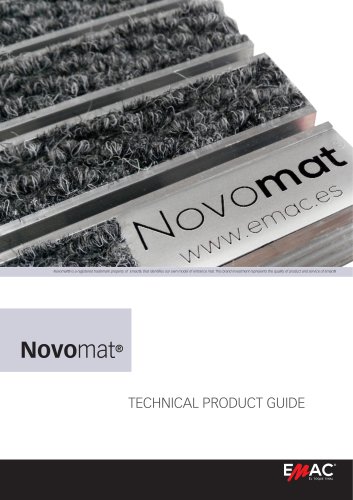 Novomat®
12 Pages
 Novojunta® Pro PA SP
3 Pages
 Novojunta® Pro Decor
3 Pages
 Novojunta® Pro Metal SP100
3 Pages
 Novojunta® Pro Metal SP50
3 Pages
 Novojunta Pro® L85
3 Pages
 Novojunta® Pro XL130
3 Pages
 Novojunta® Pro XL105
3 Pages
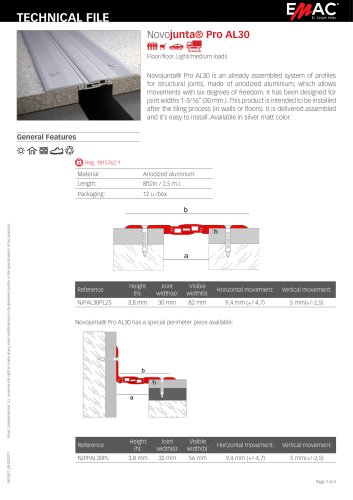 Novojunta® Pro AL30
4 Pages
 NovoPilastra®
3 Pages
 Novoescuadra XL
2 Pages
 Novoescuadra Maxi
3 Pages
 Novoescuadra Stainless steel
2 Pages
 Novoescuadra PVC
2 Pages
 Novocanto Aluminium
5 Pages
 Novolistel® 3 Aluminum
4 Pages
 Novosuelo/Novopared PVC
2 Pages
 Novocanto® Methacrylate
3 Pages
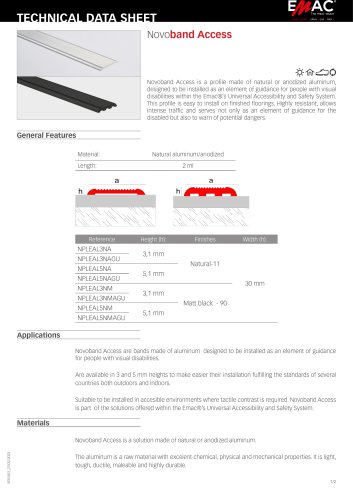 Novoband Access
2 Pages
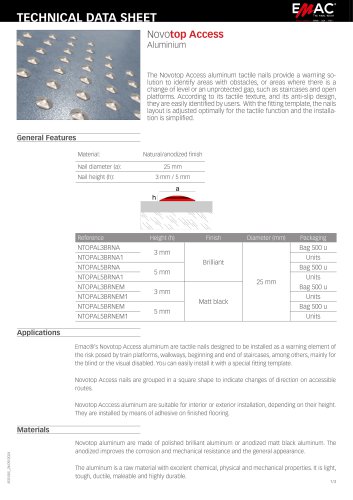 Novotop Access
3 Pages
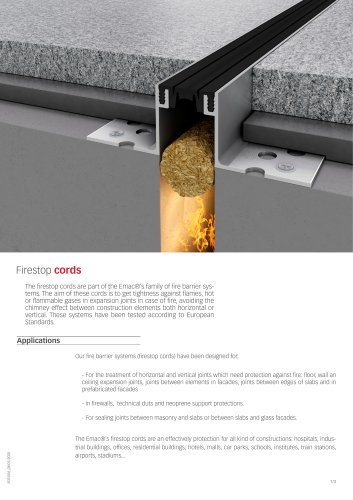 Cordón cortafuegos
3 Pages
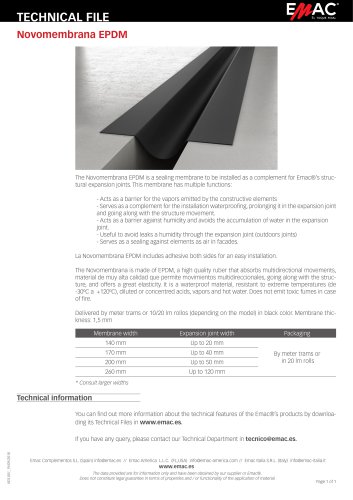 Novomembrana EPDM
1 Page
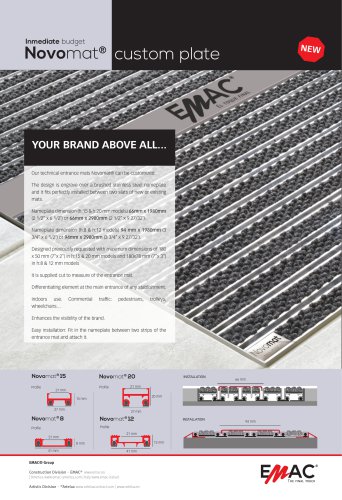 Novomat®
1 Page
 Novovierteaguas LX
3 Pages
 Novolistel 3
3 Pages
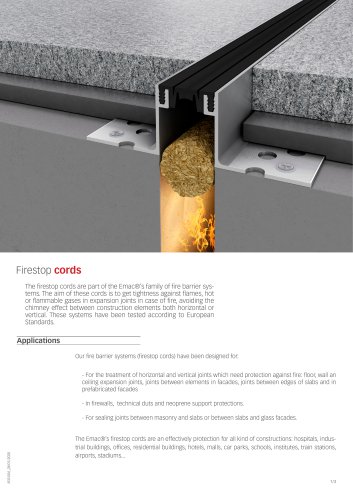 Firestop cords
3 Pages
 Novotapajuntas NDA
3 Pages
 Novotapajuntas NCJE
3 Pages
 Novotop Access
2 Pages
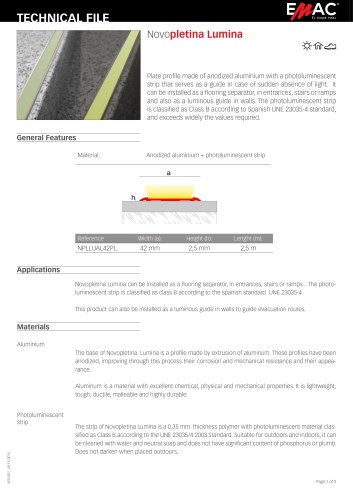 Novopletina® Lumina
3 Pages
 Novopletina Safety
2 Pages
 Novopletina Aluminium
2 Pages
 Novonivel Forte
3 Pages
 Novonivel Access Slimm
2 Pages
 Novoescuadra Eclipse® Sunset
3 Pages
 Novolistel Eclipse® Sunset
3 Pages
 MAXI COLLECTION
16 Pages
 Novorodapie® Semiflex
2 Pages
 Novoescocia® 4
3 Pages
 Novopeldaño® 4 Aluminum
3 Pages
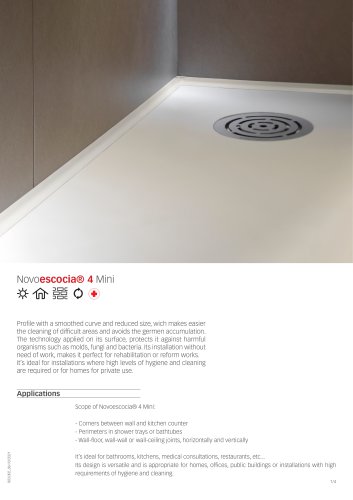 Novoescocia® 4 Mini
4 Pages
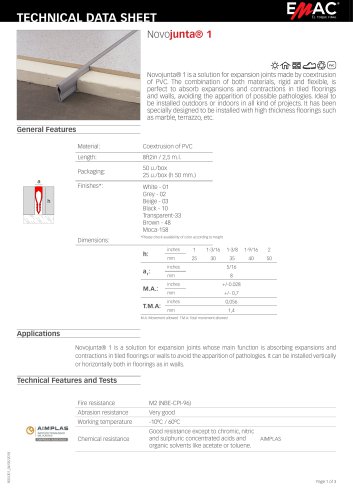 Novojunta® 1 PVC
3 Pages
 Novopeldaño Eclipse® Aura
3 Pages
 Novorodapie® Rehabit
4 Pages
 Novoescuadra MINI
3 Pages
 Novosepara® MINI
3 Pages
 Novojunta® Pro Aluminio PLUS
4 Pages
 Novojunta® Pro SP
3 Pages
 Novostrip aluminium
2 Pages
 Novopeldaño MaxiSoho® Dakar
4 Pages
 Novojunta® Pro Metal 100
4 Pages
 Novorodapie Eclipse®
3 Pages
 Maxi Catalogue
16 Pages
 Novostrip SP
3 Pages
 Novotri Eclipse®
3 Pages
 Novopeldaño Eclipse®
4 Pages
 Novopeldaño Astra® Nori
3 Pages
 Novonivel Access
2 Pages
 SOLUTIONS FOR PROJECTS
114 Pages
 Novojunta® Pro Metal 80
4 Pages
 Novojunta Pro Sisma PE
5 Pages
 Novosuelo/Novopared Brass
2 Pages
 Novojunta® Pro WP80
3 Pages
 Novojunta Pro® L65
3 Pages
 Novojunta Pro® L55
3 Pages
 Novojunta® Pro L50
3 Pages
 EMAC® new trends at a glance
32 Pages


Archived catalogs
 EMAC® at glance
2 Pages
 METHACRYLATE
2 Pages
 BRASS
BRASS3 Pages
 Novoperi
2 Pages
 Trends EMAC® 2018
32 Pages
 Novoescuadra Plus
2 Pages
 Solutions for façades
6 Pages
 Trends Emac® 2017
19 Pages
 TRENDS 2015
15 Pages
 TRENDS 2014
15 Pages
 NOVOESCOCIAS BROCHURE
6 Pages


- Waterproofing membrane
- EMAC edge trim
- Lighting profile
- LED profile
- Commercial lighting profile
- Metal profile
- EMAC expansion joint
- EMAC baseboard
- EMAC tile edge trim
- EMAC aluminum edge trim
- Integrated lighting profile
- EMAC metal expansion joint
- Aluminum profile
- Home lighting profile
- EMAC aluminum expansion joint
- EMAC floor expansion joint
- Profile with symmetrical section
- Entrance mat
- Commercial entrance mat