
- Catalogs
- DYWIDAG-Systems International (DSI)
- Accessories for Concrete Structures


Accessories for Concrete Structures

Accessories for Concrete Structures
- Threadbars: Available in non-weldable and weldable types, with specifications such as diameter, steel grade, maximum load, and working load. Compliance with French Norm NF P 93-350 standard is noted, and options for galvanization are available.
- Anchorages in Concrete: Includes various types like Wobble, Hook, Loop, and Fix Anchors. Specifications include bar diameter, length, and weight. Working loads depend on factors like concrete strength and installation depth.
- Nuts and Couplers: Different types such as Wing Nut Bracket, Slope Plate, and Combination Plate are detailed with specifications including bar diameter, plate size, and weight. Working loads are specified for different diameters.
- Water Stops: Essential for preventing water ingress in concrete structures.
- Cones for Lost Formties and Climbing Formwork: Used in formwork systems to ensure stability and alignment.
- Includes various tools and accessories designed to enhance the efficiency and safety of concrete construction processes.
- Guidelines and examples provided to ensure safe and effective use of accessories in concrete structures.
- Horizontal and Vertical Spacers: Used to maintain proper spacing in reinforcement setups.
- Profiles and Formwork Material: Details on materials used for formwork and reinforcement.
- Joints and Bearings: Specifications for ensuring structural integrity and movement accommodation.
- Systems for lifting and fixing concrete elements, including spherical head anchors, flat anchors, and sockets. Calculations for actions on lifting inserts are provided.
- Includes mould release agents, mortars, concrete admixtures, and surface treatment products to enhance concrete performance and durability.
- Details on spacers, profiles, magnetic strips, and chamfers used in the precast concrete industry.
1. Ribbed Reinforcing Steel FeE500 is used with eye anchors and foot & eye anchors. The total length of the steel depends on the concrete strength, with specific lengths provided for different concrete strengths (10MPa, 20MPa, etc.).
2. Foot & eye anchors are available in black carbon steel or hot dip galvanized steel.
Procedures:
1. Rubber recess formers can be used 30 to 40 times and are available in round and narrow types, each with specific dimensions and references.
2. Fixing sets for rubber recess formers include a plate with welded threadbar and a wing nut.
Norms and Standards:
1. Double head anchors are provided with a CE certificate and are zinc plated.
2. Lifting hooks must be checked annually by a qualified person and are provided with a CE certificate.
Recommendations:
1. For tilt-up anchors, recommended reinforcement should be added, and the working load should be divided by two.
2. Minimum edge distances must be respected for tilt-up anchors.
Key Data from Tables:
1. Rebar diameters and lengths are specified for different concrete strengths and anchor classes.
2. Load-bearing capacities and dimensions are provided for various lifting sockets and anchors.
3. Minimum center distances and thicknesses are specified for different anchor classes and concrete strengths.
Critical Information:
1. Lifting sockets with cross holes have half the load-bearing capacity on lateral tension compared to axial tension.
2. Lifting sockets must always be used with a steel rebar, and specific dimensions are provided for reinforcement stirrups.
3. Minimum reinforcement and concrete strength requirements are specified for using lifting inserts.
The document outlines specifications for reinforcement in concrete structures, focusing on lifting sockets and their associated reinforcements. Minimum reinforcement can be substituted with stirrups and longitudinal reinforcement, especially under diagonal tension, which requires additional reinforcement as detailed in Table 3. Lifting sockets must adhere to minimum dimensions specified in Table 2.
Reinforcement for Tension
Additional reinforcement is necessary for lateral and diagonal tension, as shown in Tables 3 and 4. Diagonal tension reinforcement is arranged opposite to the tensile force direction. Lateral reinforcement is required when slabs are tilted, covering diagonal tension cases as well.
Lifting Loops and Special Lifting Devices
Lifting loops, used with lifting sockets, must follow specific instructions and are available with Rd thread. They must be inspected annually and are not suitable for lateral tension. Special Lifting Devices, suitable for lateral and diagonal tension, must ensure contact with the concrete surface to prevent spalling and damage.
Load Bearing Capacity and Dimensions
Tables provide load-bearing capacities and dimensions for lifting loops and special lifting devices, emphasizing the importance of correct installation to avoid damage.
Calculation of Actions on Lifting Inserts
The document details the calculation of forces on lifting inserts, considering factors like precast unit weight, adhesion to the mould, dynamic actions, sling angle, and the number of efficient lifting points. The formula provided ensures the Safe Working Load exceeds the calculated actions.
Fixing Systems with Sockets
Different types of fixing sockets (cross hole, bent end, waved end) are described, each with specific installation requirements and load capacities. They are not for lifting but for fixing, with permissible loads defined for a concrete compressive strength of 25MPa.
Certification and Compliance
The document concludes with certification details, emphasizing compliance with European regulations for free movement of goods.
This document provides detailed information on various products related to concrete structures, including mould release agents, mortars, concrete admixtures, surface treatment products, and adhesives. These products are CE marked and adhere to specific certification standards.
Certification and Standards
The products are certified under the standard "Admixtures for concrete, mortars and grouts – curing compounds" with Identification No. NF 085. The products are manufactured in the European Union and are designed to meet health and environmental standards.
Mould Release Agents
Mould release agents are used to facilitate the removal of concrete elements from moulds by reducing adhesion. The consumption of these agents varies based on several factors, including the type of formwork and surface condition. Application should be in thin coats to avoid issues such as retarded setting and poor adhesion.
Types of Mould Release Agents
- Vegetable-based: Products like EMULDEM® HQS and BIODEM® offer high-quality facings and are biodegradable.
- Synthetic: Products like DECOSYNTEC® provide good water resistance and corrosion protection.
- Recycled Mineral: CIRTEC® and DEMOTEC® are used for immediate mould release.
Mortars
Mortars are pre-dosed and controlled for quality and regularity. They are available in various shades and application thicknesses, and can be single or two-component products. Mortars are categorized into four major families: finishing coat pastes, anchoring and grouting mortars, repair mortars, and tanking mortars.
Application and Preparation
Before applying mortars, ensure the substrate is compatible, clean, and prepared as necessary. Different mortars have specific mixing and application instructions, with varying pot lives and application thicknesses.
Environmental and Health Considerations
The product range aligns with market trends for health and environmental safety, with continuous improvements and labeling for VOCs.
- Pumped Concrete: Additives reduce friction and facilitate application, suitable for ready-mixed concrete with a dosage of 0.2 to 1% of cement weight.
- Lightweight Concrete: Used for flooring renovation, insulation, and soundproofing. Dosage is 1 to 2kg/m³.
- Stabilized Mortars: Additives for laying bricks and breezeblocks, with retardation from several hours to 48 hours. Dosage is 0.3 to 3% of cement weight.
- Curing Compounds: Essential for durable concrete, creating an impermeable film to prevent water loss and cracking. Application involves spraying on fresh concrete once bleed water disappears.
- Damp Proofing Agents: Products like TIPTEC® and TIPTEC® E provide damp proofing and maintain gaseous exchanges, suitable for various substrates including traditional renders and architectonic concrete.
- Waterproofing of Foundations: Products like FONDAFUGE and EMULBLACK protect and waterproof basements and foundations, with specific application methods and consumption rates.
- COPOX COLLE REPRISE: Epoxy adhesive for concrete bonding, suitable for humid environments and providing protection against chemical attacks.
- TECHNALATEX®: Adhesion promoting resin that improves mechanical strength and waterproofing, used in screed mortars and repairs.
- TECHNA RETARD SURFACE: Surface deactivating and curing agents that stop surface setting of cement, available in different deactivation levels for various applications.
- TECHNA PROTECT: Protects surroundings from projections during roadworks, suitable for various building materials.
- The document details two types of bi-component adhesives, labeled 'A' and 'B'.
- Adhesive 'A' consists of epoxy resin (6.4kg) and a hardener (3.2kg), suitable for waterproofing and gluing concrete plugs.
- Adhesive 'B' is available in smaller pots (0.40kg) and is used for similar applications.
Certification and Standards:
- The adhesives comply with decree No. 95-354 and are certified by AFNOR CERTIFICATION.
- Products are CE marked, ensuring compliance with European standards for free movement of goods.
Production and Design:
- Laroche products are manufactured in a modern factory in the EU, with a focus on quality and user collaboration.
- Concrete spacers are designed to be invisible post-installation and can be customized in color and cement type.
Concrete Implementation:
- Utilizes siliceous sand and CPA CEM I 52.5 cement.
- Concrete products undergo specific curing processes, including damp environment curing and low-temperature oven drying.
Spacers and Profiles:
- Various spacers are available for light and regular reinforcements, with specific dimensions and applications.
- Magnetic profiles are designed for building and precasting, with options for screwing, sticking, or magnetic fixing.
Mould Release Agents:
- Different types of mould release agents are available, including vegetable, synthetic, and mineral-based options.
- The choice of agent depends on factors like temperature, formwork type, and environmental considerations.
- Application guidelines emphasize thin coats to avoid issues like retarded setting and poor adhesion.
Key Recommendations:
- Ensure cleanliness of surfaces before applying adhesives or mould release agents.
- Follow specific guidelines for the application of magnetic profiles and spacers to ensure proper alignment and effectiveness.
- Consult with Laroche for custom concrete solutions and specific product availability.
The document provides detailed information on various construction products, including mould release agents, finishing coat mortars, repair mortars, liquid admixtures, and curing compounds. Each product is described with its properties, application areas, and usage instructions.
Mould Release Agents
- EMULDEM® HQS CONCENTRE: A vegetable oil emulsion, VOC-free, improves concrete surface quality, and is biodegradable. Suitable for temperatures above -5°C or 5°C depending on the variant.
- EMULDEM® CS: A synthetic oil emulsion, VOC-free, enhances the appearance of facings and is odorless. Suitable for temperatures up to 40°C.
- DECOSYNTEC® 2000: Synthetic-based, ensures clean formworks, and provides corrosion protection. Suitable for temperatures up to 50°C.
- CIRTEC®: A wax in solvent for white, colored, and stamped concrete, offering excellent facing quality and water resistance.
Finishing Coat Mortars
- FINENDUIT®: Powder levelling mortar for interior and exterior jobs, with a pot life of around 2 hours.
- FINIMUR® GROS: Quick and easy to apply, suitable for levelling jobs with good adhesion.
- FINIMUR® FIN: Offers a smooth finish and good impact resistance, suitable for general levelling jobs.
Repair Mortars
- FIBRALCHOC®: Fibre reinforced mortar with good adhesion and impact resistance, suitable for various repair jobs.
- FIBRALCHOC® R: Rapid setting time, suitable for quick repairs.
- STARFIX®: Offers good resistance to aggressive water and rapid strength development, suitable for prefabricated elements and anchoring.
Liquid Admixtures and Curing Compounds
- TECHNIPRISE® 25: Chloride-free setting accelerator, suitable for mould turnaround and steam curing.
- CRD® 19: Contains chloride, accelerates mould turnaround, and suitable for cold weather form removal.
- ADDIFOR® 2005: Super plasticizer that increases concrete fluidity and decreases capillary absorption.
- ADDIFOR® 2001: Increases plasticity and workability while improving mechanical strength.
- ADDIFOR® 2015: Increases concrete fluidity and improves mechanical strength.
General Information
The products are made in the European Union and benefit from CE marking as per the EN 934-2 Standard. They are inter-compatible, allowing for combination to achieve desired characteristics. The document also includes contact information for various companies and a disclaimer about the non-binding nature of the technical data provided.
Catalog excerpts

Accessories for Concrete Structures
Open the catalog to page 1
DYWIDAG Threadbar, not weldable
Open the catalog to page 6
The working loads of all products on this page depend on concrete strength, installation depth, distances between anchors and other factors. Please ask DSI for details. Wobble Anchor Made of MUKUSOL Threadbars For the anchorage of brace frames with a 45° angle On request: made of DYWIDAG Threadbars
Open the catalog to page 7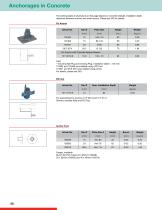
The working loads of all products on this page depend on concrete strength, installation depth, distances between anchors and other factors. Please ask DSI for details. Forged, weldable Bunch fits PVC Tubes 22 x 26mm (100239), 32 x 38mm (100283) and 40 x 46mm (100313)
Open the catalog to page 8
The working loads of all products on this page, except the Weldable Neck Flange, depend on concrete strength, installation depth, distances between anchors and other factors. Please ask DSI for details. Plate Anchor Weldable, application with steel structures, max. working load 90kN Application is shown on page 25.
Open the catalog to page 9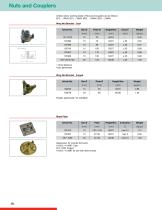
Unless noted, working loads of Nuts and Couplers are as follows: 012...: 30kN; 015...: 90kN; 020...: 150kN; 026...: 250kN Wing Nut Bracket - Cast Galvanized, for inclined formwork 101913 / 101897: Cast 20 F 1030: Forged 101913 / 101897 for use with steel chords.
Open the catalog to page 10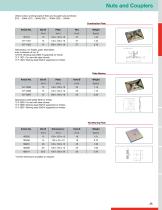
Unless noted, working loads of Nuts and Couplers are as follows: 012...: 30kN; 015...: 90kN; 020...: 150kN; 026...: 250kN Combination Plate * Further dimensions available on request
Open the catalog to page 11
Unless noted, working loads of Nuts and Couplers are as follows: 012...: 30kN; 015...: 90kN; 020...: 150kN; 026...: 250kN Wing Nut - Cast Cast, galvanized 1 Working load of 100309: 200kN 2) Stainless steel, grade 316 (V4A) All Hex Nuts also available galvanized.
Open the catalog to page 12
Unless noted, working loads of Nuts and Couplers are as follows: 012...: 30kN; 015...: 90kN; 020...: 150kN; 026...: 250kN For screwing and tensioning with two fixed bar ends. 1) Tensile force 40kN if a torque of 0.5kNm is applied 2) Tensile force 70kN if a torque of 0.75kNm is applied 3) Tensile force 100kN if a torque of 1.0kNm is applied
Open the catalog to page 13
Water Stops prevent water from seeping alongside the Threadbar. Data sheets, installation instructions and test results are available on request. Water Stop Type N Only plate without Threadbar, which has to be ordered separately. ^ Calculation of bar length: Bar length = wall thickness minus double concrete cover of cone Water Stop Type G Cast 1) For tubes with 26mm inner diameter
Open the catalog to page 14
Bentonite coating which swells when in contact with water and seals up the concrete actively and permanently. On stock for Water Stop Type N On request for Water Stop Type G, Water Stop Type S
Open the catalog to page 15
Unless noted, working loads of cones for Lost Formties are as follows: 012...: 30kN; 015...: 90kN; 020...: 150kN; 026...: 250kN Steel Cone 1 C = concrete cover, all cones galvanized For de-installation, please use the hexagon wrench .. F 7044 PE Sleeve for Steel Cone For re-locking the cone holes of the Steel-Plastic Cone.
Open the catalog to page 16
Different systems can be used for anchoring climbing formwork. Two standard systems are presented on the following pages: a) DYWIDAG System b) Arteon System. Upon request, we also develop and manufacture special solutions and individually designed products. Positioning Cone To ensure easy unscrewing of Positioning Cones, the PE-Sleeve is put on the cone before assembly.
Open the catalog to page 17
Climbing Cone Steel Cone for shear load. To be used with Hex Screws or adapters.
Open the catalog to page 18
To replace Shear Cones after use.
Open the catalog to page 19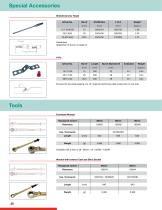
Special Accessories Shebolt (Anchor Head) Article No. Galvanized. Application is shown on page 24. Weight [kg/pc] Ensures the accurate keeping of a 45° angle for anchoring walls worked fair on one side. Tools Formwork Wrench Hexagonal socket Available with a claw in 36 / 38mm : ref. 102003 / 102004 Wrench with Inversor Cam and Short Socket Hexagonal socket SATECO / HUSSOR
Open the catalog to page 20
Tools Bent Wrench with Inversor Cam and Short Socket Hexagonal Socket Friction Wrench Hexagonal Socket Socket for Friction Wrench B20 Hexagonal Socket For screwing Vm3.65 and Vm2.40, use a 27mm double socket ref. 100038.
Open the catalog to page 21
Additional Tools are available on request. Universal Wrench Universal tool with the following features: ■/ Square 18mm, for Positioning Cone 15 F 3073 ■/ Hex size 12mm, for all Nail Plates ...3073/N ■/ Square 13mm, for all Climbing Cones .3038 ■/ Wrench for 15mm DYWIDAG Threadbars Square Wrench Tool for all 0 15, 20 and 26.5mm DYWIDAG Threadbars.
Open the catalog to page 22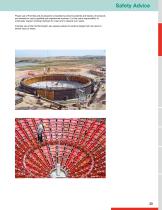
Safety Advice Proper use of Formties and Accessories is essential to prevent accidents and failures. All products are intented for use by qualified and experienced workmen. It is the user’s responsibility to continually inspect working hardware for wear and to discard worn parts. Improper use of the Formtie System can expose workers to extreme danger that may result in severe injury or death.
Open the catalog to page 23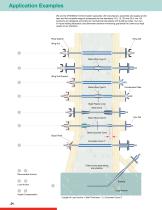
Application Examples We are the DYWIDAG Formtie System specialist. We manufacture, assemble and supply anchor bars and the complete range of accessories for bar diameters 12.5, 15, 20 and 26.5 mm. All products are designed according to international standards and building codes. Our own in-house testing laboratory and permanent external monitoring guarantee the continuous high quality of our products. Plate Washer 1 Water Stop Type G Wing Nut Bracket 3 Water Stop Type S Combination Plate Steel Plastic Cone Steel Cone Water Stop Type N 6 Steel Concrete Cone Slope Plate Concrete Cover C* 7 Other...
Open the catalog to page 24
Application Examples Suspensions in rock or concrete with expansion shells Expansion Shell Weldable Neck Flange Steel Structure Plate Anchor Plastic Foot Cones for climbing formworks Flange Screw Cap Feed Cone Wobble Anchor Climbing Cone Subject to technical alterations.
Open the catalog to page 25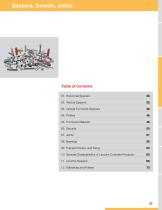
Table of Contents 01. Horizontal Spacers 28 10. General Characteristics of Laroche Concrete Products 65
Open the catalog to page 27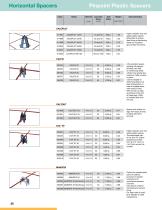
Pinpoint Plastic Spacers Code CALEPLOT Name Concrete Cover [mm] Highly resistant and very stable plastic spacer. Wide base to ensure ideal fixing of reinforcing steels on insulators, ground floor formwork, Ultra resistant spacer, building site special. Workers can walk on reinforcing steels without any special precautions, Calfix remains in place. Can be clipped on reinforcing steel or at steel intersections in case of welded fabric with small 0 wires. With its well cut legs and stops at the end of these legs, Calfix is invisible after form removal. Spacer with widely cut legs with stops at ends. Invisible...
Open the catalog to page 28All DYWIDAG-Systems International (DSI) catalogs and technical brochures
 STAY CABLE BRIDGE
13 Pages
 ROCK BOLTING AND MESH
24 Pages
 ANCHOR SYSTEMS
20 Pages
 POST-TENSIONING SYSTEMS
32 Pages

- Industrial metal mesh
- Building metal mesh
- Metal profile
- Silver-colored metal mesh
- Exterior fitting metal mesh
- Profile with symmetrical section
- Piping
- Steel metal mesh
- Roll metal mesh
- Metal pump
- Fencing metal mesh
- Industrial geogrid
- Multifunction sensor
- Sensor
- Lozenge mesh woven wire fabric
- Anchoring system
- Reinforcement geogrid
- Industrial monitoring system
- Steel bridge