

INSTALLATION AND CLEANING

INSTALLATION AND CLEANING
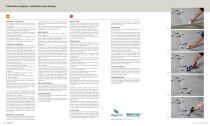
- Adjust pliers to tile thickness and insert spacers.
- Lay the next tile and insert wedges.
- Compress wedges with pliers.
- Continue laying adjacent tiles using the same method.
- Once adhesive sets, gently tap wedge corners towards the joint and collect wedges for reuse.
Catalog excerpts
Colocación y limpieza | Installation and cleaning ANTES DE LA COLOCACIÓN El primer paso es verificar si el modelo, formato y calidad que está impreso en la caja se ajusta a la descripción del pedido. El siguiente paso es abrir varias cajas y comprobar que el modelo que se indica en las cajas se corresponde con el mencionado en el albarán de entrega. Al finalizar la verificación del producto, procederemos a preparar la superficie donde se va a colocar, la cual debe estar limpia y aplomada. Si el producto es pavimento se debe replantear sobre la superficie para ver el efecto. Para colocación modular del producto, se debe solicitar a fábrica que el tono y el calibre sean compatibles. DURANTE LA COLOCACIÓN La elección del material de agarre va en función de las características de la superficie de colocación, el tipo de material cerámico, condiciones climáticas y el uso. Adhesivo recomendado: H40 Eco Flex de Kerakoll – adhesivo C2 E según UNE 12004/12002. Altamente deformable para la colocación de producto porcelánico, en interior y exterior. Especialmente recomendado para colocación de fachadas pegadas, suelos radiantes, alto tránsito, sobrecolocación… disponible en blanco y gris. Para su aplicación es importante utilizar las herramientas recomendadas (maza de goma, llana para rejuntado de goma, llana dentada, etc.) Los lados de las piezas deben estar limpias y, estas deben colocarse perfectamente alineadas. Para un mejor resultado aconsejamos el sistema de nivelación cerámica de PEYGRAN 1.- Ajustar el alicate al espesor de la cerámica. Introducir los calzos 2.- Colocar la siguiente pieza e insertar las cuñas 3.- Apretar con el alicate las cuñas. 4.- Seguir colocando las piezas adyacentes, realizando la misma operación. 5.- Una vez fraguada la cola, romper los calzos con un golpe seco en el sentido de la junta. Posteriormente recuperar las cuñas. Para la colocación de “junta trabada”, hay que colocar las piezas separadas un máximo del 20% de la longitud total de las mismas. Excepto en la colección Chelsea donde aconsejamos no superar el 15%. El producto porcelánico DURSTONE está rectificado con un microbisel para evitar despuntados. La junta para este tipo de producto debe ser de 2 mm en interiores y hasta 3 mm en exteriores. Para el sellado de la junta debemos utilizar material específico (recomendamos Fila MP/90); este sellado se realizará siempre con llana de goma una vez se fragüe el cemento cola (adhesivo) y, siempre, respetando el tiempo de aplicación del material. Posteriormente, se procederá a la limpieza de la junta con una esponja húmeda. Para espacios de más de 8 m2 hay que dejar una junta de 5 mm por todo el perímetro; para espacios superiores a 50 m2 en interiores y 30 m2 en exteriores, hay que utilizar junta de partición para absorber posibles movimientos. DESPUÉS DE LA COLOCACIÓN Una vez se termina el rejuntado, hay que retirar el material sobrante antes de que se seque y se endurezca y se procederá a la limpieza del mismo mediante productos no abrasivos, evitando el uso de ácidos fluorhídricos. Seguidamente, se limpiará (recomendamos DETERDEK o Fila PS/87). Una vez finalizada la colocación, es importante cubrir todo el suelo con cartón u otros elementos para no causar daños en el producto ya colocado. MANTENIMIENTO Para la eliminación de restos de polvo y sólidos: por barrido o aspiración. Se recomienda no utilizar mopas atrapa polvo con siliconas y ceras (productos que abrillantan las piezas y por tanto alteran la superficie de la cerámica). El lavado de la superficie se debe realizar con jabón neutro y la cantidad de agua caliente recomendada por el fabricante. No se deben usar productos de limpieza abrillantadores, cerosos o con aditivos similares ya que con el paso del tiempo pueden dejar una capa impermeabilizante sobre la cerámica que altera el aspecto superficial de la misma. De haberlos utilizado, para la correcta eliminación de dichos productos, aplicar limpiador en polvo con un poco de agua en la superficie afectada, con una bayeta, frotar suavemente, y posteriormente enjuagar y secar con papel. Antes de usar cualquier producto químico para la limpieza, es necesario comprobar su efecto sobre la superficie del producto cerámico o porcelánico, usándolo sobre una zona no visible para ver el efecto que deja ese producto químico. En los pavimentos de porcelánico pulido hay que tener mucho cuidado tanto en la limpieza inicial como en la posterior ya que, en el proceso del pulido se les abre el microporo de la superficie, lo que significa que son más vulnerables a mancharse por determinados líquidos. También es muy importante que, cualquier producto que pudiera afectarlos (aceite, bebidas gaseosas o alcohólicas, ácidos, etc. ) deben ser limpiados con agua a la mayor brevedad posible para evitar que se manche el pavimento. SERVICIO POST-VENTA Es muy importante la comprobación del producto suministrado antes de su colocación ya que no se aceptará ninguna reclamación sobre producto ya colocado. Por tanto, si se observan anomalías en el producto, deberán de ser comunicadas antes de estar colocado. RECOMENDACIONES Para colocación se recomienda el sistema de nivelación de cerámica PEYGRAN Para producto porcelánico se recomienda sellado de Fila MP/90. Para limpieza y mantenimiento se recomienda usar Fila CLEANER. — BEFORE LAYING Firstly, we have to verify that the model, size and quality impressed in the box are the same as per the order. Next, we have to open some boxes to check that the model is the same as that one written in the delivery note. Once we have checked the product is the correct one, we have to prepare the surface where the material is going to be laid. This surface must be clean and smooth. When we are working with floor tile, we have to place some pieces on the surface to see their effect. For modular installation, we must ask the factory for compatible caliber and shade. DURING LAYING The material used for laying tiles depends on the characteristics of the laying surface, the kind of ceramic product, climate conditions and its use. Recommended adhesive: H40 Eco Flex by Kerakoll – adhesive C2 E according to UNE 12004/12002. Highly deformable for the laying of porcelanic material, both interior and exterior surfaces. Specially recommended for the laying of stuck facades, highlevelled flooring, high traffic….. available in white and grey colour. Using the correct tools it is a very important point when laying tiles (rubber mallet, rubber float for pointing, toothed tiling trowel, etc.) The sides of the tiles have to be clean and they have to be placed in perfect alignment. For a better results use The Ceramic Levelling System of Peygran 1.- Adjust the pliers according to the ceramic thickness. Place the crossheads. 2.- Lay the next ceramic tiles and put the wedges. 3.- Press the wedges with the pliers. 4.- Lay the ceramic tiles around and do the same. 5.- Once mortar is set, hit the crosshead on its corner, in the same direction of the join. After all, pick up the wedges for later use. When laying tiles in an offset pattern, they must be laid with a distance maximum 20% of the length of the tile. Excepting Chelsea´s collection where we advise 15% as a maximum. Once laying is finished, it is important to cover all the floor using cardboard or other elements in order not to damage the laid product. MAINTENANCE To remove remains of dust and solids: sweeping or vacuum cleaning. Do not use dust-catcher mops with silicones and waxes The surface must be washed with neutral soap and the amount of hot water recommended by the manufacturer. Do not use cleaning products containing wax, brighteners or similar additives, since in time they may leave a waterproof layer on the tile which alters its surface appearance. If this occurs, Durstone, recommends cleaning the surface with dry cleaning products (detergents in powder form) and cleaning the tiles as indicated above. Before using any chemical product for cleaning, it is necessary to check its effect over the surface of the ceramic or porcelanic product, using it over a non-visible area to see its effect over the product. When flooring porcelanic material we have to be careful in both the initial and the final cleaning because, during the polished process, the micropores in its surface open up; this means that they are more vulnerable to be stained by certain liquids. It is also important that any product that may affect polished porcelain tiles (oil, fizzy and alcoholic drinks, acids, etc.) must be cleaned using water as soon as possible in order to avoid they become stained. AFTER-SALE SERVICE It is very important the checking of the supplied product before laying it as we do not accept any claim over already laid product. Therefore, if any anomaly in the product is observed, the factory must be informed about them before laying the material. RECOMMENDATIONS When using rectified porcelain product it is recommended tiling using ceramic levelling System of PEYGRAN, seiling using Fila MP/90 and cleaning and maintenance using Fila CLEANER. — DURSTONE porcelanic is rectified with a microbisel to avoid chips. Joints, when laying this kind of product, must be of 2 mm indoors and up to 3 mm outdoors. When sealing the joints, it is important to use specified products ( we recommend Fila MP/90); this sealing must be made using rubber float once the adhesive has completely set and, always, respecting the material’s application times. Then, joints can be cleaned using a soaked sponge. In those areas which surface is larger than 8 sqm, the joint must be of 5 mm around the whole perimeter; on the other hand, in those areas with a surface larger than 50 sqm indoors and 30 sqm outdoors, partition joints must be used in order to absorb any possible movement. AFTER LAYING Once joining is finished, the excess material has to be removed before it dries and hardens and, also, the tiles must be cleaned using non-abrasive products, avoiding the use of hydrofluoric acid. After this, tiles can be cleaned (we recommen
Open the catalog to page 1All DURSTONE catalogs and technical brochures
 NOVELTIES 2024
49 Pages
 CORTESÍA
47 Pages
 SCOTT COLLECTION
24 Pages
 MUSTANG COLLECTION
15 Pages
 L'HERITAGE COLLECTION
11 Pages
 INDIGA COLLECTION
21 Pages
 NOVEDADES CEVISAMA 2020
53 Pages
 GENERAL CATALOGUE DURSTONE 2019
145 Pages
 VILLA IBIZA
11 Pages

